In this guide10 sections
- 01Why does a restaurant lose calls exactly when it is busiest?
- 02What does a voice assistant handle in HoReCa: the scenario map
- 03How does an order taken by the AI voice agent sound?
- 04A day with the AI voice agent at a pizzeria
- 05What does a restaurant gain from phone automation?
- 06What stays with the floor team and what the agent will not do
- 07What do you prepare before switching the agent on in your venue?
- 08How do you start the AI voice agent in a restaurant, step by step?
- 09Test an AI voice agent on your own restaurant’s needs
- 10How much does an AI voice agent for restaurants cost?
An AI voice agent for restaurants and HoReCa is a voice assistant that answers the phone for you, takes orders and table bookings, confirms reservations placed online and calls guests back after a visit. In AgentVocal AI, this AI voice assistant speaks naturally, notes every detail correctly and sends the confirmation by WhatsApp, SMS or email. For a venue that lives off its rush hour, phone automation means no call ever rings out, not on a Saturday night and not in the middle of service.
Below you will find four things: where the phone gets lost when the venue is full, every scenario you can switch on in the app, one incoming call from hello to the WhatsApp confirmation, and the clear line between what the agent handles and what stays in the kitchen.
Why does a restaurant lose calls exactly when it is busiest?
The phone in a venue rings most often when nobody can pick it up: Friday at eight in the evening, when every table is taken and the kitchen is buried in tickets. The person who should answer is carrying plates or taking a payment. The result is always the same:
- missed calls during the evening peak, when every booked table and every takeaway order counts;
- after-hours calls, when a guest wants to book for the weekend and the venue is already closed;
- repeated questions about opening hours, the menu, allergens or the delivery area, which eat into a waiter’s time;
- tables booked online and never honoured, because nobody had a minute to confirm them.
Every missed call at a pizzeria or a hotel front desk is an order or a booking that walks to the venue next door. A voice assistant does not replace the kitchen, but it never lets the phone ring out, and that single change is what the automation is for.
What does a voice assistant handle in HoReCa: the scenario map
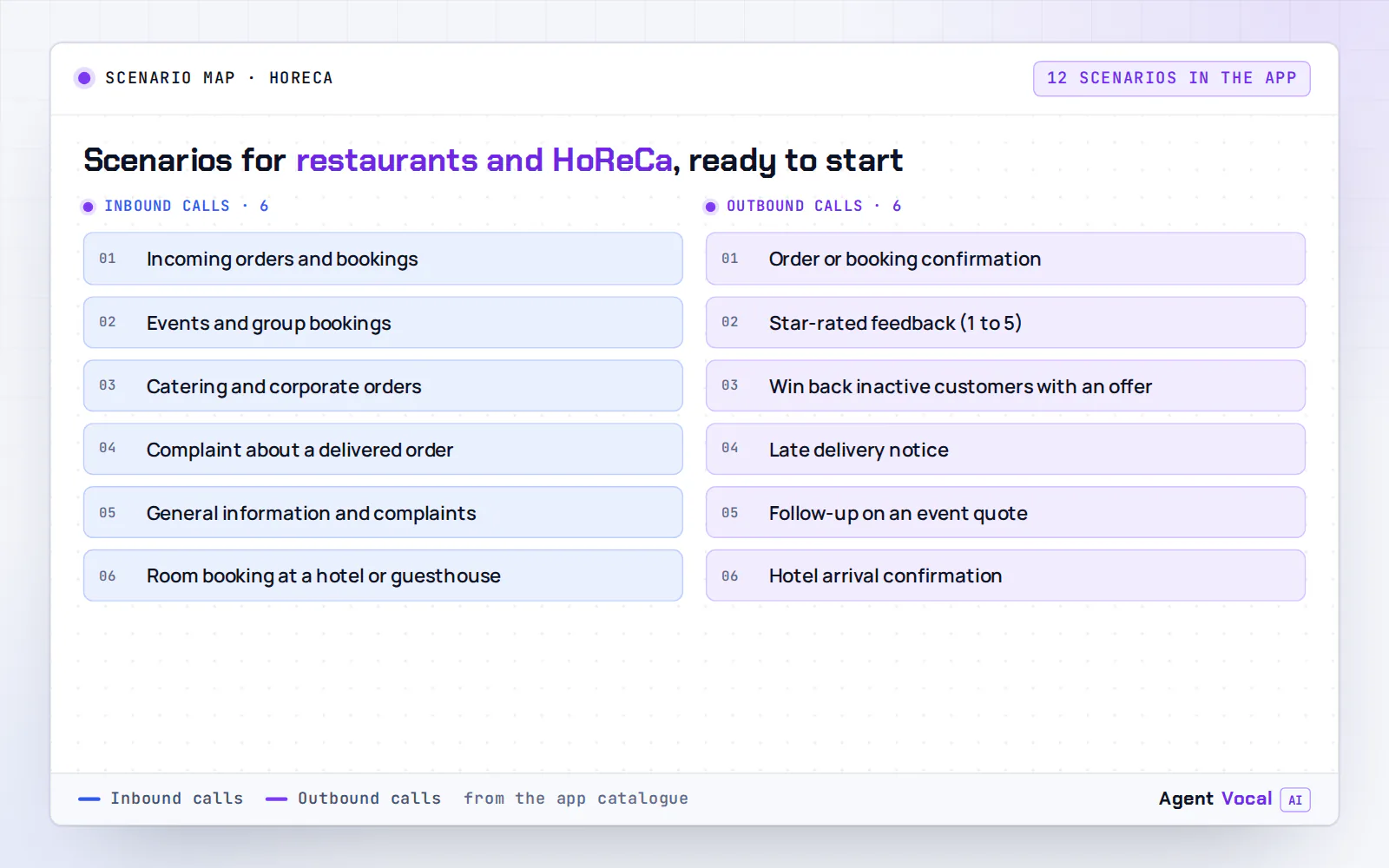
The AI voice agent covers two kinds of calls: the ones it receives from guests and the ones it makes itself, following rules you set. Below are all the scenarios from the app, exactly as you choose them in AgentVocal AI at the “Industry and scenarios” step. You switch on only the automation you need, scenario by scenario, and add the rest later.
Incoming calls
- Incoming orders and bookings: the guest calls to order, book a table or confirm an existing order. The agent notes every detail correctly, reads it all back to confirm and sends the after-call message. The win: the order reaches the kitchen without mistakes, even in the middle of service.
- Events and group bookings: someone calls about a birthday, a christening or a company dinner. The agent collects the date, the number of people and any special requirements and passes the request to the colleague who prepares the quote. No large event is lost to an engaged tone.
- Catering and corporate orders: a company asks for team lunches or catering at an event. The agent notes the full request, with the number of portions and the date, and sends it to the colleague who takes the order. Recurring orders no longer depend on who grabs the phone.
- Complaint about a delivered order: the guest calls unhappy because an order was late, arrived cold or is missing an item. The agent listens, apologises, notes the exact problem and passes it to the team. The complaint stays written down, with a recording, and does not vanish on a busy night.
- General information and complaints: questions about opening hours, address and parking, the daily menu, allergens, card or meal-voucher payment and the delivery area. The agent answers from the knowledge base and logs complaints in full. People get an answer at once, not “call back later”.
- Room booking at a hotel or guesthouse: the caller asks about a room, about availability or wants to change an accommodation booking. The agent notes the dates, the people and the room type, and a colleague confirms. The front desk stops losing stay requests after hours; see the full guesthouse bookings scenario.
Outbound calls
- Order or booking confirmation: the agent calls the guest who ordered or booked online and confirms the details, so no table is reserved for nothing. The seat you held actually gets filled.
- Star-rated feedback (1 to 5): after the visit or a delivered order, the agent asks 7 short questions, each rated from 1 to 5 stars, and notes the comments. You learn what people liked and what they did not, in their own words.
- Win back inactive customers with an offer: the agent calls guests who have not ordered in a while and presents the offer from the brief. If they are interested, it takes the booking or notes the interest. The old customer base comes back to life.
- Late delivery notice: when an order runs late, the agent calls the guest before they call in angry, gives the new estimated time from the brief and notes whether they wait, change or cancel. The guest feels respected, not forgotten.
- Follow-up on an event quote: a few days after the quote for an event or catering went out, the agent calls, checks it arrived and finds out whether they accept it, want changes or need more time. Quotes no longer sit unanswered.
- Hotel arrival confirmation: a day or two before arrival, the agent calls the guest, confirms the accommodation booking, asks for the approximate arrival time and notes special requests. The front desk knows who is expected and when.
Two scenarios turn up at almost any business, but here they speak the language of the venue: at General information and complaints the agent knows about allergens, the delivery area and voucher payment, and at Star-rated feedback (1 to 5) it asks about the food, the speed of delivery and the evening spent at the table.
How does an order taken by the AI voice agent sound?
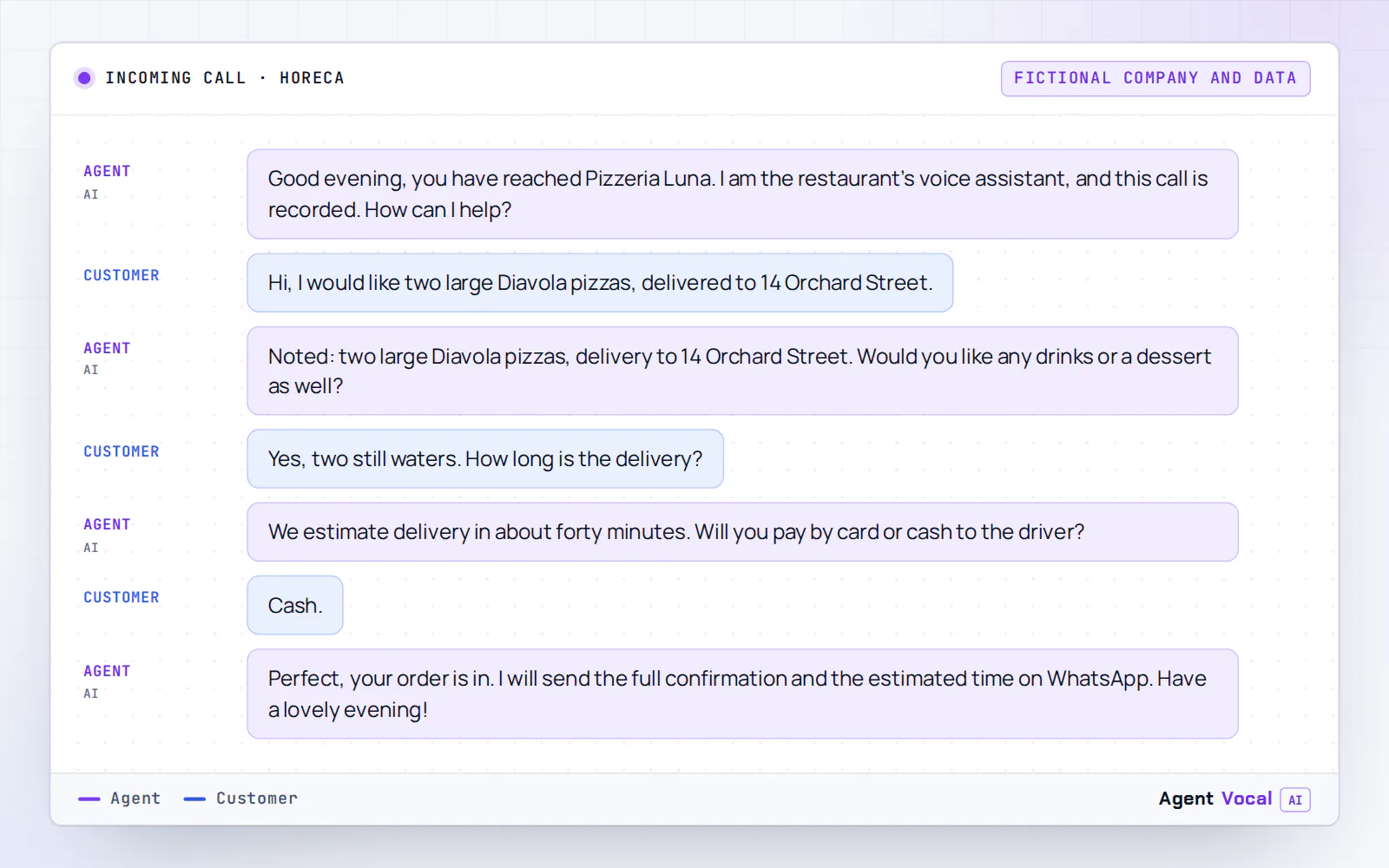
Listen to the call above once more and notice how little it left to chance. It introduced itself as a virtual assistant and said straight away that the call is recorded, as every AI voice agent on the platform does. It took the order, repeated the items and the address so there was no misunderstanding, estimated the delivery using only information it actually has and settled the payment. Every AI voice assistant in AgentVocal AI works with the same discipline. After the call it wrote the order in the portal, with a recording, a transcript and a summary, and sent the guest a confirmation on WhatsApp. A waiter working the evening shift could not have done all that without leaving a table unserved.
A day with the AI voice agent at a pizzeria
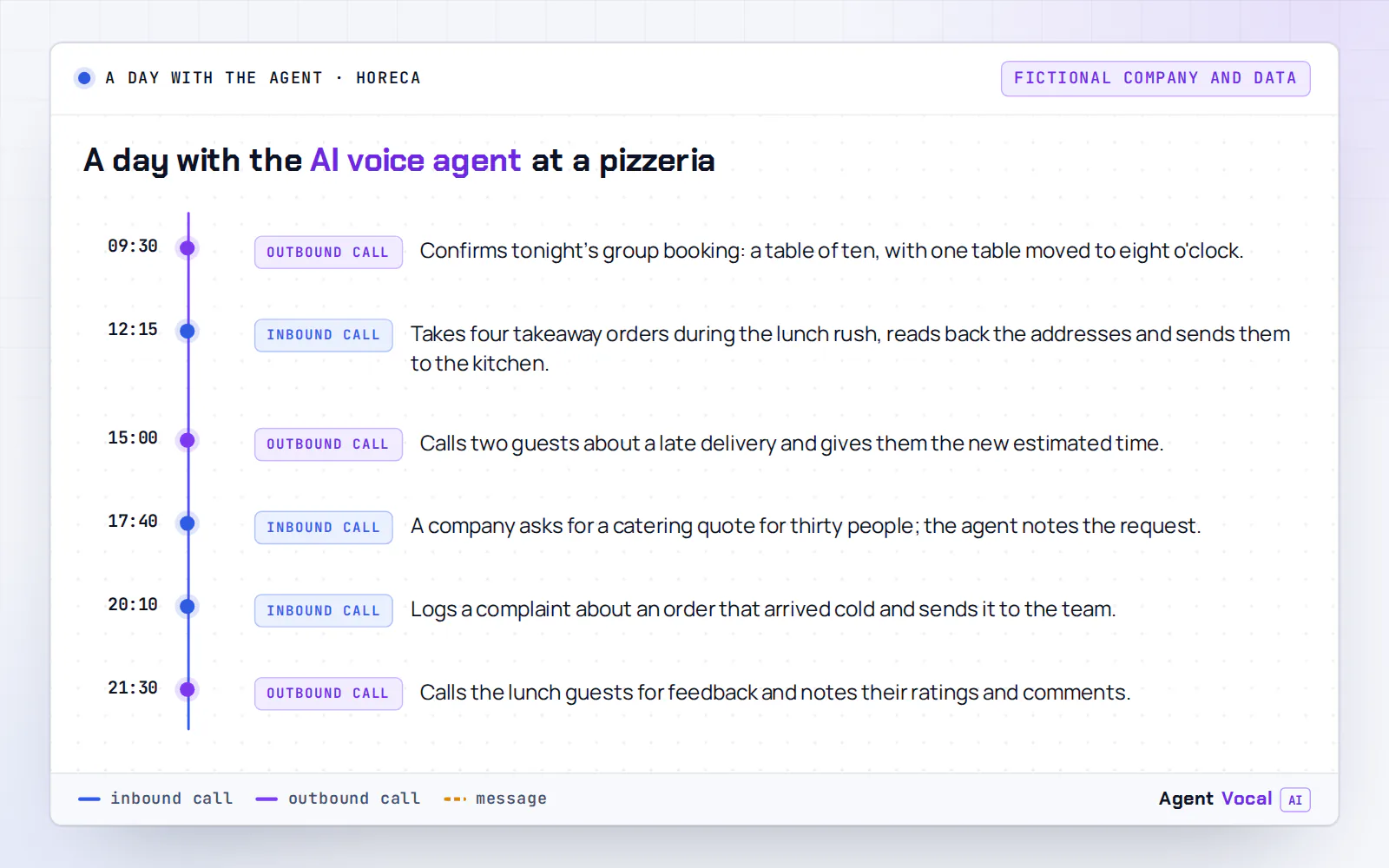
At Pizzeria Luna, a fictional venue that delivers across the neighbourhood, the morning starts quietly: the agent confirms the group booking for the evening and moves one table to another time. At lunch, as order follows order, the AI voice assistant takes four takeaway orders in parallel, repeats the addresses and sends them to the kitchen while the cooks keep cooking.
In the afternoon, two deliveries run late, so the agent calls the guests before they call in and gives them the new time. In the evening it logs a complaint about an order that arrived cold, and later, as the venue empties, it calls the lunch guests for feedback. The next day the owner finds every call in the AgentVocal AI portal with a summary, without having spent a second with the phone in hand. That is what phone automation means: work done even when nobody is at the receiver.
What does a restaurant gain from phone automation?
The gain is not only that the phone gets answered. Through automation, a restaurant gets a few concrete things:
- no lost call: the agent answers on the first ring, in parallel with dozens of other calls, including 24/7;
- confirmations before the seat is lost: tables and online orders are confirmed in time, and late deliveries are flagged;
- colleagues are freed from the repetitive part and go back to the guests in the room;
- everything stays in the portal, with a recording, a transcript and a summary, plus WhatsApp, SMS or email messages after the call;
- it answers in less than a second and in any of the 84 languages available, which helps with tourists.
A well-tuned AI voice assistant does not promise miracles; it simply never lets a call drop. For how you measure the outcome, there is more in the guide on how to prepare the knowledge base.
In a venue, a missed call shows up nowhere: it walks off quietly to a competitor. An AI voice agent makes visible exactly what used to disappear.
What stays with the floor team and what the agent will not do
An honest voice assistant has clear limits, and you set them:
- it does not negotiate prices and does not offer discounts you never gave it;
- it does not promise a free table if the calendar has none; it notes the request for a colleague;
- it does not resolve a delicate complaint or a complex event quote on its own: it sends them to the team;
- it does not pretend to be human; it introduces itself as a virtual assistant and says the call is recorded;
- it honours “do not call me again” on outbound calls and the time slots you set.
Cooking, serving and business decisions stay with people. AI voice agents take over the phone, not the kitchen.
What do you prepare before switching the agent on in your venue?
The more clearly you describe the venue, the better the agent answers:
- the knowledge base: the menu, allergens, opening hours, the delivery area and cost, the policy for groups;
- the calendar: tables, capacity per slot, hotel rooms and the check-in rules;
- the contact lists for outbound calls: customers to win back, bookings to confirm, guests who are arriving;
- the connections: your calendar, WhatsApp, SMS, email and, if you have one, a CRM or ERP;
- the time slots when the agent may call, so you do not disturb guests.
Details about connections are on the integrations page, and the full list of languages available is on the languages page.
How do you start the AI voice agent in a restaurant, step by step?
Nobody sets the agent up for you, and there is no need: you tune it yourself, and our team only approves the account, within 24 hours at most. If you want the overview first, see how it works, step by step.
- Prepare the menu, the delivery and booking rules and the frequent answers.
- Register and work through the 9-step guide: company, industry and scenarios, modules, price, connections, agent and voice, the phone number assigned automatically, lists and schedule, test call. In a real test, the technical setup took 4 minutes and 38 seconds.
- Make a few test calls from your own phone: order, ask for a table at a busy hour, leave a complaint.
- Start with a single scenario, for example the after-hours calls, then expand.
The full steps are in the launch checklist. If you want to hear how a call sounds, listen to the demo or see the 24/7 call answering scenario.
Test an AI voice agent on your own restaurant’s needs
You do not have to take any of the above on trust. Create an account on our site, at Create your account: it takes a few minutes, and the form shows you the estimated cost for your call volume from the start. You pick the HoReCa industry and exactly the scenarios above that actually hurt you, from taking orders in the rush hour to confirming weekend bookings, and you get the 9-step guide that carries you from your company details to the phone number assigned automatically.
Then you make the first test call from your own phone, before the agent calls a single guest: order two pizzas for delivery, ask for a table for eight on a Saturday night, ask about allergens and leave a complaint about an order that arrived cold. You listen to the recording, read the summary in the portal and see for yourself how the AI voice agent notes the order. If you like how it sounds for your venue, you start with a single scenario; if not, you have called nobody and lost nothing.
How much does an AI voice agent for restaurants cost?
You pay per minute of conversation, rounded up on each call, plus a one-off setup per channel. The only calls that are not charged are the ones nobody answers; voicemail is charged as a normal minute. You do not pay a subscription per employee, only the minutes the agent actually spends talking to a guest. The exact figures are on the pricing page, and if you want to see how it fits a particular venue, start from the HoReCa industry page. An AI voice assistant for HoReCa from AgentVocal AI pays off quickly, because every call answered in the rush hour is an order that would otherwise have left. For questions about feedback, see also the phone surveys and feedback scenario.