In this guide10 sections
- 01Why does recruitment lose calls, and what does it cost?
- 02What a voice assistant handles in recruitment: the scenario map
- 03How does a screening call with the AI voice agent sound?
- 04A day with the AI voice agent at a recruitment agency
- 05What does an agency gain by automating phone screening?
- 06What an AI voice agent will not do in recruitment
- 07What to prepare before you switch on in an agency
- 08How do you start an AI voice agent in a recruitment agency?
- 09Test an AI voice agent on your own recruitment needs
- 10How much does an AI voice agent for recruitment cost?
An AI voice agent for recruitment is a voice assistant that makes and answers calls in place of your HR team: it greets candidates who apply, screens them against the employer’s questions, books interviews and confirms attendance. As an AI voice assistant it speaks naturally, logs every answer in the candidate file and leaves a recording and transcript in the portal. AgentVocal AI brings this automation to your agency’s phone, so no recruiter spends hours on repetitive calls.
Recruitment lives on volume: hundreds of candidates to call for every wave of ads, and interviews that too often no one attends. Below you will see what an agency loses on the phone, every scenario an AI voice agent can take over, how a real call sounds and how you switch it on.
Why does recruitment lose calls, and what does it cost?
Recruitment work gets stuck in the same place every time: the phone. A recruiter has a long list of people who applied, but never gets to call them all on the day that matters. When they do call, half do not pick up, and the ones who do ask the same questions about hours, pay and the workplace.
The outcome is familiar in any agency:
- good candidates who are not called in time and take a job elsewhere;
- hours lost on screening calls that end with “not interested anymore”;
- interviews the candidate simply does not attend, because no one called to confirm;
- employers unhappy that the agency reacts slowly, when the real problem is only a shortage of time on the phone.
A voice assistant does not decide who you hire. It takes over exactly the part that drains the recruiter’s hours: the repetitive screening, the reminders and the confirmations, so the person is left with the interviews that truly need judgement.
What a voice assistant handles in recruitment: the scenario map
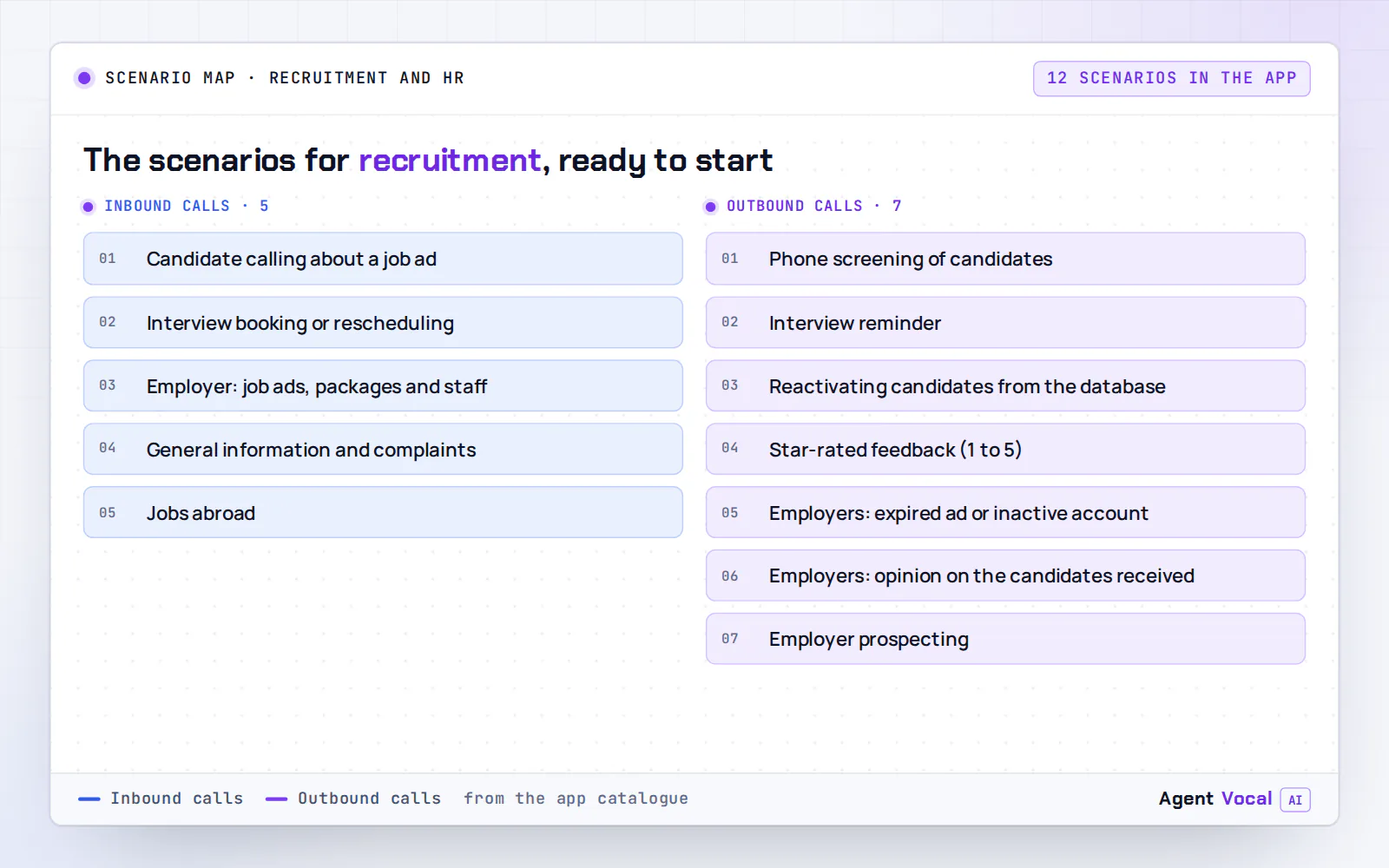
In AgentVocal AI, an AI voice agent for recruitment covers both the calls you receive from candidates and employers and the calls you make out to whole lists of candidates, as a complete automation of the phone. Switch on all of them, or only the ones you need.
Incoming calls
- Candidate calling about a job ad: the person calls about a published role, and the agent gives the details from the ad, asks the screening questions and, if they meet the mandatory requirement, books them for an interview. It all lands in the candidate file, so the recruiter no longer rebuilds the conversation from memory.
- Interview booking or rescheduling: an invited candidate calls to set, move or cancel their interview, and the agent finds the free slots and confirms. The calendar stays clean, with no overlaps.
- Employer: job ads, packages and staff: an employer calls to publish or pay for a job ad, to learn about the packages and prices or to ask for help with recruitment. The agent answers from the knowledge base, suggests the right package and books a discussion with a consultant.
- General information and complaints: someone asks how to apply, how to send a CV, which documents are required or how to make a personal data request, or raises a complaint. The agent answers from the knowledge base and logs complaints in full for the team.
- Jobs abroad: people interested in a role abroad call about conditions and documents, and the agent answers from the knowledge base and notes the application for the recruiter, in the language the person speaks.
Outbound calls
- Phone screening of candidates: the agent calls candidates who applied, confirms their interest, asks the employer’s questions and books an interview for those who meet the mandatory requirement. This is where the automation shows most clearly: a wave of hundreds of calls is handled without the recruiter lifting the receiver.
- Interview reminder: the day before, the agent calls the booked candidates, reminds them of the day, time and address and confirms attendance. That strikes straight at no-shows.
- Reactivating candidates from the database: the agent calls older candidates from your database about a new role that fits their profile and finds out whether they are available. Your CV pool comes back to life without manual work.
- Star-rated feedback (1 to 5): after the recruitment process and the interview, the agent asks 7 short questions, each scored from 1 to 5 stars, and notes the comments. You learn how candidates and employers felt, first-hand, not by guessing.
- Employers: expired ad or inactive account: the agent calls employers with expired ads, packages running low or inactive accounts, finds out whether they are still hiring and proposes republishing or renewing from the company’s offer.
- Employers: opinion on the candidates received: the agent calls employers who received candidates and finds out whether the profiles matched, whether the role was filled and what needs adjusting. That lets you correct your screening filters as you go.
- Employer prospecting: the agent calls companies from the prospecting list, finds out whether they need staff and books a discussion with a consultant. The sales team gets warm leads, not a cold list.
The secret is not one spectacular call, but hundreds of calls that are equally good, all logged just as tidily in the portal. That is what an AI voice agent does better than any person worn out by the fiftieth call of the day.
How does a screening call with the AI voice agent sound?
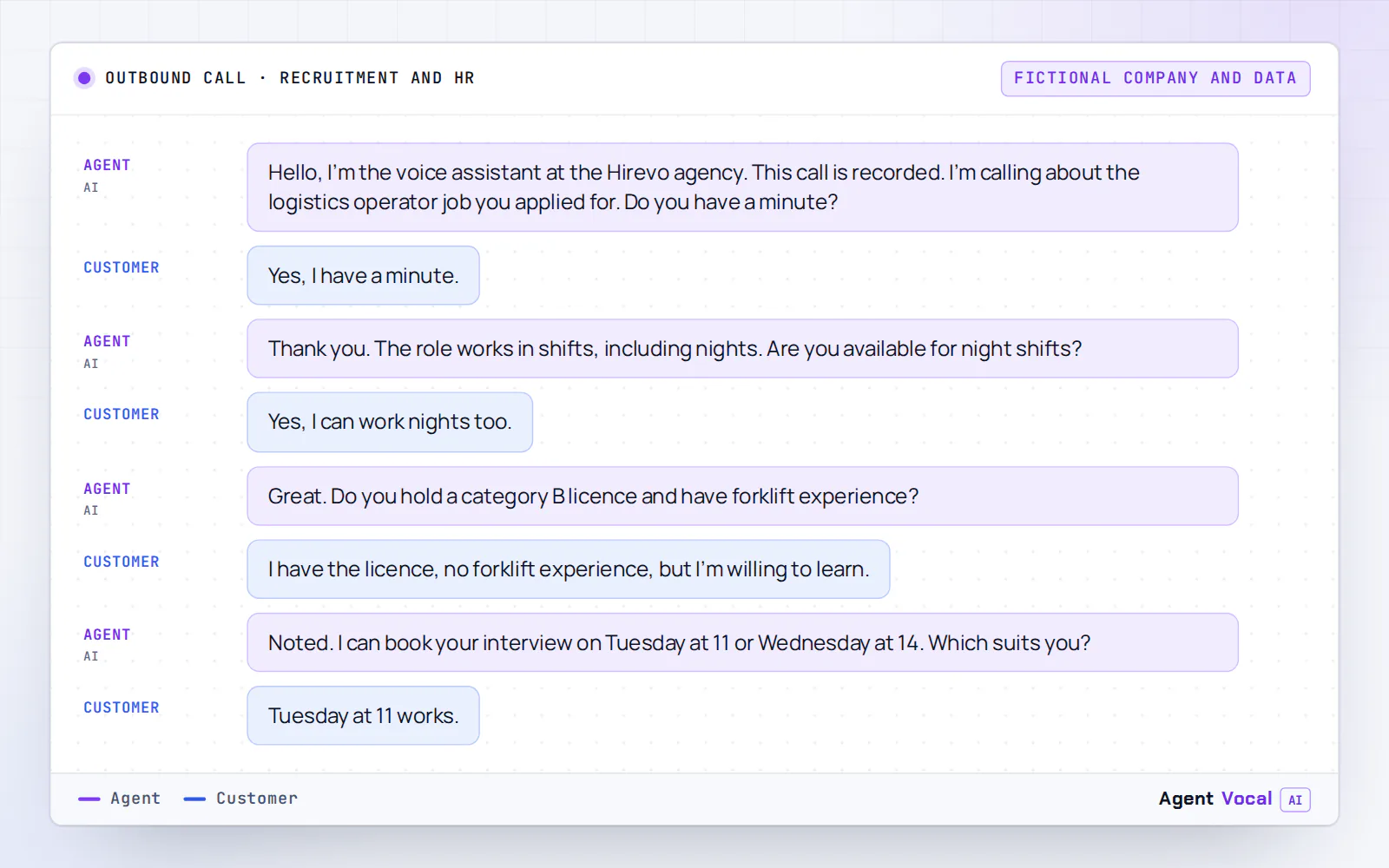
In the call above, an AI voice assistant from AgentVocal AI calls a candidate for a logistics operator role. Notice the steps: the agent introduces itself as a virtual assistant and says from the start that the call is recorded. It asks the employer’s mandatory question, the one about night shifts, because the rest of the conversation depends on it. It then checks the licence and the experience, notes honestly that the person has no forklift experience but wants to learn, and only at the end offers two or three interview slots, not a long list.
After the call, the candidate receives the confirmed interview details by WhatsApp, SMS or email. In the portal, the candidate file keeps the recording, the transcript and the summary, and the recruiter sees at a glance whether the person moves forward. The agent did not promise a salary, did not invent conditions and did not pretend to be human.
A day with the AI voice agent at a recruitment agency
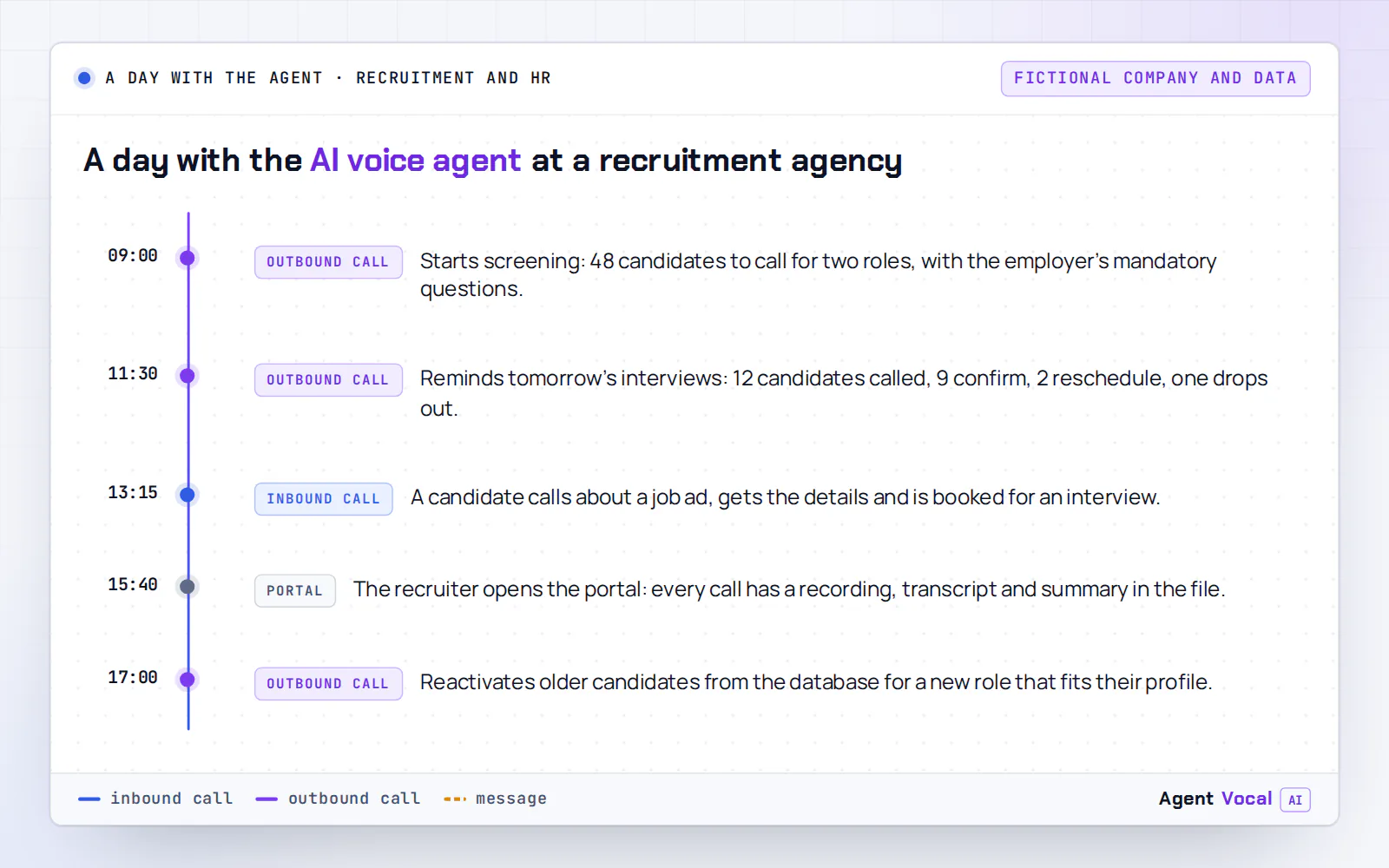
At the fictional Hirevo agency, which uses AgentVocal AI, the morning starts with a screening wave: the agent calls dozens of candidates for two roles, asks the mandatory questions and books interviews only for those who clear the basic requirement. The recruiter is not on the phone; they read the summaries as they appear in the portal and prepare the interviews that matter.
At midday, the AI voice agent reminds the next day’s interviews and gathers the confirmations, and in the afternoon it takes a candidate calling about a job ad. Towards evening, it runs a reactivation scenario and pulls a few suitable candidates from the old database for a new role. By the end of the day no one on the team missed a call, and thanks to the AI voice assistant the candidate shortlist is in better shape than it was in the morning.
What does an agency gain by automating phone screening?
An AI voice agent for recruitment changes the agency’s rhythm through simple mechanisms, not miracles:
- No candidate left unscreened in time: outbound calls start on their own, in the set time slots, and do not stop when the recruiter is in an interview.
- Round-the-clock answers: candidates who call in the evening or at the weekend get an answer, not a machine repeating “sorry, we are closed”.
- Fewer no-shows: the reminders and confirmations sent before the interview keep the slots filled with people who actually come.
- Your candidate database becomes useful again: reactivating old candidates is a simple scenario, not weeks of manual dialling.
- Everything in the portal: every call has a recording, transcript and summary, linked to the candidate file; after-call messages go out by WhatsApp, SMS or email.
- 84 languages: the agent speaks to candidates abroad in their own language and answers in less than a second.
An AI voice assistant and the automation behind it do one concrete thing: they lift the recruiter off the repetitive calls and leave time for the part only a person does well, the judgement no tool can stand in for. To see how this ties into outbound work, read the guide on automated outbound call campaigns.
What an AI voice agent will not do in recruitment
Honesty is part of the job, so we state the limits plainly:
- It does not decide hiring and does not reject a candidate for good; it filters by the mandatory requirement and leaves judgement to the recruiter.
- It does not negotiate salary and promises no conditions that are not in the ad or the knowledge base.
- It does not invent answers about a role; if it does not know, it notes the question for a colleague.
- It does not pretend to be human: it introduces itself as a virtual assistant and announces the recording.
- It respects “do not call me again”: the request is noted and honoured at once, with no further calls.
An AI voice agent is a tireless colleague on the phone, not a recruiter in its own right. See what stays with people in the guide on the AI virtual receptionist.
What to prepare before you switch on in an agency
For the agent to screen well, you give it the raw material:
- The knowledge base: the active ads, the employer’s screening questions, the mandatory requirements and the answers to candidates’ frequent questions. How you prepare it is in the guide on the knowledge base.
- The calendar: the interview slots, how long each takes, who interviews and when.
- The contact lists: the candidates to call for screening and reactivation, with the phone number and the target role.
- The connections: the link to your recruitment CRM or your candidate files, so the outcome of each call lands where it should. The options are in integrations.
- The time slots: when outbound calls go out, so you do not ring people at the wrong hour.
How do you start an AI voice agent in a recruitment agency?
Setup is self-service: you do it yourself in the platform, and the team only approves the account, within 24 hours. In short, you register with the cost estimate in sight, go through the nine-step setup, make a test call and start with a single scenario. In one real test, the technical setup of a complete agent took 4 minutes and 38 seconds. The detailed steps are in the section above and in the launch checklist. If you would rather understand the mechanism first, read how it works.
Test an AI voice agent on your own recruitment needs
The best way to see whether an AI voice agent fits you is to try it on your real work, not on a generic example. You create an account in a few minutes at Create your account, see the cost estimate right in the form, choose the recruitment industry and tick your own scenarios, from phone screening of candidates to interview reminders and database reactivation.
Then you get the nine-step guide, set up the agent yourself and make the first test call on your own phone, before the agent calls a single real candidate. That way you hear how your screening sounds, with your own mandatory questions, and decide with the full picture. You shape the AI voice assistant to your own needs and listen to it before you switch it on, so nothing goes live until it convinces you.
How much does an AI voice agent for recruitment cost?
You pay per minute of conversation, rounded up on each call, plus a one-off setup per channel. The only calls that are not charged are the ones nobody answers, and voicemail is billed as a normal minute. For an agency that calls hundreds of candidates, that means you pay for real conversations, not for empty attempts. The full model, with no surprises, is on the pricing page, and a longer explanation is in the guide on how much an AI voice agent costs. This keeps the automation with AgentVocal AI predictable to pay for. Want to see the industry page first? Go to recruitment and HR.