In this guide10 sections
- 01Why does a guesthouse lose bookings on the phone?
- 02Which calls can a hospitality voice assistant take over?
- 03How does a room booking sound over the phone?
- 04A day with the AI voice agent at a mountain guesthouse
- 05What does booking automation give a hotel?
- 06What reception keeps, and what the agent never does
- 07What to set up before your first guest call
- 08Launching a voice agent at a hotel or guesthouse, step by step
- 09Test an AI voice agent on your own bookings
- 10What does an AI voice agent for hotels cost?
An AI voice agent for tourism is an AI voice assistant that answers the phone at a hotel, a guesthouse or a travel agency, takes quote and booking requests, confirms arrivals and asks guests for their opinion after the stay. It is, in effect, phone automation for the reception desk, one that answers even while the person at the desk is doing check-in or is away. With AgentVocal AI, a voice agent can speak with guests in their own language, out of the 84 available, and every voice assistant call is saved in your portal.
Below you will find the full map of what an AI voice assistant can take over in tourism, a sample call, a full day at a guesthouse and the parts that rightly stay with the host and reception. The examples come from real reception work, around a fictional business.
Why does a guesthouse lose bookings on the phone?
A hotel, a guesthouse or a travel agency lives on bookings, and the booking calls come at exactly the wrong moment: while reception is doing check-in, while the host is serving breakfast, late in the evening or at the weekend, when people finally have time to plan a holiday. A phone that rings out unanswered means an unsold room or a stay that has gone to another hotel.
On top of this, a few things are specific to tourism:
- calls lost in peak season, when everyone rings in the same week for the same nights;
- foreign guests who speak another language and give up if they are not understood;
- the same questions repeated about check-in time, parking, breakfast and pets;
- guests already on the road, with a problem that needs an answer on the spot.
An AI voice assistant does not stand in for your hospitality, but it takes on the repetitive part of the phone: it answers, informs, notes the booking and reminds people of a payment or an arrival. No call goes unanswered, day or night.
Which calls can a hospitality voice assistant take over?
The scenarios below come ready-made in AgentVocal AI; you pick them at the “Industry and scenarios” step, and the voice agent takes each one on exactly as it is. You use the whole set, or only what makes sense for your hotel. See also the dedicated page for tourism and guesthouses.

Incoming calls
- General information and complaints: the agency or hotel address, the hours, the check-in and check-out times, parking, breakfast, pets, all from the knowledge base. Complaints are logged in full for the team, so nothing is lost.
- Quote request for a holiday: when a customer calls about a holiday, the voice agent finds out the destination, the dates, the number of people, the budget and the preferences, so the travel agent sends the right offer. No request stays as a note on the desk.
- Booking request at a hotel or guesthouse: the agent notes the arrival and departure dates, the guests and the room type, and reception confirms availability and the rate. At guesthouses, the voice assistant sees availability in the room calendar before it notes anything.
- Booking change or cancellation: the customer wants to change the dates, the guests or the room, or to cancel. The agent notes the request and states the change policy only from the knowledge base, without inventing exceptions.
- Booking a place on a tour or trip: for a guided tour, a day trip or an activity, the voice agent offers the free departures from the calendar and notes the place booked.
- Assistance for customers who are travelling: a customer already away calls with a problem, the transfer did not come, the accommodation does not match, the flight changed. The agent notes it quickly and passes it urgently to colleagues, with the call summary.
Outbound calls
- Booking confirmation before arrival: a few days ahead, the agent calls the guest, confirms the booking, finds out the estimated arrival time and notes special requests. Reception knows in good time who is coming and when.
- Deposit or balance payment reminder: politely and without pressure, the agent reminds the customer that the deposit or the balance in the brief is nearly due and notes when the payment will be made.
- Last-minute offer for past customers: the voice agent calls customers who travelled with the company before and presents the offer from the brief briefly. If they are interested, it notes the dates and the people for a travel agent.
- Travel documents reminder: before departure, the agent reminds the customer which documents they must have and which details are missing from the file, exactly as in the brief.
- Star-rated feedback (1 to 5): after the stay or trip ends, the agent asks 7 short questions, each rated from 1 to 5 stars, and notes the customer’s comments. See what a phone feedback survey looks like.
- Follow-up on a website quote request: the agent calls people who requested a quote on the website or on social media and completes what is missing from the request: the dates, the people, the budget, the preferences.
How does a room booking sound over the phone?
For the guest, the call sounds like a chat with reception, not like a keypad robot. The AI voice assistant listens to the request and does on the spot what it can do.
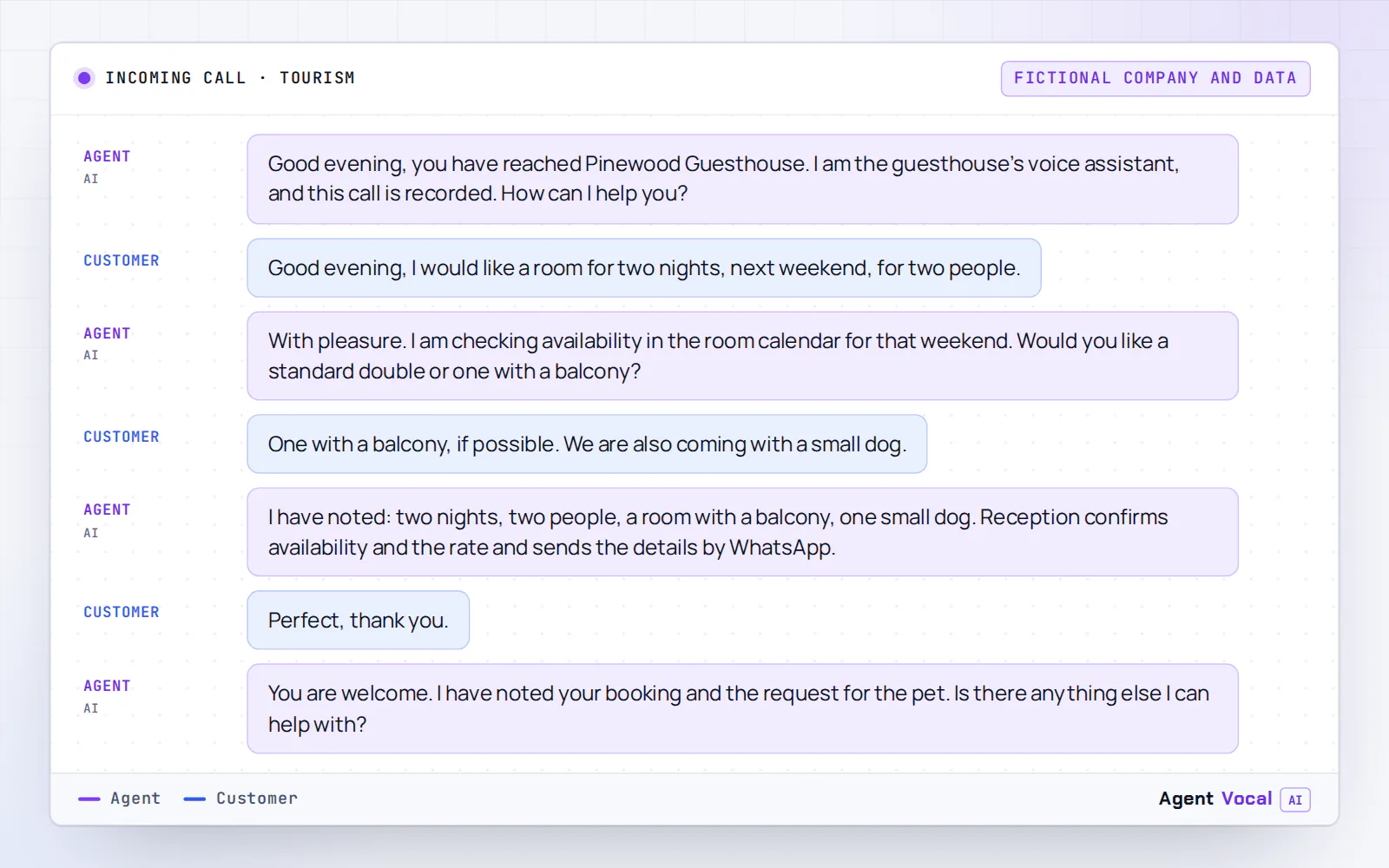
Notice the path of the call. The agent introduced itself as the guesthouse’s voice assistant and said the call is recorded, as it does on every call. It listened to the request, checked availability in the room calendar, asked what room type the guest wanted and noted every detail, including the small dog. It confirmed by repeating, so there is no misunderstanding, and left reception the final step: confirming the rate and the availability. In the portal it leaves the recording, the transcript and the summary. That way, AgentVocal AI takes the full request, and the host no longer loses the booking because they were busy.
A day with the AI voice agent at a mountain guesthouse
Follow the automation across a day at Pinewood Guesthouse (a fictional business), a small mountain guesthouse in full season.
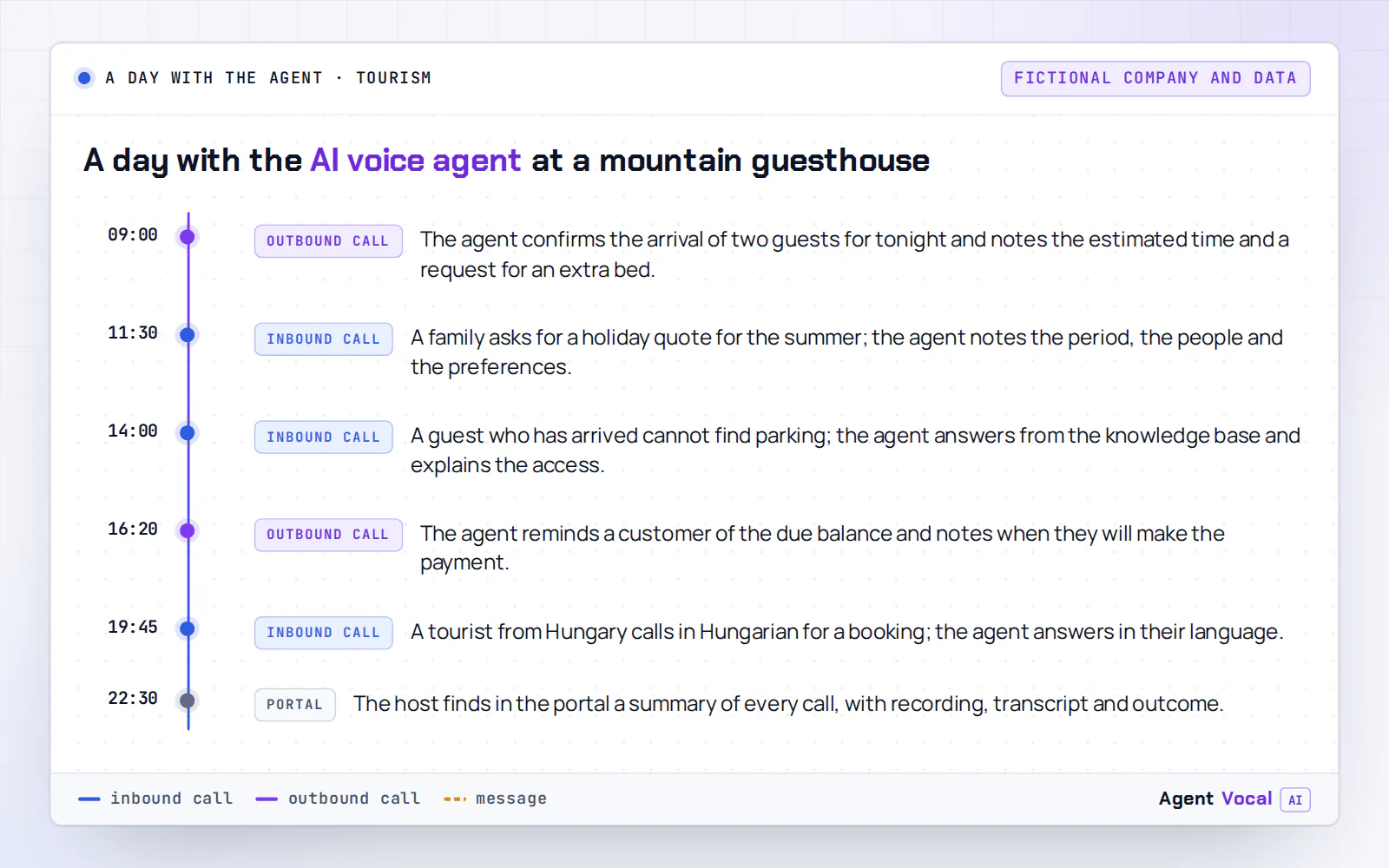
In the morning, while the host prepares breakfast, the voice agent confirms two arrivals for that evening and notes a request for an extra bed. At midday it takes a holiday quote request for the summer and answers a guest who cannot find parking. In the afternoon it reminds a customer of a balance, politely, and in the evening, when the house is full, a tourist from Hungary calls in Hungarian for a booking and gets an answer in their own language. Late at night, the host finds a summary of every call in the portal, with recording and transcript. No booking was lost, and the host slept soundly.
What does booking automation give a hotel?
With AgentVocal AI on the phone, the automation brings things you can see in the booking calendar:
- No lost booking: the agent answers from the first ring, in parallel, however many guests call at the same time, even in peak season.
- A 24/7 answer: in the evening, at night and at the weekend, when people plan their holiday, the phone no longer rings into the void.
- Foreign guests served in their own language: 84 languages available, useful for hotels and agencies with clients from abroad.
- Confirmations and reminders on time: guests are reminded of arrivals, deposits and travel documents before it is too late, by call, WhatsApp, SMS or email.
- People for hospitality: reception is freed from the repetitive part and is there for the guest at the desk.
- Everything stays written down: every call has a recording, a transcript and a summary in the portal, at hand whenever you need it.
- An answer on the spot: less than a second until the agent replies, so the guest does not feel they are talking to a machine.
At a guesthouse, a room calendar kept up to date makes all the difference: from it the agent sees what is free before it notes a booking, so it does not overbook.
What reception keeps, and what the agent never does
A decent AI voice assistant says from the start what it does not do. At a hotel or a guesthouse:
- It does not confirm the final rate itself on a room booking; it notes the request, and reception confirms availability and the rate.
- It does not negotiate the price of a holiday and does not offer discounts you have not given it in the brief.
- It does not make exceptions to the cancellation policy or to rules it does not know; it notes the request for a colleague.
- It does not pretend to be human: it introduces itself as a virtual assistant and states that the call is recorded.
- It respects ‘please do not call me again’ at once and keeps to the time slots you have set for outbound calls.
On recording and on guests’ data, read the guide call recording and GDPR and the security page.
What to set up before your first guest call
The better you prepare its material, the more the agent sounds like a host. Before you start, gather:
- The knowledge base: the check-in and check-out times, parking, breakfast, the rules for pets and children, the cancellation policy, how to get there. The guide on how to prepare the knowledge base helps.
- The room calendar: the room types, availability and time slots, so the voice agent sees what is free before it notes a booking.
- The contact lists for the outbound calls: guests arriving soon, customers with a balance due, past customers for last-minute offers.
- The connections: your CRM, the calendar, WhatsApp, SMS and email. The list of possible integrations is on the integrations page.
- The time slots in which the agent may make outbound calls, so you do not ring guests at awkward hours.
Launching a voice agent at a hotel or guesthouse, step by step
Setup is self-service: you build the agent yourself in the platform, and our team only approves the account, within 24 hours at most. The steps from the guide of 9 steps, adapted to tourism:
- Pick a single scenario at first, for example incoming bookings or arrival confirmations.
- Prepare the knowledge base with the answers to guests’ frequent questions.
- Put the rooms in the calendar, with the types, availability and time slots.
- Register and go through the 9 steps: company from the tax registry, industry and scenarios, modules, price, connections, agent and voice, phone number assigned automatically, lists and schedule, test call. In a real test, the technical setup took 4 minutes and 38 seconds.
- Make a test call from your own phone: ask for a room, a change, a holiday quote.
- Start with part of the calls and expand as your confidence grows.
Test an AI voice agent on your own bookings
Convince yourself on your own scenarios, not on an example. You create an account in a few minutes at Create your account and see the estimated cost in the form as you fill it in. You choose the “tourism” industry and the scenarios above that fit you: booking requests, arrival confirmations, holiday quotes or feedback after departure.
Once the account is approved, you get the guide of 9 steps, you put your rooms in the calendar, you set up the voice agent yourself and you make the first test call from your own phone, before it calls any guest. You hear how an AI voice assistant answers for your guesthouse and you switch it on only when you are happy. No real person is called until you decide.
What does an AI voice agent for hotels cost?
The cost of AgentVocal AI for tourism is worked out per minute of conversation, rounded up per call, plus a one-off setup per channel. The only calls that are not charged are the ones nobody answers; voicemail is charged as a normal minute. You do not pay a fixed monthly sum, but for how much the voice agent actually talks with your guests, so the bill follows the season. The full model is on the pricing page, and if you would rather hear it first, listen to the demo calls. The automation of the reception phone stays predictable, and you decide at any time which scenarios you run and which time slots you use.