In this guide10 sections
- 01Why does a utility provider’s phone line jam in waves?
- 02What an AI voice assistant covers at a utility provider: the scenario map
- 03How does a meter reading call work, step by step?
- 04A day with the AI voice agent at an energy supplier
- 05What does a utility provider gain from call automation?
- 06What stays with the field team, and what the agent will not do
- 07What to prepare before go-live at a utility provider
- 08Launching your voice agent at a utility provider, step by step
- 09Test an AI voice agent on your own utility workflows
- 10What does an AI voice agent cost for a utility provider?
An AI voice agent for a utility provider is an AI voice assistant that answers the phone and makes calls for electricity, gas, water or internet: it takes the meter reading, listens to outage reports, books technicians and politely reminds customers of overdue bills. In short, the voice assistant from AgentVocal AI keeps the line open around the clock, in each customer’s language, and notes everything in the portal. This automation absorbs the wave of repetitive calls, so the field team can handle what truly matters.
In utilities, the phone does not ring steadily; it rings in waves that overwhelm any human switchboard: an outage, a reading period, a month’s end. Below you will see where these peaks come from, which scenario the agent takes at each one, how a meter reading call unfolds, and where the firm’s decisions stop.
Why does a utility provider’s phone line jam in waves?
At an energy or water supplier, the phone has peaks that overwhelm any human reception. When the power goes out in a neighbourhood, dozens of people call in the same minute. During the meter reading period, everyone wants to submit a reading at once. At month’s end, bill calls rise. The typical problems:
- outage calls in a crush, when the line is busy and people call again and again;
- readings that are hard to take by phone, with errors in the serial or the digits;
- overdue bills forgotten, which a timely reminder would settle;
- technician bookings that get lost among the other calls.
A good AI voice assistant does not get annoyed and does not tire. It takes dozens of calls at once, checks safety on an outage and repeats every digit of the reading for confirmation. This is the kind of automation that genuinely helps a public service.
During an outage, people are stressed and talk fast, and a single operator cannot calm ten callers in the same minute, so the rest hear the busy tone and call again. An AI voice assistant takes every call with the same clarity, asks for the exact address and repeats the safety step from the knowledge base. Here the automation does not replace the response; it starts it sooner, because the dispatcher receives every report at once, not one by one.
What an AI voice assistant covers at a utility provider: the scenario map
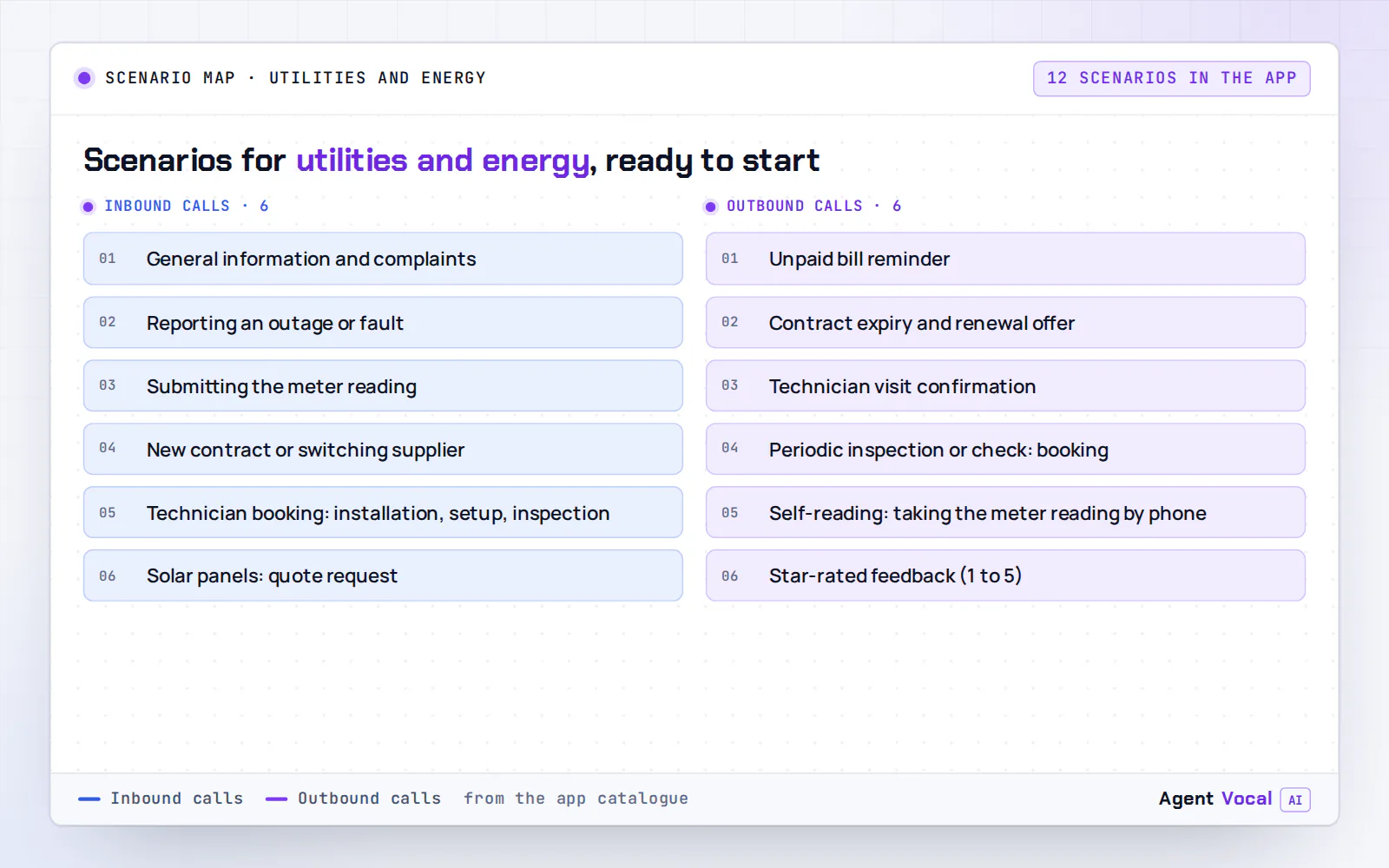
In utilities the scenarios split into incoming calls, where speed and accuracy count, and outbound calls, where tact counts. Everywhere, safety comes first: on an outage, the agent says the safety step from the knowledge base before it notes anything.
Incoming calls
General information and complaints. The customer calls with a question about how the bill is read, payment methods, opening hours, the documents for a new contract or how to submit a reading, or with a complaint. The AI voice assistant answers from the knowledge base and records complaints in full for the team.
Reporting an outage or fault. The customer reports an interruption to power, gas, water, internet, a lift or stairwell lighting. The agent checks safety first, notes the fault with the address and passes it to the field team. During a wave of calls, it takes them all at once.
Submitting the meter reading. The customer gives the reading on the electricity, gas or water meter. The agent notes the reading, the meter serial and the customer code and repeats each one back for confirmation, so no error spoils the bill.
New contract or switching supplier. The person wants a new contract, to move from another supplier, or an internet subscription. The agent finds out the consumption point, the approximate consumption and the current supplier, and passes the request to an adviser.
Technician booking: installation, setup, inspection. The customer asks for a visit: a meter fitting, an internet installation, an inspection or check of the gas system, a boiler call-out. The agent books the visit in a free slot in the calendar.
Solar panels: quote request. The person wants solar panels. The agent finds out the building and roof type, the consumption, the rough budget and any interest in financing schemes, and passes the request on.
Outbound calls
Unpaid bill reminder. The agent politely tells the customer that a bill has passed its due date and notes whether they have paid or when they will. No threats and nothing cut off, just a warm reminder.
Contract expiry and renewal offer. The agent tells the customer that their contract or offer is expiring, presents the renewal offer from the brief and notes the decision, so no one is left without a contract through inattention.
Technician visit confirmation. The agent confirms the booked technician visit with the customer, the date, the slot, the address, and that someone will be home to allow access. That way the team does not travel for nothing.
Periodic inspection or check: booking. The agent tells the customer that the periodic inspection or check of the gas system, the boiler or the panels is due, from the brief, and books the visit in a free slot.
Self-reading: taking the meter reading by phone. The agent calls the customer during the reading period and takes the meter reading directly in the call, repeated and confirmed. A form of automation that empties the call queue on those days.
Star-rated feedback (1 to 5). After a call-out or a service, the agent makes a short outbound call, asks seven questions scored from one to five stars and notes the customer’s comments. See the logic in the phone surveys and feedback scenario.
The overall picture of the sector is on the page for the AI voice agent for utilities and energy.
How does a meter reading call work, step by step?
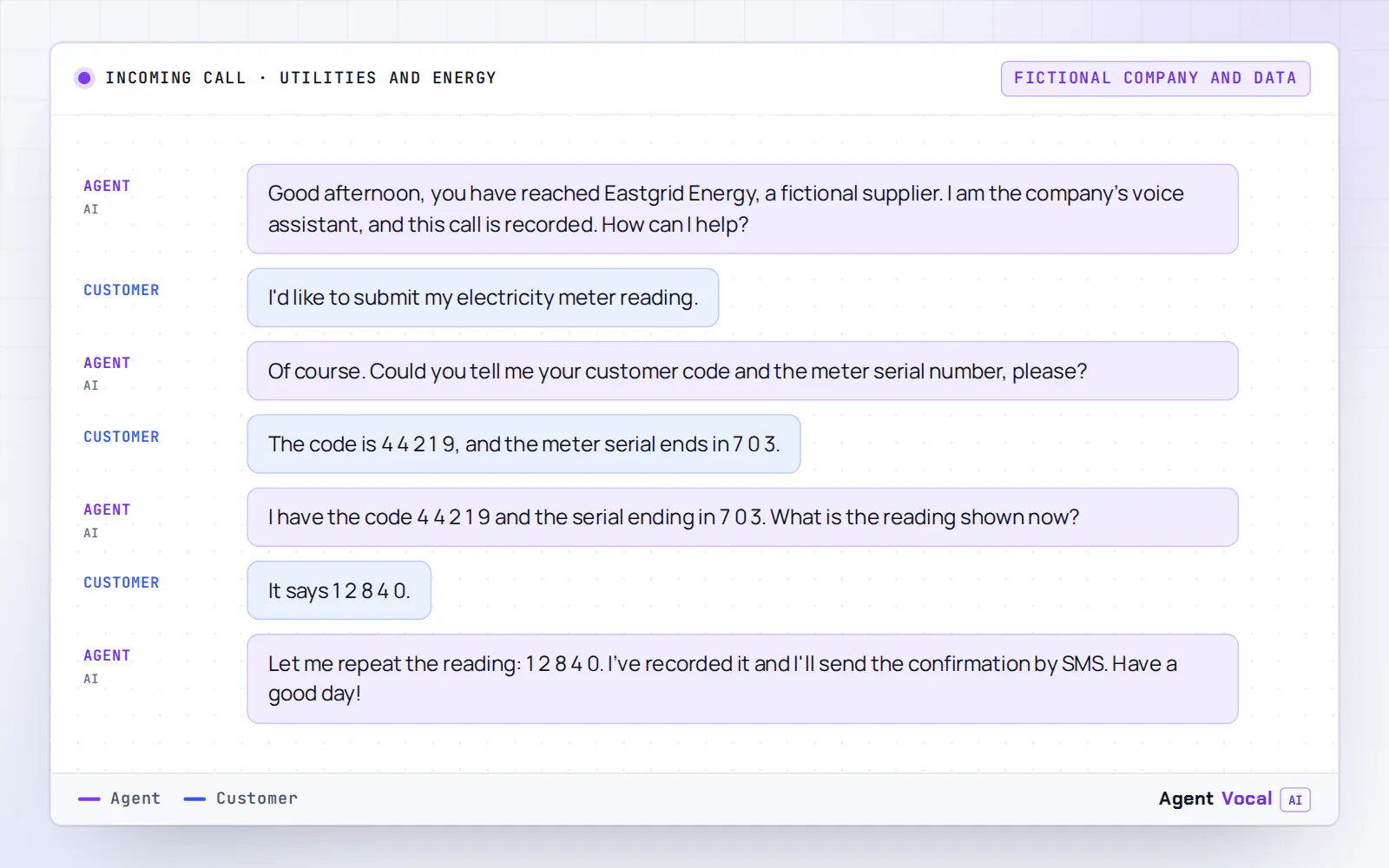
Submitting a reading is the perfect test for an AI voice assistant: it demands precision. The agent introduces itself as a virtual assistant and states that the call is recorded, then asks for the customer code and the meter serial. The important part is that it repeats every digit of the reading and the serial, like a careful person, and only records them after confirmation. At the end it sends an SMS with what it captured, and the recording, transcript and outcome stay in the portal. A wrong reading spoils a bill; that is why confirming by repeating is not a nicety but the heart of this automation. At AgentVocal AI, this attention to digits is built in, not optional.
A day with the AI voice agent at an energy supplier
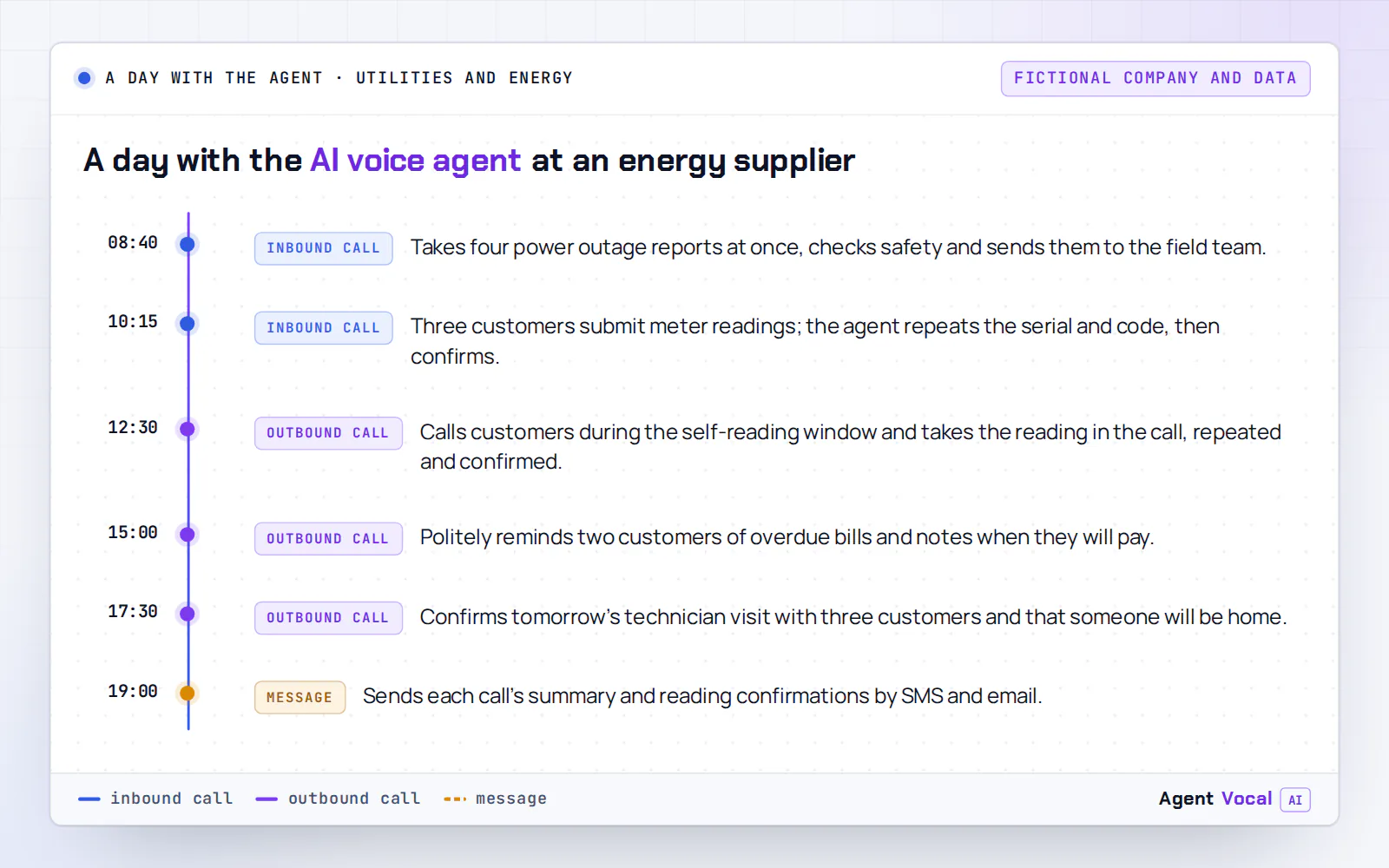
At Eastgrid Energy, a fictional supplier, the morning catches a power cut in one neighbourhood. People call one after another, but the AI voice agent answers them all at once, checks safety and sends the reports to the field team. Also in the morning, other customers submit readings, and the agent repeats every digit. At midday, the agent calls the customers in the self-reading period itself and takes the reading in the call.
The afternoon brings the calm part: polite bill reminders and visit confirmations for technicians. In the evening, the dispatcher finds the summary of every call in the portal. No one listened to the same requests for hours, and no outage call went unanswered. That is the point of an AI voice assistant at a service that is not allowed to fall silent. The voice agent carries the repetitive load, while people handle the real call-outs and the hard cases.
What does a utility provider gain from call automation?
At a service that cannot go quiet, the gain shows in outage calls taken instantly and readings that no longer spoil bills. A well configured AI voice assistant from AgentVocal AI brings:
- no missed calls, neither at the peak of an outage nor after hours;
- correct readings, because every digit is repeated and confirmed;
- a fast reaction to faults, with a safety check and handover to the team;
- bills reminded on time, politely, without pressure;
- colleagues freed from the repetitive part, left to handle call-outs and hard cases;
- everything in the portal, with a recording, transcript and summary;
- after-call messages by SMS, WhatsApp or email, and a reply in under a second in 84 languages.
On an outage, how fast the call is taken matters more than anything. An AI voice assistant that answers instantly, to dozens of calls at once, completely changes the customer’s experience.
After-call messages are described in the follow-up after call scenario, and incoming calls taken around the clock in 24/7 call answering. No matter the scenario, every call lands in the portal in the same shape, a recording, a transcript and a summary, with the reading, the fault report or the payment the customer gave, ready for the team the next morning.
What stays with the field team, and what the agent will not do
The agent has clear limits, which we state plainly:
- it does not repair a fault and does not dispatch crews on its own; it notes and passes on;
- it gives no dangerous technical advice on gas or power; it says only the safety steps from the knowledge base;
- it cuts off no service and never threatens over an unpaid bill;
- it does not sign a new contract on its own; it notes the request for an adviser;
- it does not interpret a bill or a clause;
- it does not pretend to be human: it introduces itself as a virtual assistant and states that the call is recorded;
- it respects “do not call me again” on outbound calls.
Decisions and call-outs stay with people. The voice agent is the line that never sounds busy.
What to prepare before go-live at a utility provider
An AI voice agent from AgentVocal AI works correctly only if the safety steps and billing data are written clearly. You prepare:
- the knowledge base: how the bill is read, the payment methods, the safety steps on an outage, the documents for a new contract. See the guide on the knowledge base;
- the briefs for outbound calls: which bill, which contract is expiring, which visit to confirm, which self-reading period;
- the contact lists for self-reading, bills and visit confirmations, with the correct customers;
- the connections with your billing system and with your CRM or ERP. See what can be linked in integrations;
- the calling hours in which the agent makes outbound calls, respecting people’s quiet time.
Launching your voice agent at a utility provider, step by step
Starting does not call for an IT project: you configure the agent yourself in the platform, and we only approve the account within 24 hours at most. If you first want the mechanism, see how an AI voice agent works.
- Choose a single scenario, for example meter readings or taking outage reports.
- Prepare the knowledge base with the safety steps and billing information.
- Upload the lists and briefs for self-reading and bills.
- Register and go through the 9-step setup: company, industry and scenarios, modules, price, connections, agent and voice, a phone number assigned automatically, lists and working hours, a test call. In a real test, the technical setup of a complete agent took 4 minutes and 38 seconds.
- Make a few test calls: submit a sample reading, describe an outage.
- Start gradually and expand as your confidence grows.
The steps are the same ones in the launch checklist.
Test an AI voice agent on your own utility workflows
The surest way to see whether an AI voice agent fits your utility business is to try it on your own real flows. You create an account in a few minutes at Create your account, and the form shows you the estimated cost before you even start. You choose the utilities industry and your own scenarios, from meter readings to taking outage reports and bill reminders.
After your account is approved, you receive the 9-step guide and configure the agent yourself: voice, language, calling hours and the knowledge base with the safety steps. Then you make the first test call on your own phone, submit a sample reading and describe an outage, to see how it repeats the digits and what it writes in the portal, before the AI voice assistant speaks to a single customer. You only start it on a real list once you are sure.
What does an AI voice agent cost for a utility provider?
The model is predictable: you pay per minute of conversation, rounded up per call, plus a one-time setup per channel. The only calls that are not charged are the ones nobody answers; voicemail is charged as a normal minute. During an outage wave, you pay for the conversations handled, not for an extra team kept idle. Exact figures are on the pricing page, and you can hear a real call on the demo page. This way, automation in utilities becomes a cost you control. An AI voice agent from AgentVocal AI stays the line that answers when everyone calls at once and repeats every digit of the reading until it comes out right.