In this guide10 sections
- 01Why do estate agencies lose calls, and what does it cost?
- 02What an AI voice assistant handles in real estate: the scenario map
- 03How does a viewing booking call sound with the voice agent?
- 04A day with the AI voice agent at an estate agency
- 05What does a real estate agency gain from call automation?
- 06What stays with the estate agent, and what the assistant will not do?
- 07What to prepare before you start in the agency
- 08How do you start the AI voice agent in an estate agency?
- 09Test an AI voice agent on your own agency needs
- 10How much does an AI voice agent for real estate cost?
An AI voice agent for real estate is an AI voice assistant that answers the agency phone, gives the public details from your listings, learns what a caller wants and books a viewing, and calls leads and owners on its own when needed. In short, it is a voice assistant that never drops a call and an automation of the repetitive phone work. AgentVocal AI runs it in Romanian and dozens of other languages, with a recording, transcript and summary for every call.
Below you take, one by one, why contacts slip away on the phone, every scenario you can switch on, a real call from hello to a booked viewing, a day inside the agency office and what stays in the hands of the estate agent.
Why do estate agencies lose calls, and what does it cost?
Real estate lives on one simple thing: the person who calls once. A buyer sees a listing, dials the number, and if nobody answers within a few seconds they move to the next listing and do not come back. The estate agent is usually out on the ground: at a viewing, at the notary, driving between two properties. That is exactly when the phone rings.
This builds up losses you will not find in any report:
- leads who call once and no longer answer when you ring them back two hours later;
- unconfirmed viewings, where the estate agent drives out for nothing because the buyer changed their mind and said nothing;
- old requests forgotten in the CRM, people who were searching a few months ago and may still be searching now;
- owners who call to put a flat up for sale and, finding no one, call the agency across the road instead.
An AI voice assistant does not solve everything, but it catches exactly these moments: it answers the first call, qualifies quickly and books the viewing while the person is still interested.
What an AI voice assistant handles in real estate: the scenario map
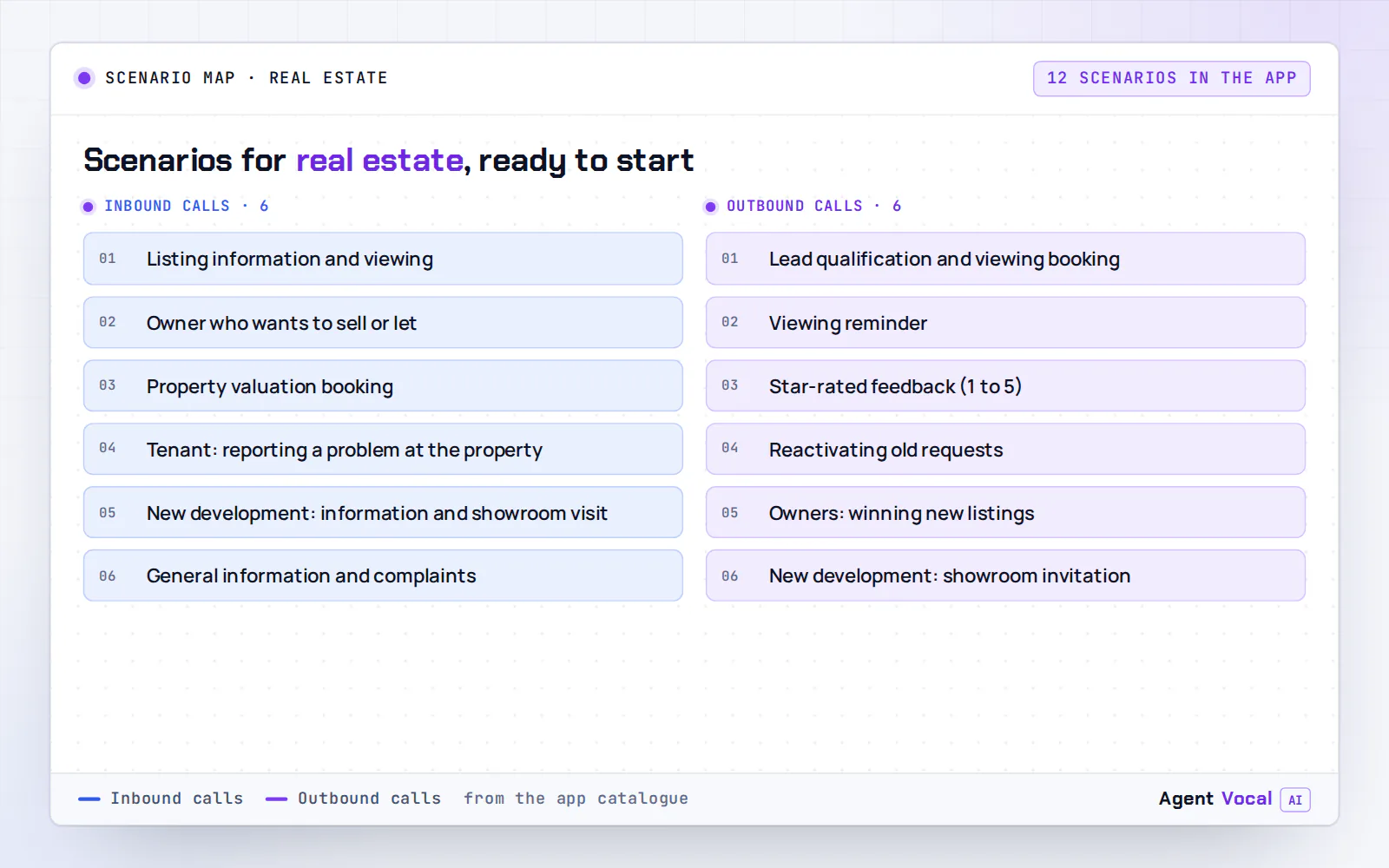
Real estate has twelve scenarios in the app, across incoming and outbound calls. You tick all of them, or only the ones that press on you now, and the agent starts right there.
Incoming calls
- Listing information and viewing: the person calls about a listing, and the agent gives the public property details from the knowledge base, finds out what they are looking for and books a viewing. The gain: no listing call goes unanswered, not in the evening and not at the weekend.
- Owner who wants to sell or let: an owner calls to put a property into your portfolio. The agent collects the property details and expectations and books a meeting with the estate agent, so you do not lose the instruction to a competitor just because no one picked up.
- Property valuation booking: someone wants a valuation for a sale, for a loan or for information. The agent notes the property details and books the valuation visit in the calendar.
- Tenant: reporting a problem at the property: for managed properties, the tenant calls with a plumbing, appliance or paperwork problem. The agent notes the issue and how urgent it is, for the property manager, and nothing is lost on a sticky note on a monitor.
- New development: information and showroom visit: for developers, the person asks about a residential development. The agent presents the details from the knowledge base, finds out what they are after and books a showroom visit.
- General information and complaints: questions about the agency hours, the office address, the fees, the documents needed for a sale or a letting, or how the agency works. The agent answers from the knowledge base and logs any complaint in full, so the team picks it up the next day.
Outbound calls
- Lead qualification and viewing booking: the agent calls people who left a request on your site or on a portal, asks what they want and for what budget, and books a viewing for the interested ones. The estate agent only receives warm contacts, not a list of cold numbers.
- Viewing reminder: before the viewing, the agent calls, reminds the person and asks for confirmation. If they can no longer come, the slot is freed on the spot and the estate agent does not drive out for nothing. For the step after the visit, see the follow-up after call scenario.
- Star-rated feedback (1 to 5): after the viewing, the agent asks seven short questions, each rated from 1 to 5 stars, and notes the comments. You learn what worked and what did not, property by property. See the phone surveys and feedback scenario.
- Reactivating old requests: the agent calls people who were searching for a property a few months ago, finds out whether they are still looking, updates the criteria and proposes a viewing. Your old contact base becomes a source of sales again.
- Owners: winning new listings: the agent calls owners who asked for a valuation or worked with the agency before, finds out whether they want to sell or let and proposes a meeting. You grow your portfolio without sitting on the phone yourself.
- New development: showroom invitation: for developers, the agent calls people interested in a new development, presents the project briefly and books a showroom visit.
How does a viewing booking call sound with the voice agent?
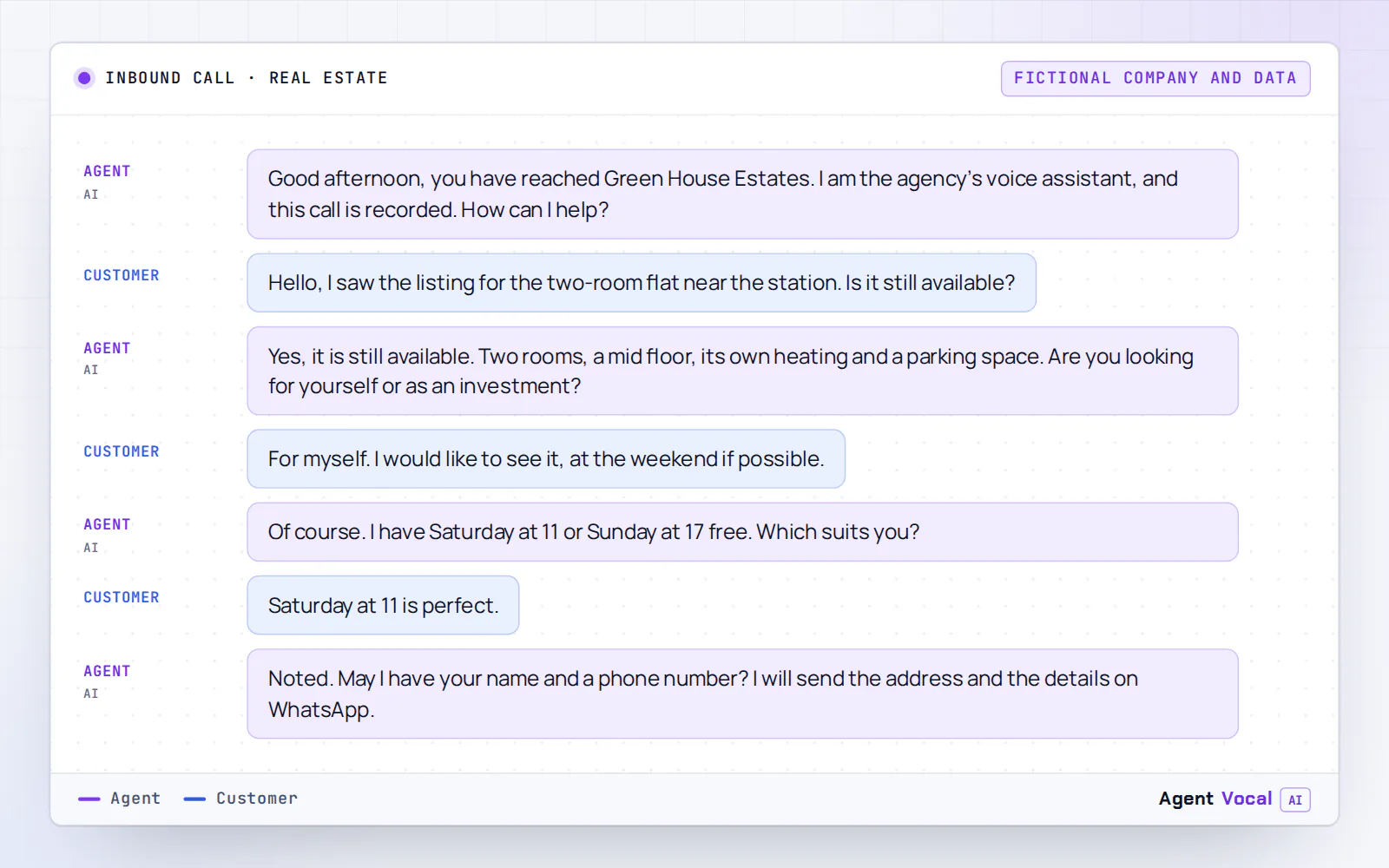
Take the call above apart, step by step. The AI voice assistant introduced itself as the agency’s assistant and said straight away that the call is recorded, as every call in AgentVocal AI is. It gave only the public details about the flat, from the knowledge base, without inventing anything. It asked one short qualifying question about the purpose of the search, offered two or three viewing slots rather than a long list, and confirmed by repeating back. After the call, it asked for the name and phone number and sent the address on WhatsApp. The whole thing took under a minute, and the estate agent found the contact already booked in the portal.
A day with the AI voice agent at an estate agency
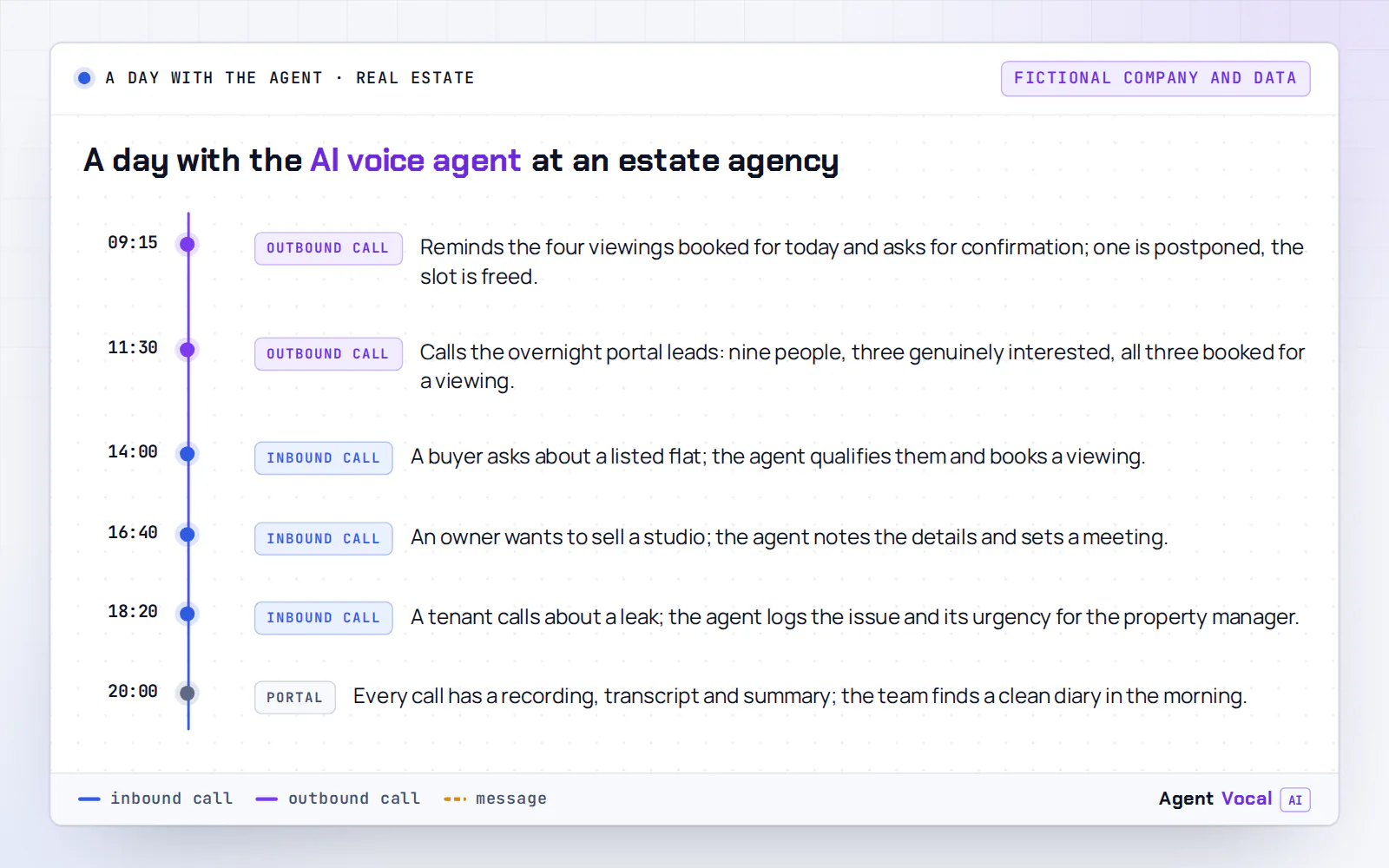
At the fictional Green House Estates, the morning starts with the reminder calls for the day’s viewings. One person postpones, and the slot is freed immediately for someone else. At midday, the agent calls the leads that arrived overnight from the portals: out of nine people, three are seriously interested and leave booked for a viewing, while the rest are noted for later. The agents, who used to lose the first hours of the day making calls, are already out on the ground.
In the afternoon a listing call comes in and, close to closing time, an owner who wants to sell a studio, then a tenant with a leak. None of them hits a voicemail box: AgentVocal AI takes them all, notes the request and passes it on. In the evening, when the office is empty, every call already has a recording, transcript and summary in the portal, and in the morning the team finds a clean diary.
What does a real estate agency gain from call automation?
Automation here does not mean “fewer people”, it means “no contact lost”. Here, briefly, is what an AI voice assistant like AgentVocal AI brings an agency through automation:
- No unanswered call: the AI voice agent picks up from the first ring, during hours and after, including at the weekend, when buyers have time to call.
- A reply in under a second and a natural conversation, not a keypad menu.
- Viewings confirmed in advance, so fewer wasted trips for the estate agent.
- Lead qualification done by automation, so people only speak to those ready to buy or let.
- Old requests reactivated regularly, with no effort from the team.
- Everything in the portal: recording, transcript, summary and outcome for every call, plus WhatsApp, SMS or email messages after the call.
- 84 available languages, useful for buyers and investors from abroad.
A real estate lead is only worth as much as it is warm. A voice assistant that answers instantly and books the viewing on the spot catches exactly the window in which the person still wants to see the home.
To see in black and white what each call leaves behind, here are the most used scenarios in an agency and their trace in the portal:
| Scenario | When it triggers | What stays in the portal |
|---|---|---|
| Listing information and viewing | Someone calls about a listing, at any hour | The summary, the search criteria, the booked viewing |
| Lead qualification and viewing booking | A new lead from the site or a portal enters the list | Interested or not, the budget and area, the booked viewing |
| Viewing reminder | A few hours before the viewing | Confirmed, postponed or cancelled, the slot freed in the calendar |
| Tenant: reporting a problem at the property | A tenant calls with a fault or a question | The issue, the urgency and the property, for the manager |
| Owners: winning new listings | The list of owners who once asked for a valuation | Whether they want to sell, the meeting proposed with the estate agent |
Behind every row sit the recording, the transcript and the summary, so a colleague can pick the case up again without calling the person a second time for the same things.
What stays with the estate agent, and what the assistant will not do?
A good voice agent knows its limits, and in real estate those matter:
- it does not negotiate the price and does not promise discounts or fees you did not give it;
- it does not run the viewing and does not replace the relationship the estate agent builds with the client;
- it gives no legal or tax advice about documents, taxes or loans; it says what is in your knowledge base and otherwise notes the request for a colleague;
- it does not invent details about a property it does not have;
- it does not pretend to be human: it introduces itself as a virtual assistant and announces the recording;
- it respects “do not call me again” on outbound calls and the time slots you set.
What to prepare before you start in the agency
Good automation starts from clean information. Prepare:
- The knowledge base: the public property details, the fees, the documents needed and how the agency works. The guide on how to prepare the knowledge base helps you structure it.
- The viewing calendar: the time slots, which agents can be booked, how long a visit takes.
- The lists for outbound calls: the portal leads and the old requests to reactivate, with name and phone number.
- The connections: your CRM, the calendar and the messaging channel. See what can be linked in integrations.
- The time slots for outbound calls, so owners and leads are called at sensible hours.
For how to check an agent before launch, see the launch checklist.
How do you start the AI voice agent in an estate agency?
You configure the agent yourself in the platform; our team only approves the account. The steps from how it works are the same for any agency:
- Fill in the registration form, where you see a cost estimate, and wait for your account to be approved, within 24 hours at most.
- Follow the 9 step wizard: company, industry and scenarios, modules, price, connections, agent and voice, the automatically allocated phone number, lists and working hours, a test call. In a real test, the technical setup took 4 minutes and 38 seconds.
- Make a few test calls from your own phone: ask about a listing, book a viewing, ask for a time that does not exist.
- Start with a single scenario, for example the listing calls, then add lead qualification and the reminders.
For bookings as a mechanism, see the guide on AI appointment booking by phone, and for how calls are recorded lawfully, call recording and GDPR.
Test an AI voice agent on your own agency needs
Nothing written here replaces hearing it live. Create an account in a few minutes at Create your account: in the registration form you see the estimated cost for your call volume, you choose the “Real estate” industry and the scenarios described above, for example only Listing information and viewing and Viewing reminder at the start. After your account is approved you receive the 9 step wizard and, at the end, you make the first test call from your own phone: you call the agent, ask about a real listing in your portfolio, request a viewing on Saturday, then have it call you as if you were a lead from a portal.
Only after you have heard how it talks about your flats, with your fees and your rules, do you decide whether to let it call a first client. Until then, the agent calls no one on your lists. Test it on your real listings, not on a generic demo, and listen to how it handles the question you get most often.
How much does an AI voice agent for real estate cost?
The AgentVocal AI model is simple: you pay per minute of conversation, rounded up per call, with a one-off setup per channel. The only calls that are not charged are the ones nobody answers; voicemail is charged as a normal minute. You do not pay per lead, per booking or per scenario, but for the time the agent actually talks. The full details are on the pricing page, and the real estate page sums up briefly how the service looks for your agency. If you want to understand what protects your clients’ data, see the security page too.