In this guide10 sections
- 01Why does a clinic miss appointments on the phone?
- 02What a voice assistant takes over in a clinic: the scenario map
- 03How does an appointment booked with the AI voice agent sound?
- 04A day with the AI voice agent in a clinic
- 05What does a clinic gain by automating its scheduling?
- 06What stays with the medical staff and what the agent will not do
- 07What to prepare before starting the agent in a clinic
- 08How do you start the AI voice agent in a clinic, step by step?
- 09Test an AI voice agent on your own clinic’s appointments
- 10How much does an AI voice agent for a clinic cost?
An AI voice agent for medical clinics is a voice assistant that answers the phone, books and reschedules appointments and calls patients to remind them of their visit, so no-shows go down. In AgentVocal AI, this AI voice assistant sees the free slots in the calendar, offers 2 or 3 times, confirms and sends the after-call message. For a clinic whose front desk always has the line engaged, appointment automation means no patient gets a busy tone and no free slot stays unfilled.
Below you learn why a clinic loses appointments on the phone, what the agent takes in each scenario, how a call runs from the first hello to the SMS confirmation, what a day at the front desk looks like and where the agent stops so the doctor can begin.
Why does a clinic miss appointments on the phone?
In a clinic, the phone rings precisely when the front desk is busiest: in the morning at opening, as patients gather at the counter, or during the lunch break. The person at the desk cannot talk to two people at once, and a call that does not get through rarely comes back. The problems repeat everywhere:
- a busy tone at peak hours, when many patients call at the same time;
- after-hours calls, in the evening or at the weekend, when people finally have time;
- repeated questions about opening hours, preparation for tests or coverage;
- no-shows, because nobody had time to call the patient to reconfirm.
Every slot left unfilled and every patient who gives up because they could not reach the desk is medical time paid for nothing. A voice assistant takes the phone without leaving anyone on hold, and that steady automation is what keeps the diary full.
What a voice assistant takes over in a clinic: the scenario map
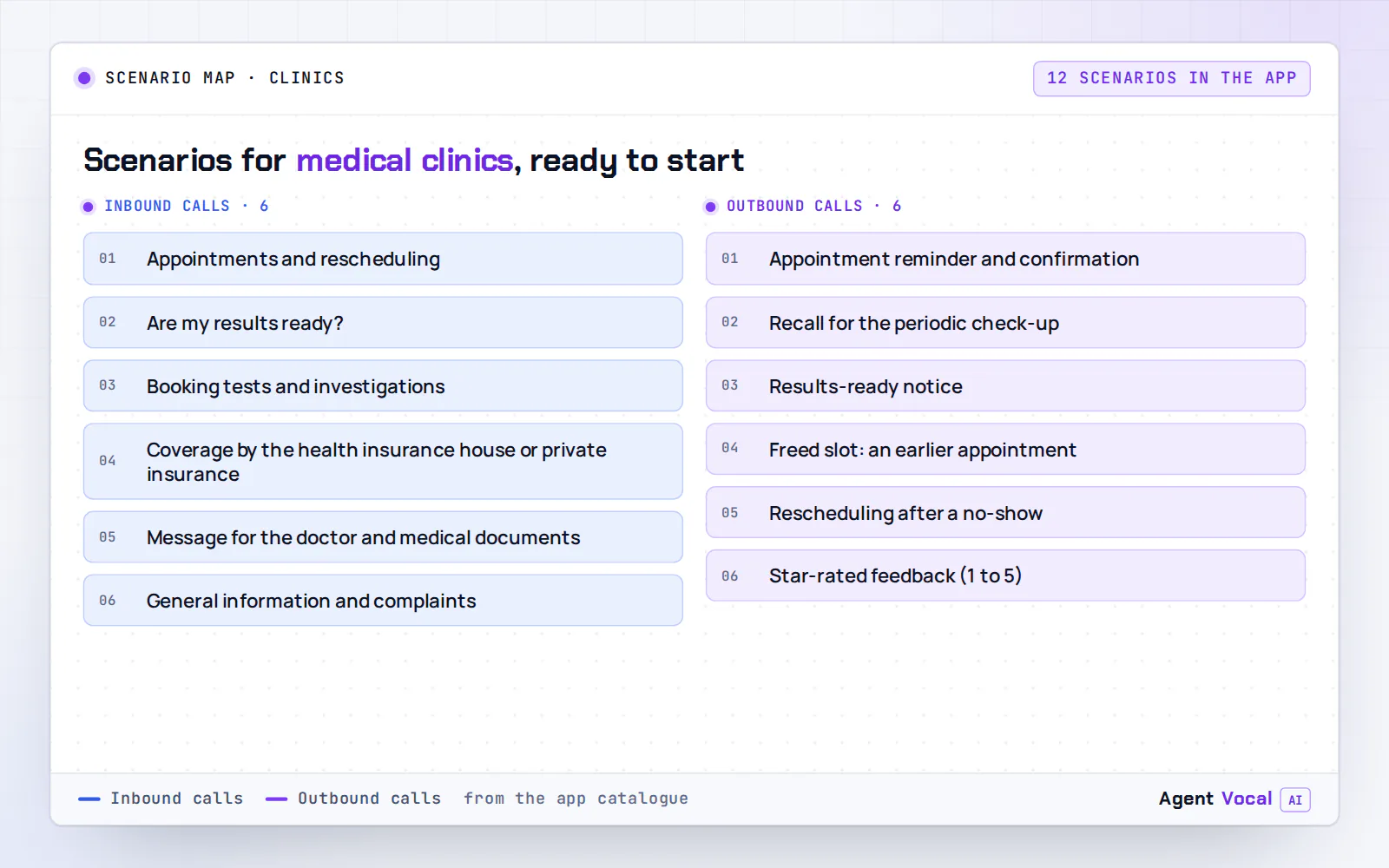
The AI voice agent covers both the calls that come from patients and the ones it makes itself, following your rules. You choose them in the platform, at the industry and scenarios step, and switch on only the automation your clinic needs right now. If your main concern is the diary, see also the guide on AI appointment booking by phone.
Incoming calls
- Appointments and rescheduling: the patient calls for a new appointment, a reschedule or a cancellation. The agent offers free slots from the clinic calendar, confirms and notes the data. The calendar no longer double-books and no longer depends on who picks up.
- Are my results ready?: the patient wants to know whether their tests are ready and how to get them. The agent says only whether they are ready and how to collect them, without stating or interpreting values. The front desk is spared dozens of such calls a day.
- Booking tests and investigations: the patient wants an ultrasound, an X-ray or other tests, paid or with a referral. The agent offers free slots and gives the preparation from the knowledge base. The patient arrives correctly prepared.
- Coverage by the health insurance house or private insurance: the patient asks whether a service is covered by the national house, with a referral, or by their private insurance. The agent answers from the knowledge base and notes what needs checking. You settle from the start who pays for what.
- Message for the doctor and medical documents: the patient wants to leave a message for the doctor, or asks for a medical letter, a prescription, sick leave or a copy of their documents. The agent notes the exact request and passes it on, with no medical advice. Nothing is lost on a sticky note.
- General information and complaints: questions about opening hours, address and parking, specialities and doctors, the fees in the service list and preparation for investigations. The agent answers from the knowledge base and logs complaints in full, for the team.
Outbound calls
- Appointment reminder and confirmation: a day or two before, the agent calls the patient, reminds them of the appointment and asks for confirmation. If they cannot come, it notes the reschedule, and the slot opens for someone else.
- Recall for the periodic check-up: the agent calls the patients whose doctor recommended a periodic check-up and offers free slots from the calendar. Patients no longer forget the yearly or six-monthly check.
- Results-ready notice: the agent calls the patient to say the results are ready and how to get them. It does not state or interpret their contents. The patient stops calling five times to ask.
- Freed slot: an earlier appointment: a slot opened earlier than the patient’s appointment, or for someone on the waiting list. The agent offers the slot and notes whether they accept it. The gaps in the diary fill themselves.
- Rescheduling after a no-show: the patient did not come to the appointment. The agent calls politely, without reproach, and offers free slots for a new appointment. A lost patient is recovered gracefully.
- Star-rated feedback (1 to 5): after the consultation or investigation, the agent asks 7 short questions, each rated from 1 to 5 stars, and notes the patient’s comments. You learn what bothers patients on their way through the clinic, in their own words.
The last two scenarios are there at almost every business, but here they are held to the discipline of a clinic: at General information and complaints the agent explains preparation for tests and coverage, and at Star-rated feedback (1 to 5) it asks about the waiting time and how the patient was received, without touching any clinical detail.
How does an appointment booked with the AI voice agent sound?
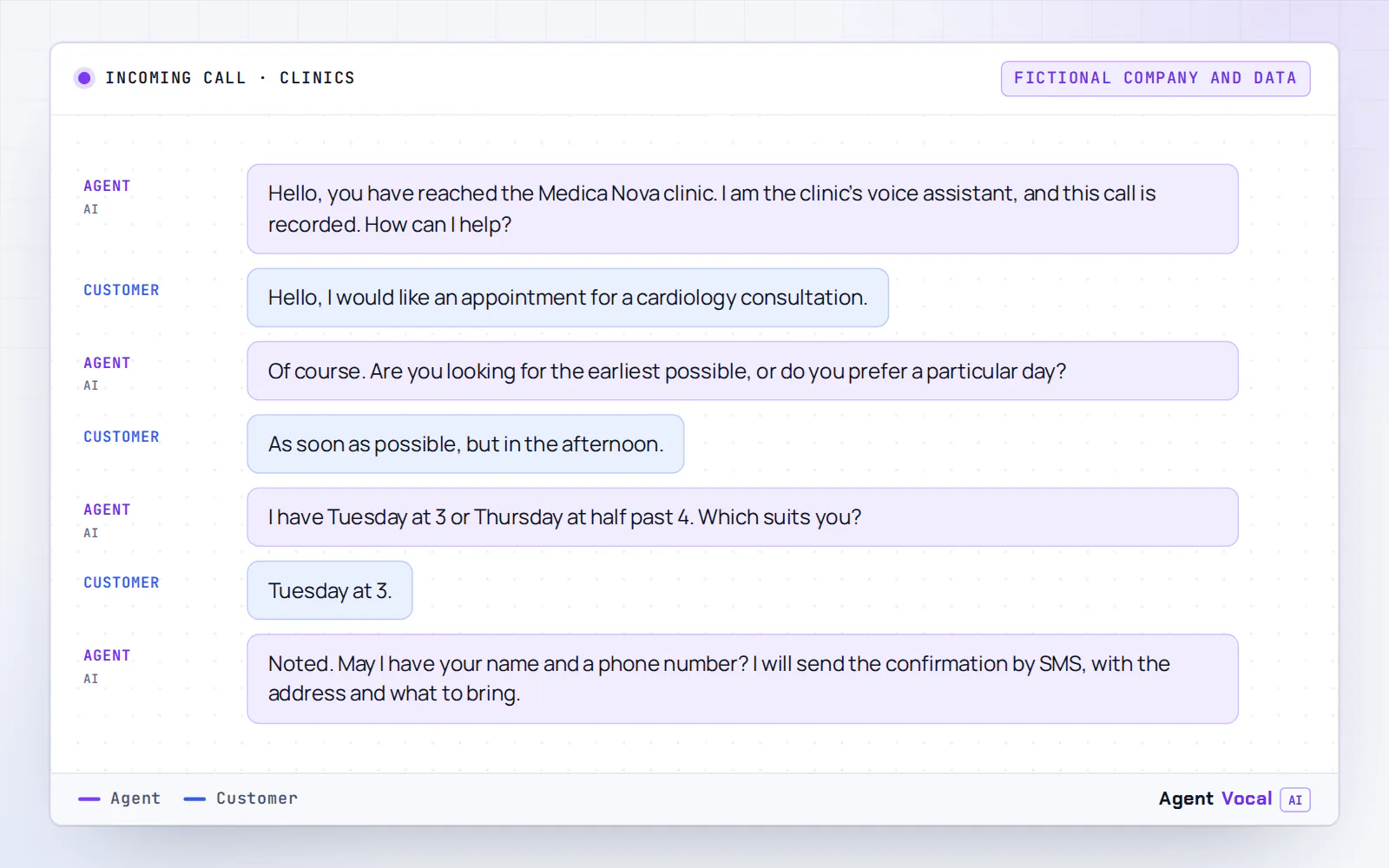
Break the call above into its steps. It answered on the first ring, introduced itself as a virtual assistant and said the call is recorded, as every AI voice agent in AgentVocal AI does. It asked which service the patient wanted and when it suited them, checked the free slots for that type of consultation, offered 2 or 3 times rather than a long list, and confirmed the chosen one. It noted the name and phone and sent the details by SMS. The slot locked in the calendar at once, so it cannot be given to anyone else. A receptionist facing three patients could not have done all that without leaving someone waiting. That is the quiet value of this AI voice assistant.
A day with the AI voice agent in a clinic
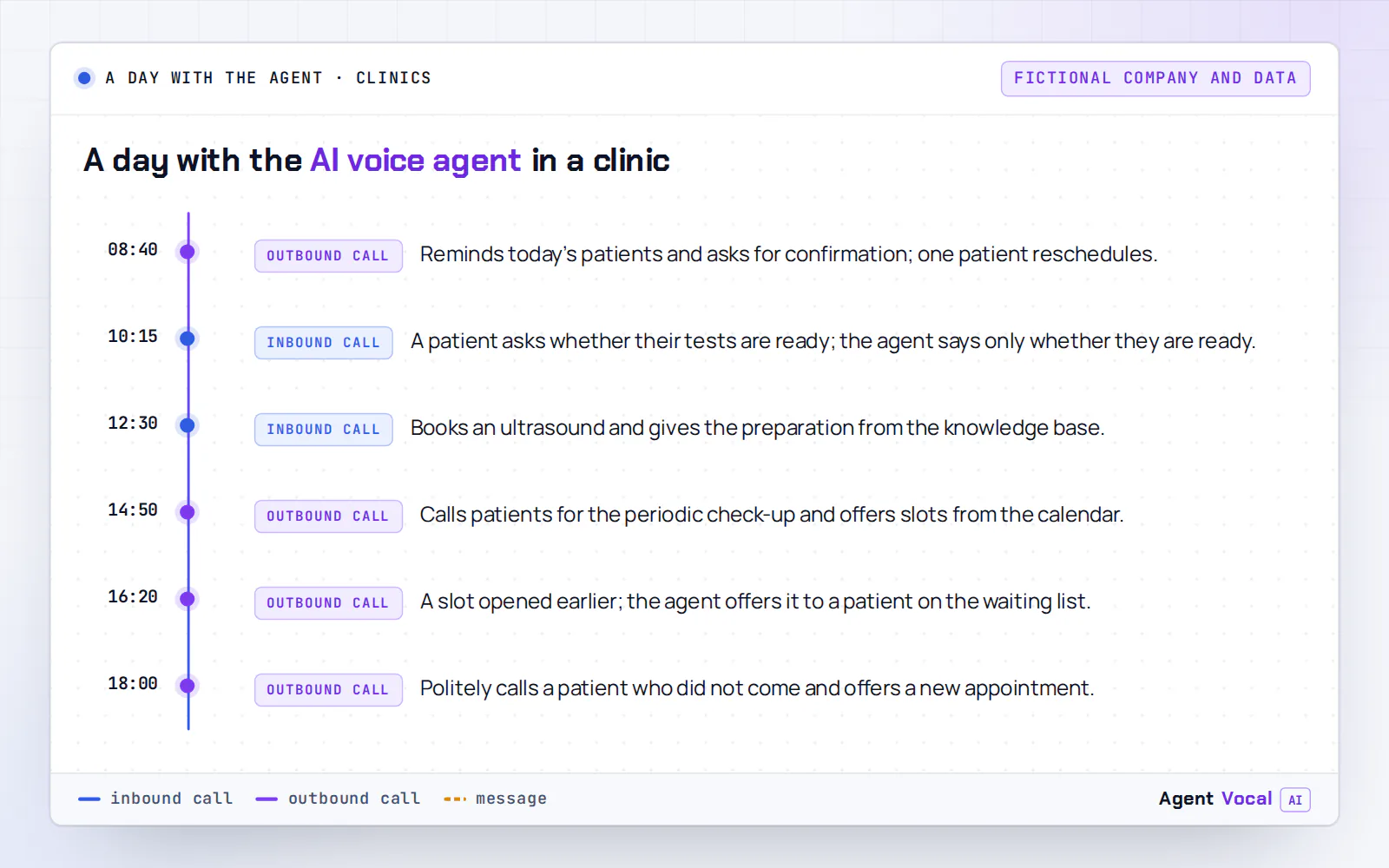
At Medica Nova, a fictional clinic with several doctors and its own laboratory, the morning starts with reminders: the AI voice assistant calls the patients booked for today and asks for confirmation, and one patient reschedules, so their slot opens on the spot. At noon, with the front desk overwhelmed, the agent takes an ultrasound booking and a question about results in parallel.
In the afternoon, a slot opens earlier, and the agent offers it to a patient on the waiting list. In the evening, once the clinic has closed, it politely calls a patient who did not show up and offers a new appointment. The next day, in the AgentVocal AI portal, every call has a recording, a transcript and a summary, and the diary is full, with no gaps. The automation kept the phone open even when the front desk no longer could.
What does a clinic gain by automating its scheduling?
For a clinic, the gain shows up in the diary and in the calm at the front desk:
- no patient with a busy tone: the agent answers in parallel, 24/7, and takes the after-hours calls;
- fewer no-shows: reminders and confirmations go out in time, and freed slots are given back;
- a full diary: earlier slots and reschedules fill without anyone lifting a finger;
- the front desk breathes: the repeated questions about hours, preparation and results no longer fall on people;
- everything in the portal, with a recording, a transcript and a summary, plus WhatsApp, SMS or email messages, an answer in less than a second and 84 languages available.
An AI voice assistant does not “guarantee” a lower no-show figure; it does something concrete: it calls each patient in time and keeps the line always free. All this automation sits in the AgentVocal AI portal. See the full flow in the clinic appointment booking scenario.
In a clinic, an unannounced free slot is lost twice: the patient who would have come was not called, and the one who does not come was not asked. An AI voice agent closes both gaps.
What stays with the medical staff and what the agent will not do
An AI voice agent for clinics has firm limits, all the more so because this is about health:
- it does not give medical advice, does not diagnose and does not say “it is nothing serious”;
- it does not read or interpret results; it says only whether they are ready and how to collect them;
- it makes no exception to your rules and does not book services it does not know;
- it does not pretend to be human or a doctor: it introduces itself as a virtual assistant and says the call is recorded;
- it honours “do not call me again” on outbound calls and the time slots you set.
The consultation, the diagnosis and the medical decisions stay, naturally, with the doctors. AI voice agents handle the phone, not the patient.
What to prepare before starting the agent in a clinic
The more clearly you describe the clinic, the better the agent books:
- the calendar: the doctors, the specialities, the duration of each service, the time slots and how far ahead;
- the knowledge base: hours, address, parking, fees from the list, preparation for investigations, coverage rules;
- the lists for outbound calls: patients to remind, to recall for a check-up, who did not show up;
- the connections: the calendar, the message channels and, if you have one, the clinic system;
- the time slots in which the agent may call patients.
You have details about connections on the integrations page, and about recording and patient data on the security page.
How do you start the AI voice agent in a clinic, step by step?
The setup is down to you, not to us: you work through the steps yourself in the platform, and the team only approves the account, within 24 hours at most. If you want the overview first, see how it works.
- Prepare the clinic calendar, the knowledge base and the frequent answers.
- Register and work through the 9-step guide: company, industry and scenarios, modules, price, connections, agent and voice, the phone number assigned automatically, lists and schedule, test call. In a real test, the technical setup took 4 minutes and 38 seconds.
- Make a few test calls: book yourself, reschedule, ask whether some results are ready.
- Start with a single scenario, for example the after-hours appointments, then expand.
The full steps are in the launch checklist. To hear how a call sounds, listen to the demo.
Test an AI voice agent on your own clinic’s appointments
The most convincing test is on your own appointments, not on a generic demo. Create an account on our site, at Create your account: the account takes a few minutes, and the form shows you the estimated cost for your front desk’s call volume from the start. You pick the clinics industry and the scenarios above that you need, from appointments and rescheduling to the reminders before the visit, and you get the 9-step guide, with the clinic calendar, the agent’s voice and the phone number assigned automatically.
You make the first test call from your own phone, before the agent calls a single patient: ask for an appointment with a particular doctor, at an hour that is already taken, reschedule yourself, ask whether some tests are ready and request a medical letter. You listen to the recording, read the summary and check that the appointment appeared in the calendar. You see with your own eyes that the agent gives no medical advice and reads no results. If it suits you, you start with the after-hours calls, on your real patients.
How much does an AI voice agent for a clinic cost?
You pay per minute of conversation, rounded up on each call, plus a one-off setup per channel. The only calls that are not charged are the ones nobody answers; voicemail is charged as a normal minute. For a clinic, each free slot recovered through a reminder or a reschedule usually covers many minutes of calls. The exact figures are on the pricing page, and for context on your trade start from the medical clinics industry page. For feedback after the visit, see the phone surveys and feedback scenario; a well-configured AI voice assistant from AgentVocal AI pays for itself out of the diary that stays full.