In this guide10 sections
- 01Why do brokers let policies and claims slip away?
- 02Which insurance calls can an AI voice assistant cover?
- 03How does a claim notification call sound?
- 04A day with the AI voice agent at an insurance brokerage
- 05What does renewal automation bring a broker?
- 06Where people stay in charge, and what the agent won’t do
- 07What to prepare before the first renewal campaign
- 08Starting a voice agent at an insurance agency, step by step
- 09Test an AI voice agent on your own policies and claims
- 10How much does an AI voice agent for insurance cost?
An AI voice agent for insurance is an AI voice assistant that answers the phone at a broker or an agency, takes quote requests and claim notifications, reminds customers about expiring policies and keeps in touch with them on claim files. In short, it is phone automation that lets no policy expire unnoticed and no file sit idle for want of a document. With AgentVocal AI, a voice agent can call dozens of customers a day, politely and on time, and every call it handles is saved in your portal.
Below you will find the full map of what an AI voice assistant can take over in insurance, a sample call, an ordinary day at an agency and the parts that rightly stay with the consultant. The examples are drawn from a broker’s daily work, around a fictional business.
Why do brokers let policies and claims slip away?
An insurance broker rarely loses customers through idleness; the losses come from having too many things to hold in mind at once. Two of them hurt most: policies that expire unnoticed and claim files that sit idle because a document is missing. Both need a call made on time, and time is exactly what the consultant does not have, caught between meetings, quotes and notifications.
In insurance, the phone has a rhythm of its own:
- motor and optional policies that expire, with the customer going to another broker if they are not called in good time;
- claim files blocked by missing documents, dragging on for weeks without anyone calling;
- the same questions repeated about the steps of a notification, the documents needed and how a policy is paid;
- customers who call for a quote and give up if nobody picks up.
An AI voice assistant does not stand in for the consultant, but it takes on the repetitive part: it reminds, informs, notes the notification and asks for the missing documents. Every call gets an answer, and no policy expires in silence.
Which insurance calls can an AI voice assistant cover?
Each scenario below is built ready in AgentVocal AI; you tick it at the “Industry and scenarios” step, and the voice agent takes it on exactly so. You switch on all the scenarios, or only the ones you need today. See also the dedicated page for insurance.
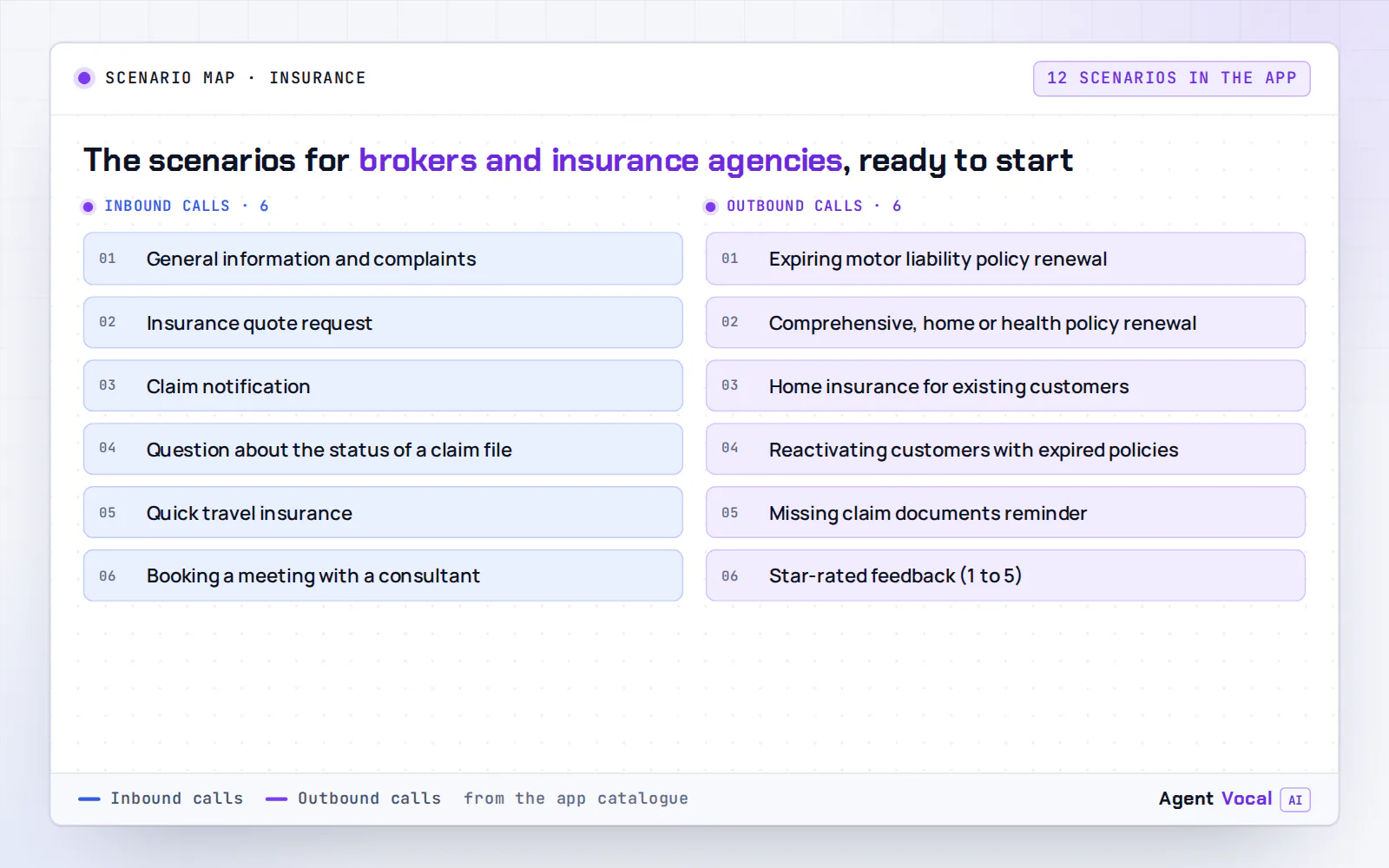
Incoming calls
- General information and complaints: the office address and hours, the types of insurance offered, how a policy is paid, how the policy is received by email, all from the knowledge base. Complaints are logged in full for the team.
- Insurance quote request: the customer wants a quote for motor liability, comprehensive, home, life or health insurance. The voice agent finds out the insurance type, the insured item and the basic details, with no sensitive data, for a consultant.
- Claim notification: after an accident, a flood, a theft or another event, the agent notes the event details to open the file and states the steps and documents from the knowledge base, without assessing the claim.
- Question about the status of a claim file: the customer asks how far the file has got. The agent notes the file details and the question, and the consultant comes back with the exact status. The agent does not guess or invent a status.
- Quick travel insurance: the customer is leaving soon and wants travel medical or cancellation cover. The voice agent notes the destination, the dates and the people, so a consultant sends the quote quickly.
- Booking a meeting with a consultant: for life or health insurance or the company’s policies, the customer wants to talk to a person. The agent offers free slots from the calendar and fixes the meeting.
Outbound calls
- Expiring motor liability policy renewal: a few days or weeks before expiry, the agent reminds the customer that the motor liability policy is expiring and finds out whether they want the renewal offer. No renewal slips by unnoticed.
- Comprehensive, home or health policy renewal: the agent reminds the customer that the optional policy in the brief is expiring and finds out whether they want to renew, with or without changes.
- Home insurance for existing customers: the voice agent calls customers who already have a policy, for example motor liability, and asks whether their home is insured too. If they are interested, it notes the basic details for a quote.
- Reactivating customers with expired policies: the agent calls former customers whose policies expired without renewal, finds out whether they still need insurance and notes the interest for a new quote.
- Missing claim documents reminder: the agent calls the customer with an open claim file and reminds them of the documents still missing, exactly as in the brief, so the file can move on.
- Star-rated feedback (1 to 5): after the policy is issued or the claim is settled, the agent asks 7 short questions, each rated from 1 to 5 stars, and notes the customer’s comments. See a phone feedback survey.
How does a claim notification call sound?
On the phone, an AI voice assistant holds a normal conversation, not a keypad menu. It understands the customer’s request and does exactly what it is allowed to do, without promising what it does not know.
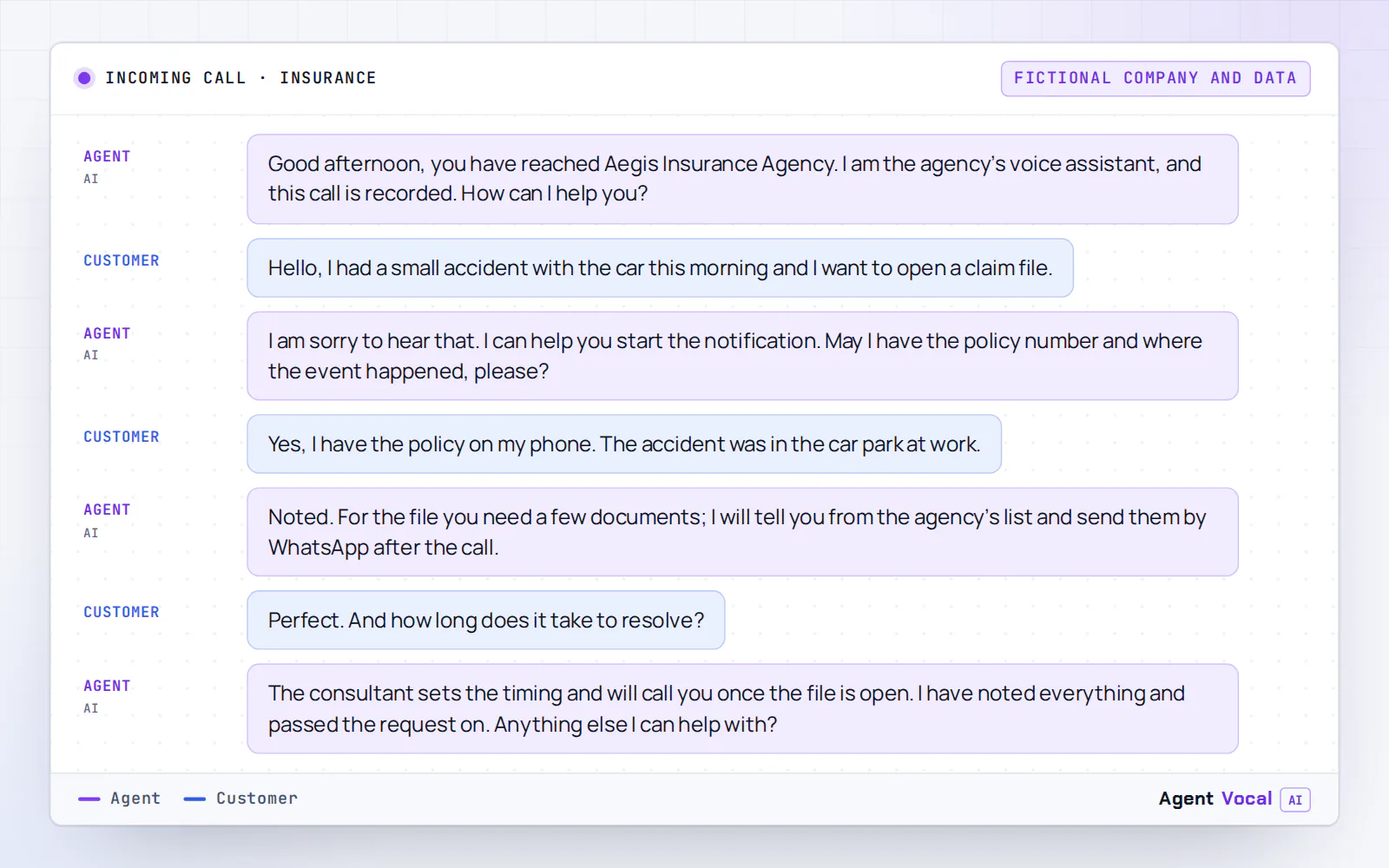
Follow what the agent did, line by line. It introduced itself as the agency’s voice assistant and said the call is recorded. It listened to the customer with empathy, noted the event details to open the file and stated the documents needed from the knowledge base. When the customer asked how long it takes, the agent did not invent a date: it said honestly that the consultant sets the timing and passed the request on. In the portal it leaves the recording, the transcript and the summary. That way, AgentVocal AI takes the full notification, and the consultant gets a file already noted, not a scribble on the go.
A day with the AI voice agent at an insurance brokerage
Watch how the automation works on an ordinary day at Aegis Insurance Agency (a fictional business), a small broker with two consultants always out in the field.
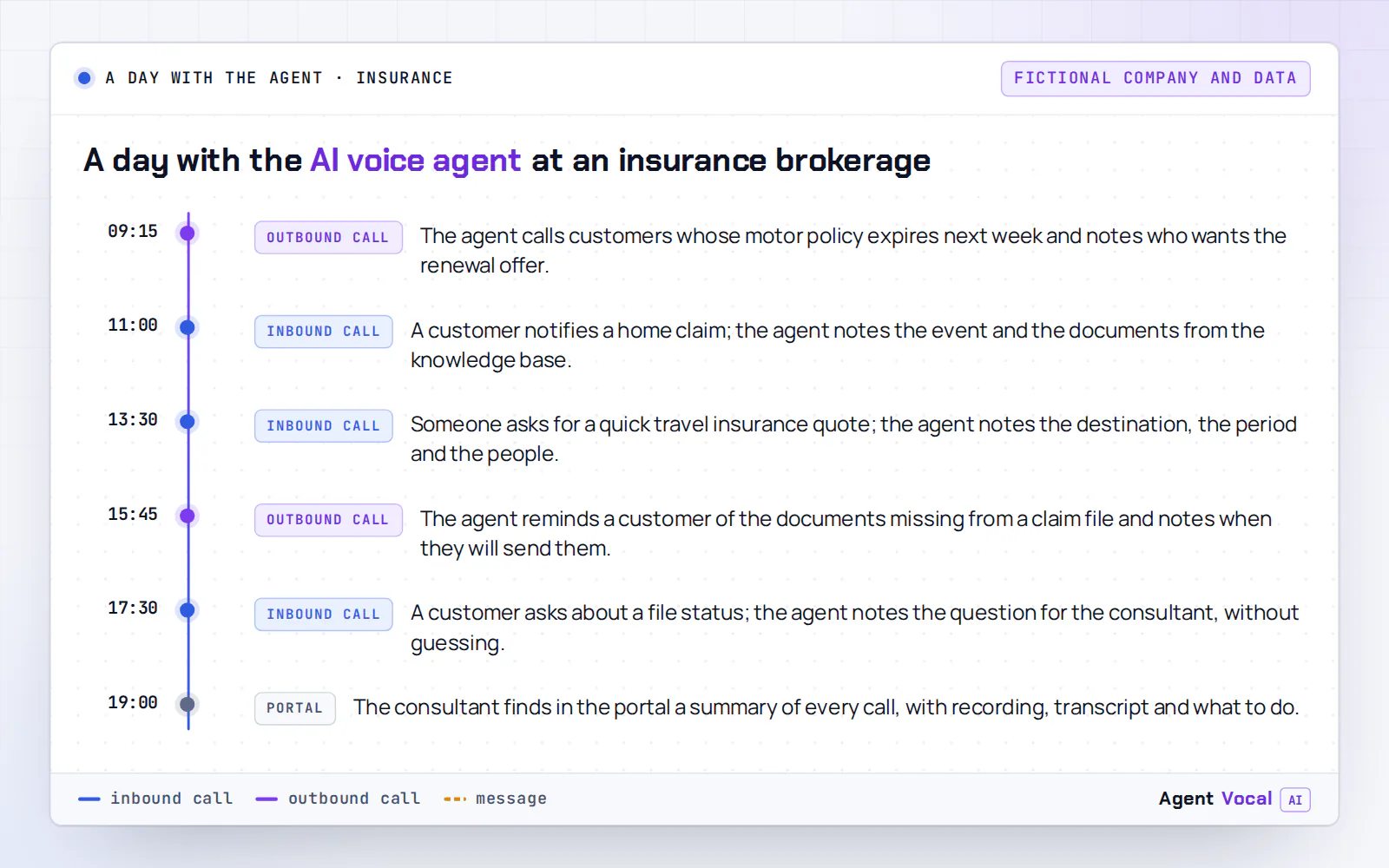
In the morning, while the consultants are in meetings, the voice agent calls customers whose motor policy expires next week and gathers who wants the renewal offer. At midday it takes a home claim notification and notes a travel insurance request. In the afternoon it reminds a customer of the documents missing from their claim file and notes a question about a file status, which it leaves for the consultant. In the evening, in the portal, the consultant finds a summary of every call, with recording and transcript, and sees at a glance what to do the next day. No policy expired unnoticed, and no file sat idle.
What does renewal automation bring a broker?
On an insurance desk, automation with AgentVocal AI changes things you can measure on the renewal list:
- No lost policy: customers are reminded of motor and optional renewals in good time, before they move to another broker.
- Files that move forward: missing documents are asked for on time, so claim files no longer sit for weeks for want of a call.
- No missed call: the agent answers in parallel, however many customers call, and after hours too, when people have time.
- People for what matters: the consultant is freed from the repetitive part and is free for negotiation, advice and the delicate cases.
- A trail for every file: the call stays in the portal with recording, transcript and summary, linked to the customer.
- 84 languages: customers from abroad, and anyone taking out travel cover, are served in their own language.
- No dead air: the agent answers in less than a second, naturally, with no awkward pauses.
The strength of an insurance agent lies in the lists: expiring policies and files with missing documents, brought to the surface and called on time, not forgotten in a spreadsheet.
Where people stay in charge, and what the agent won’t do
In insurance, the limits matter a great deal, and an honest AI voice assistant states them from the start:
- It does not give advice and does not recommend a particular policy; it notes the need and passes it to the consultant.
- It does not assess the claim and does not promise amounts or settlements; it notes the notification and the steps from the knowledge base.
- It does not interpret clauses and does not state the exact status of a file it does not have; it notes the question for the consultant.
- It does not ask for sensitive data and does not finalise a policy itself; it gathers only the basic details for a quote.
- It does not pretend to be human: it introduces itself as a virtual assistant, states that the call is recorded, and respects ‘please do not call me again’.
What to prepare before the first renewal campaign
A good agent starts from clean data. Before you start, prepare:
- The knowledge base: the types of insurance, the steps of a claim notification, the documents needed, how a policy is paid and how it is received. The guide on how to prepare the knowledge base helps.
- The contact lists for the outbound calls: customers with expiring policies, files with missing documents, former customers for reactivation.
- The calendar for booking meetings with a consultant, with the available time slots.
- The connections: your CRM, the calendar, WhatsApp, SMS and the agency’s email. The list of possible integrations is on the integrations page.
- The time slots in which the agent may make outbound calls, so you do not ring customers at awkward hours, and the rules for ‘please do not call me again’.
Starting a voice agent at an insurance agency, step by step
Setup is self-service: you build it yourself in the platform, and we only approve the account, within 24 hours at most. The steps from the guide of 9 steps, adapted to a broker:
- Pick a single scenario at first, for example a motor liability renewal campaign.
- Prepare the knowledge base with the steps of a notification and the documents needed.
- Set up the calendar and the lists with the expiring policies and the files with missing documents.
- Register and go through the 9 steps: company from the tax registry, industry and scenarios, modules, price, connections, agent and voice, phone number assigned automatically, lists and schedule, test call. In a real test, the technical setup took 4 minutes and 38 seconds.
- Make a test call from your own phone: ask for a quote, notify a claim, simulate a reminder.
- Start with part of the calls and expand as your confidence grows.
Test an AI voice agent on your own policies and claims
Test it on your own policies and files, not on theory. You create an account in a few minutes at Create your account, and the estimated cost appears in the form as you fill it in. You choose the “insurance” industry and the scenarios above that fit you: policy renewals, claim notifications, missing-document reminders or quote requests.
After approval you get the guide of 9 steps, you set up the voice agent yourself, you upload the lists of expiring policies and you make the first test call from your own phone, before it calls any customer. You hear how an AI voice assistant sounds for your agency and you let it onto real calls only when you are happy. Nothing calls out to a real person before you decide.
How much does an AI voice agent for insurance cost?
The cost of AgentVocal AI for insurance is worked out per minute of conversation, rounded up per call, plus a one-off setup per channel. The only calls that are not charged are the ones nobody answers; voicemail is charged as a normal minute. You do not pay a fixed monthly sum, but for how much the voice agent actually talks with your customers, so the bill follows how many renewals and files you work. The full model is on the pricing page, and if you would rather hear it first, listen to the demo calls. That way the automation that reminds about policies and asks for missing documents stays predictable, and you decide at any time which scenarios you run and which time slots you use.