In this guide10 sections
- 01Why do home services firms miss calls while on site?
- 02What a voice assistant covers for home services: the scenario map
- 03How does a booking call with the AI voice agent play out?
- 04A day with the AI voice agent at a home services firm
- 05What do you gain by automating calls to the home?
- 06What remains with technicians and what the agent avoids
- 07What to get ready before your first home services call
- 08Starting an AI voice agent for home services, step by step
- 09Test an AI voice agent on your own home services needs
- 10How much does an AI voice agent for home services cost?
An AI voice agent for home services is a voice assistant that answers the phone while the plumber, electrician or cleaning crew is already on site: it books jobs, triages emergencies with safety steps, confirms visits and reminds inspections. As an AI voice assistant it notes the address and the problem correctly and leaves everything in the portal, with a recording and transcript. AgentVocal AI brings automation to the firm’s phone, so no customer ever hears a busy tone while the technician is up a ladder.
Home services live on a paradox: the phone rings most often exactly when the person who should answer has their hands full, under a sink or up a ladder. Below you will find what such a firm loses on each missed call, every scenario the agent takes over, a real call line by line and the steps to switch it on yourself.
Why do home services firms miss calls while on site?
A plumber, an electrician or a cleaning crew spend their day on the job, not next to the phone. When a new customer calls, the technician is in the middle of a repair and either does not hear it or cannot answer with dirty hands. A missed call usually means a lost customer: the person simply rings the next firm.
What slips away, concretely:
- new customers who give up after the first unanswered call and ring elsewhere;
- emergencies handled badly, because no one answered in time to state the safety steps;
- wasted trips, when the technician reaches an address where no one is home, because the visit was not confirmed;
- inspections and subscriptions forgotten, because nobody had time to call old customers back.
A voice assistant does not change the tap and does not do the cleaning. It takes the phone that always rings at the wrong moment: it books, confirms, reminds and triages emergencies, so the technician stays on the job.
What a voice assistant covers for home services: the scenario map
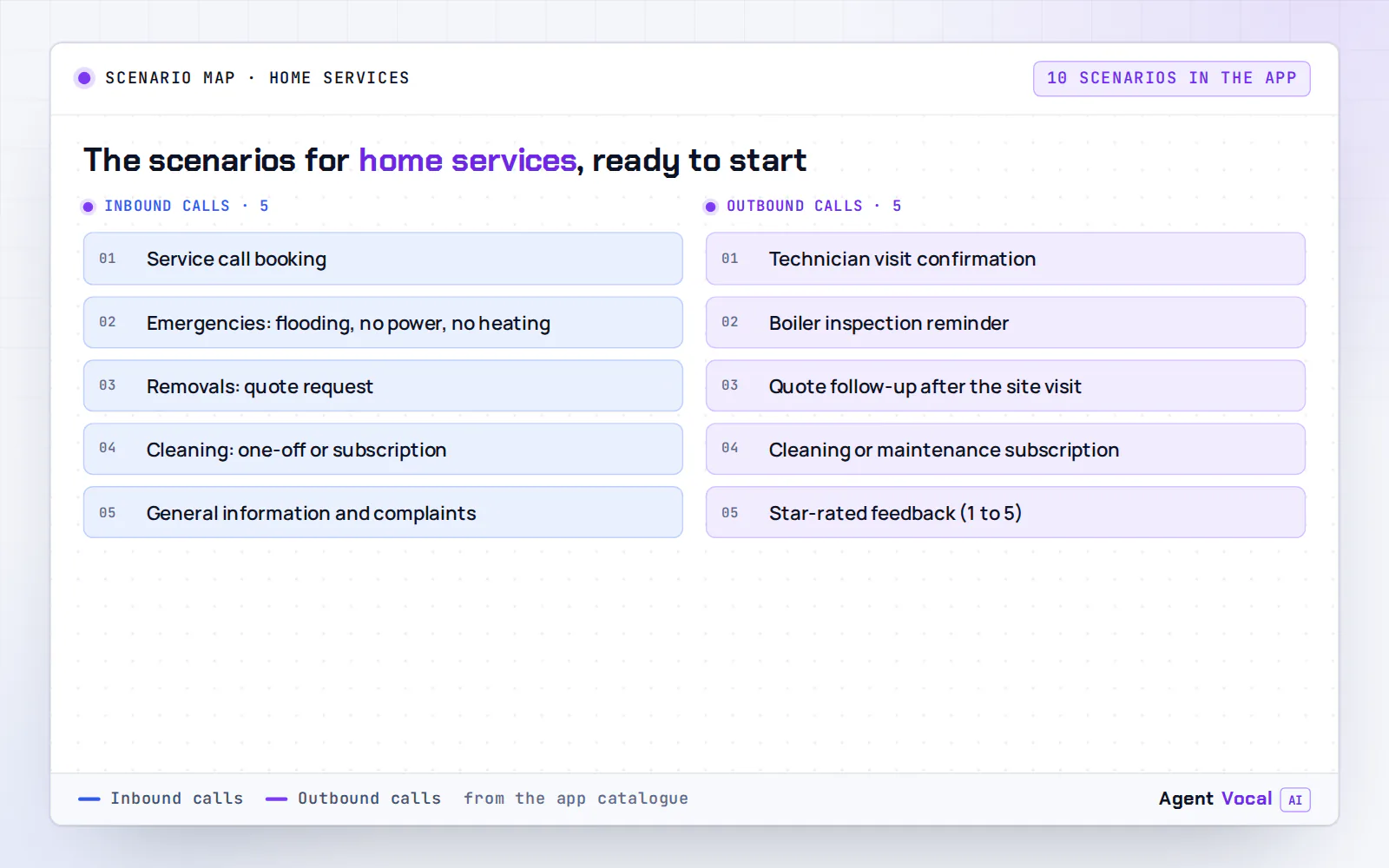
In AgentVocal AI, an AI voice agent for home services covers both the calls you receive from customers and the calls you make out to them, as a complete automation of the phone. Take the whole package or only the scenarios you need. Even on a busy day, the AI voice assistant keeps every line answered.
Incoming calls
- Service call booking: the customer calls for a plumber, an electrician, an appliance repair, an installation or a boiler, and the agent finds out the problem and the address and books the visit in a free slot. No call goes unanswered during a job.
- Emergencies: flooding, no power, no heating: the customer calls with an emergency, and the agent checks safety first, states only the safety steps from the knowledge base and passes the case to the on-call team. A frightened person gets calm guidance on the spot.
- Removals: quote request: the customer wants to move house, and the agent finds out the volume, the addresses, the floors and the lift, the desired date and the extra services, so a colleague prepares the quote. No request is lost on the way.
- Cleaning: one-off or subscription: the customer asks for a general clean, a post-renovation clean or a periodic subscription, and the agent finds out the area, the type of cleaning, the frequency and the date and books it or notes the quote request.
- General information and complaints: someone asks about the services offered, the areas served, the hours, the call-out fee or the workmanship guarantee, or raises a complaint. The agent answers from the knowledge base and logs complaints in full for the team.
Outbound calls
- Technician visit confirmation: the day before, the agent calls the customer, confirms the day, the time slot and the address and checks access. This is where the automation shows: dozens of visits confirmed in the morning, without the dispatcher calling each one.
- Boiler inspection reminder: the agent calls customers whose yearly boiler inspection is due, reminds them of the deadline and proposes an appointment. The records stay alive, and the firm stops losing sure work.
- Quote follow-up after the site visit: after the on-site assessment and the quote was sent, the agent calls the customer, checks that it arrived and finds out whether they accept it. Quotes no longer die in an inbox.
- Cleaning or maintenance subscription: the agent calls customers who used the services once and proposes a periodic subscription from the firm’s offer. A happy customer becomes a regular one.
- Star-rated feedback (1 to 5): after the home service, the agent asks 7 short questions, each scored from 1 to 5 stars, and notes the customer’s comments. You learn first-hand what worked and what did not, from the person who stood face to face with the technician.
In home services, the first call answered wins the customer. That is why an AI voice agent that always answers, even when every technician is on site, shows up in the number of jobs done.
How does a booking call with the AI voice agent play out?
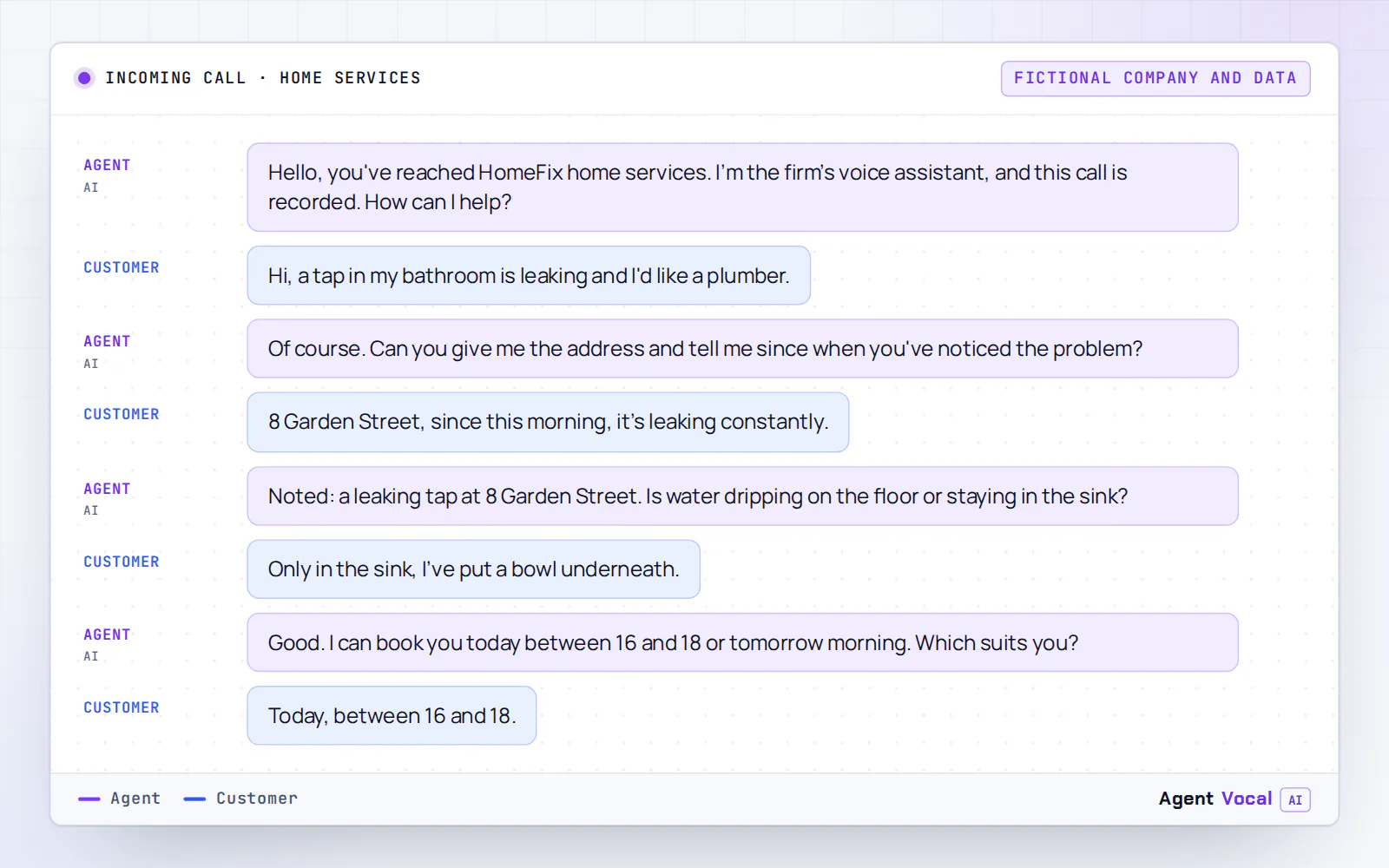
In the call above, a customer rings about a leaking tap. An AI voice assistant from AgentVocal AI introduces itself as a virtual assistant and says from the start that the call is recorded. It finds out the problem and the address, then asks a simple question about severity, whether water is dripping on the floor or staying in the sink, so the team knows how urgent it is. It repeats what it noted and offers two or three slots, not a long list.
After the call, the customer gets the confirmed slot and the access details by WhatsApp, SMS or email, and in the portal the call keeps the recording, the transcript and the summary. The agent did not estimate the repair price, which only the plumber can give after seeing the problem, and did not pretend to be human. It did exactly what it should: noted things correctly and fit the person into the schedule.
A day with the AI voice agent at a home services firm
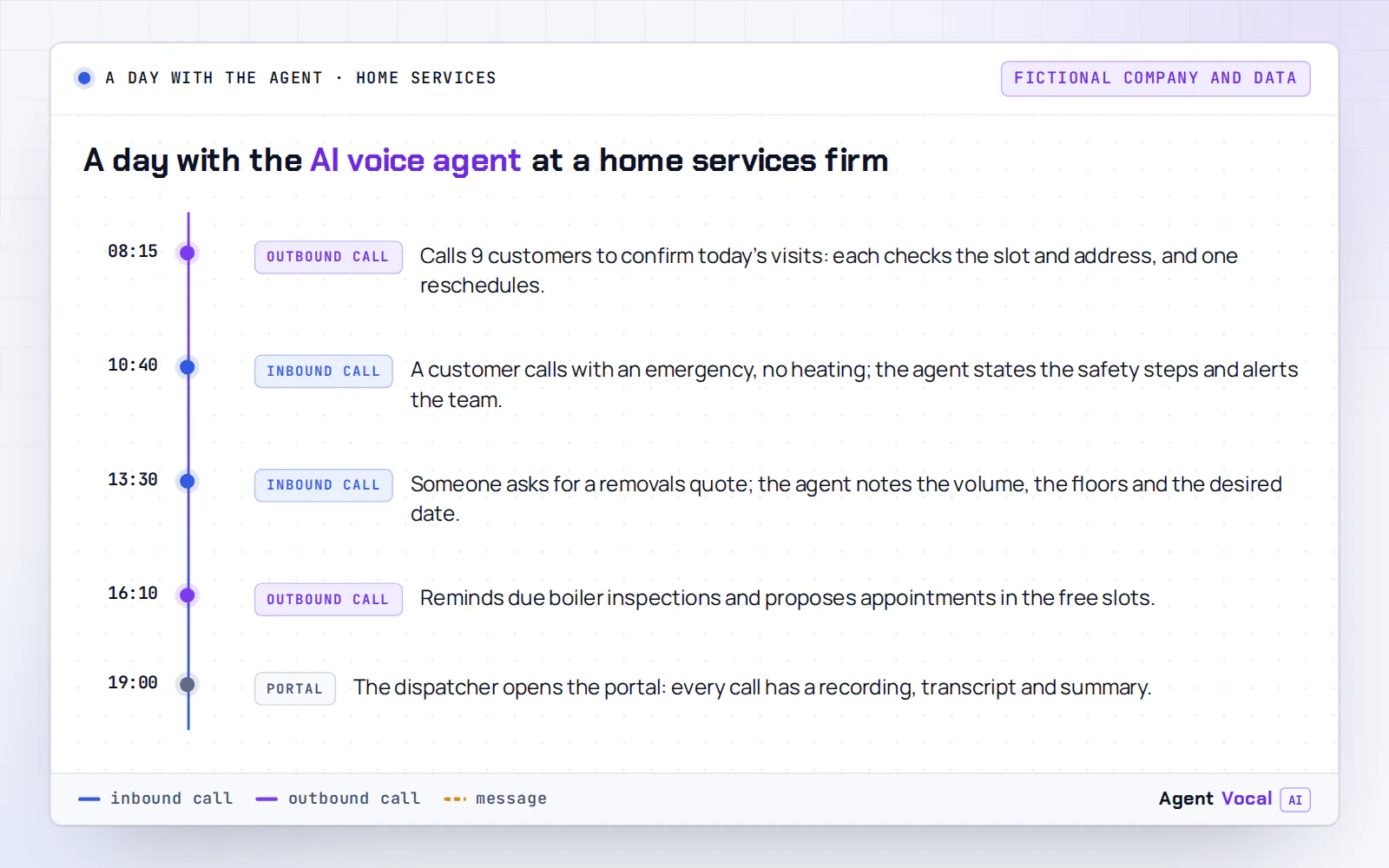
At the fictional HomeFix firm, which uses AgentVocal AI, the morning starts with confirmations: the agent calls the customers booked for today, confirms the slot and the address and checks access. The technicians set off with a realistic schedule, not with addresses where no one is home.
Through the day, the AI voice agent takes a no-heating emergency, where it first states the safety steps and alerts the team, then a removals quote request, and reminds the due boiler inspections. In the evening, the dispatcher opens the portal and finds every call with a recording, transcript and summary. No customer heard a busy tone, even though every technician was on site all day. Because each request stayed noted correctly, the next day the team starts with a clear plan, not with scribbled slips and calls forgotten on the road.
What do you gain by automating calls to the home?
For a firm that lives on call-outs, the gain is measured in trips that are no longer wasted and customers who no longer leave for a competitor. An AI voice agent for home services brings this through concrete things, not promises:
- No missed call: new customers get an answer even when the whole crew is on site, so they do not leave for a competitor.
- Emergencies triaged correctly: the safety steps stated at once and the case passed to the team, with no improvising.
- Trips saved: visits confirmed in advance mean fewer empty journeys.
- Customers brought back: inspections, subscriptions and pending quotes are called with a simple automation scenario.
- Everything in the portal: every call has a recording, transcript and summary; after-call messages go out by WhatsApp, SMS or email.
- 84 languages: the agent speaks to any customer in their own language and answers in less than a second.
We promise no figures and invent no numbers. The AI voice assistant does one clear thing: it keeps the phone open while the crew works. How it books, concretely, is in the guide on AI appointment booking by phone, and the messages sent after each call are in the follow-up after a call scenario.
In short, here is when a few of the scenarios trigger and what stays written in the portal after each call:
| Scenario | When it triggers | What stays in the portal |
|---|---|---|
| Service call booking | When the customer calls with a problem | The problem, the address and the slot booked for the technician |
| Technician visit confirmation | The day before the visit | Whether someone is home, the access checked and any reschedule |
| Boiler inspection reminder | When the yearly inspection is due | Whether the customer wants an appointment and for when |
| Quote follow-up after the site visit | After the quote was sent | Whether they received it and whether they accept or have questions |
The table is only a starting point; the scenarios you switch on depend on your trade, from installations to cleaning. What stays the same everywhere is the trail in the portal: every call has a recording, transcript and summary, so the dispatcher no longer rebuilds from memory what a customer asked three days ago.
What remains with technicians and what the agent avoids
We say plainly what an AI voice agent does not do in home services:
- It does not give technical advice in an emergency; it states only the safety steps from the knowledge base and calls the team.
- It does not estimate the price of a repair or a job without what the technician sees on site.
- It does not do the work; the physical part, from diagnosis to repair, stays with the technician.
- It does not pretend to be human: it introduces itself as a virtual assistant and announces the recording.
- It respects “do not call me again”: the request is noted and honoured at once.
The agent is the voice on the phone, not the person with the toolkit. See how you prepare the right answers in the guide on the knowledge base.
What to get ready before your first home services call
For the agent to work well, you give it the firm’s information:
- The knowledge base: the services, the areas served, the call-out fee, the workmanship guarantee and the safety steps for emergencies.
- The calendar: the technicians’ schedule, the length of each job and who can be sent where.
- The contact lists: the customers to call for visit confirmation, inspections and subscriptions.
- The connections: the link to your work system or the firm’s files, so the outcome of each call lands where it should. See integrations.
- The time slots: when outbound calls go out, so you do not ring people at the wrong hour. The agent can also speak other languages if you have foreign customers; see the languages available.
Starting an AI voice agent for home services, step by step
We do not send a technician to install the agent for you: you set it up yourself, and our team only approves the account, within 24 hours. You register with the cost estimate in sight, go through the nine-step guide, make a test call and start with a single scenario, for example service call booking, before you add emergencies and reminders. In one real test, the technical setup of a complete agent took 4 minutes and 38 seconds, about as long as it takes a dispatcher to note three bookings. The detailed steps are above. If you want to see the mechanism first, read how it works.
Test an AI voice agent on your own home services needs
To know whether an AI voice agent fits you, try it on your real call-outs, not on a generic example. You create an account in a few minutes at Create your account, see the cost estimate in the form, choose the home services industry and tick your own scenarios, from service call booking and emergencies to visit confirmation and inspection reminders.
Then you get the nine-step guide, set up the agent yourself and make the first test call on your own phone, before the agent calls a single real customer. You hear how it takes an emergency with your own safety steps or how it confirms a visit, with your areas and your rules. We promise no result: we give you an AI voice assistant you shape to your needs and check before you switch it on.
How much does an AI voice agent for home services cost?
You pay per minute of conversation, rounded up on each call, plus a one-off setup per channel. The only calls that are not charged are the ones nobody answers, and voicemail is billed as a normal minute. For a small installation or cleaning firm, that means you pay for real conversations, not for the phone ringing into the void. The full model is on the pricing page, explained at length in the guide on how much an AI voice agent costs. The automation with AgentVocal AI stays predictable to pay for. For the industry page, go to home services.