In this guide10 sections
- 01Why do lenders and finance firms lose calls and time on the phone?
- 02What an AI voice assistant handles in a finance firm: the scenario map
- 03How does a respectful instalment reminder sound, step by step?
- 04A day with the AI voice agent at a finance firm
- 05What does a finance firm gain from automation?
- 06What stays with your loan advisers, and what the agent never does
- 07What to prepare before the first reminder call
- 08Starting your voice agent in a finance firm, step by step
- 09Test an AI voice agent on your own financial cases
- 10How much does an AI voice agent cost for a finance firm?
An AI voice agent for a finance firm is an AI voice assistant that answers the phone and makes calls in place of your team: it politely reminds customers of due instalments, asks for the documents missing from a file, qualifies loan requests and answers questions, always calm and compliant. In short, the voice assistant from AgentVocal AI takes over the repetitive part of the phone, while decisions stay with people. This automation works around the clock, in each customer’s own language.
In finance, how you say something matters as much as what you say. A reminder delivered badly frightens the customer; the same reminder said calmly brings them to pay. Below: where a lender gets stuck on the phone, how each scenario works, how a correct reminder call sounds, and where the agent stops so the decision stays with an adviser.
Why do lenders and finance firms lose calls and time on the phone?
A lender, a pawnshop or a leasing office lives on two things over the phone: instalments that must be reminded on time, and files that must be completed. Both are repetitive, and both stall easily:
- forgotten instalments, because no one has time to call every customer before the due date;
- files on hold because of one missing document that nobody asked for in time;
- incoming calls after hours, when people finally have a minute to ask about a payment or a certificate;
- identical conversations about documents and payment methods that eat up an adviser’s day.
An AI voice assistant does not solve everything, but it takes exactly the mechanical part: the polite reminder, noting the intention to pay, and asking for the documents that are missing. The rest stays with a person. This is automation applied with good sense, not pressure.
Money conversations call for tact. A colleague on the tenth call of the day can sound rushed, and the customer closes up; an AI voice agent keeps the same calm tone from the first call to the last and never improvises a promise. That is why this kind of automation fits polite reminders: it takes fatigue and haste out of the equation and leaves the customer feeling respected.
What an AI voice assistant handles in a finance firm: the scenario map
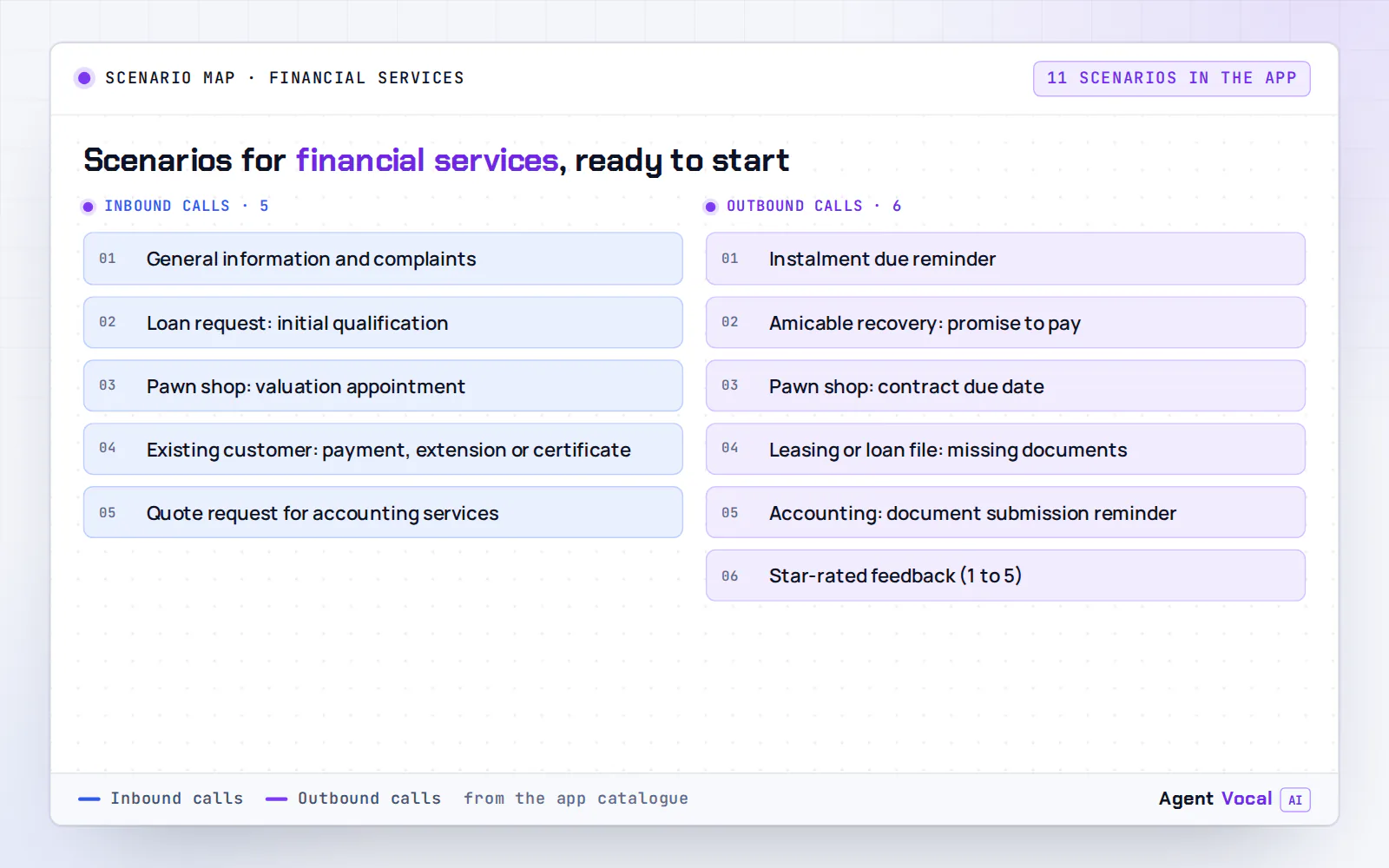
In financial services the scenarios split into what comes to you, the customers who call, and what you start, the reminders and document collection. Each has a narrow, compliant role: the agent reminds, notes and passes on, but decides nothing beyond your brief.
Incoming calls
General information and complaints. The customer calls with a question about credit, pawn or leasing products, the documents needed, payment methods or branch opening hours. The AI voice assistant answers from your knowledge base and records complaints in full for the team, so nothing is lost.
Loan request: initial qualification. The person wants a loan or a lease. The agent finds out the amount they want, the term and the general income situation, with no sensitive data, and passes the request to an adviser. It approves nothing and rejects nothing; it only prepares the conversation with the right person.
Pawn shop: valuation appointment. Someone wants to pawn an item, from gold to a phone, a laptop or a car. The agent notes the item, states the documents required from the knowledge base and books the valuation in a free slot in the calendar.
Existing customer: payment, extension or certificate. A customer with an active contract calls about an instalment, extending a pawn, a certificate or early repayment. The agent explains the general steps, notes the exact request and sends it to the colleague who carries it forward.
Quote request for accounting services. An entrepreneur is looking for an accountant. The agent finds out the legal form, the volume of documents, the number of employees and whether the firm is VAT registered, then passes on the full request so the quote can go out quickly.
Outbound calls
Instalment due reminder. The heart of this trade. The agent reminds the customer that the instalment is approaching its due date, or has passed it, and notes whether and when they will pay. No pressure, no threats, just a warm reminder at the right moment. This single piece of automation is often the first reason a firm starts.
Amicable recovery: promise to pay. The agent contacts the holder of an overdue amount, calmly states the situation from the brief and notes the date and amount the customer themselves proposes. It does not negotiate, does not promise discounts and never talks about writing off debt.
Pawn shop: contract due date. The agent reminds the customer that the term of the pawn contract is approaching and notes whether they want to extend it or redeem the item, so no one loses a deadline through inattention.
Leasing or loan file: missing documents. The agent tells the applicant that the file is incomplete, states exactly which documents are missing, from the brief, and notes when they will be sent. That way files no longer sit blocked for weeks over one forgotten page.
Accounting: document submission reminder. The agent reminds the accounting firm’s client to send the month’s paperwork, invoices, statements and receipts, by the deadline in the brief, and notes the answer.
Star-rated feedback (1 to 5). After an experience ends, the agent makes a short outbound call, asks seven questions scored from one to five stars and notes the customer’s comments. The full logic is in the phone surveys and feedback scenario.
For the full picture of the sector, see the page on the AI voice agent for financial services.
How does a respectful instalment reminder sound, step by step?
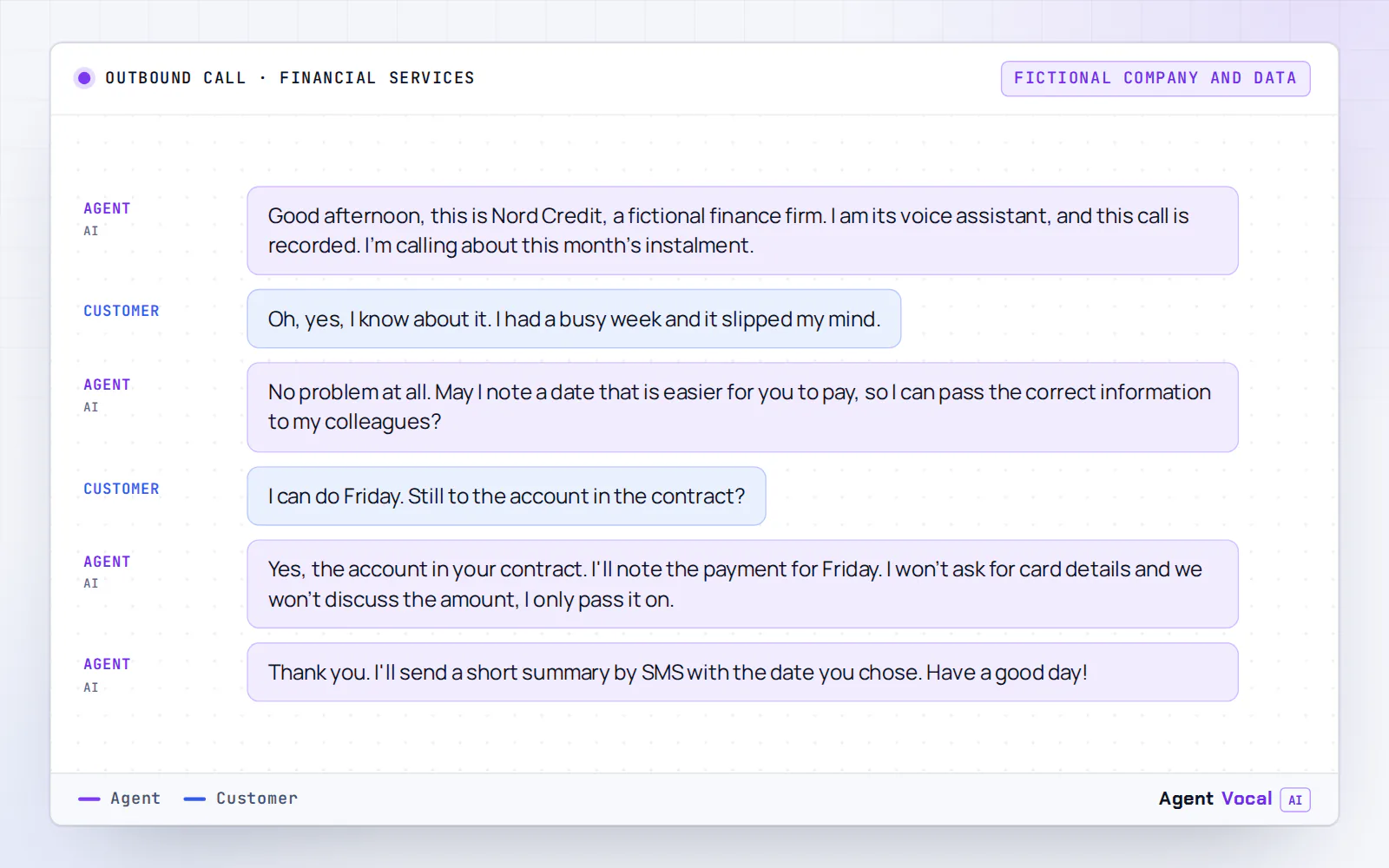
The dialogue above shows the right tone for finance. The agent introduces itself as a virtual assistant and states that the call is recorded, as the law requires. It reminds the customer of the due date without reproach, lets them explain and notes the payment date they propose, not one imposed. It does not ask for card details and does not discuss the amount. Afterwards the customer receives a summary by SMS with the chosen date, while the recording, transcript and outcome stay in the portal. An AI voice assistant from AgentVocal AI stays as calm on the hundredth call as on the first; this automation keeps respect in every call, even over a late payment.
A day with the AI voice agent at a finance firm
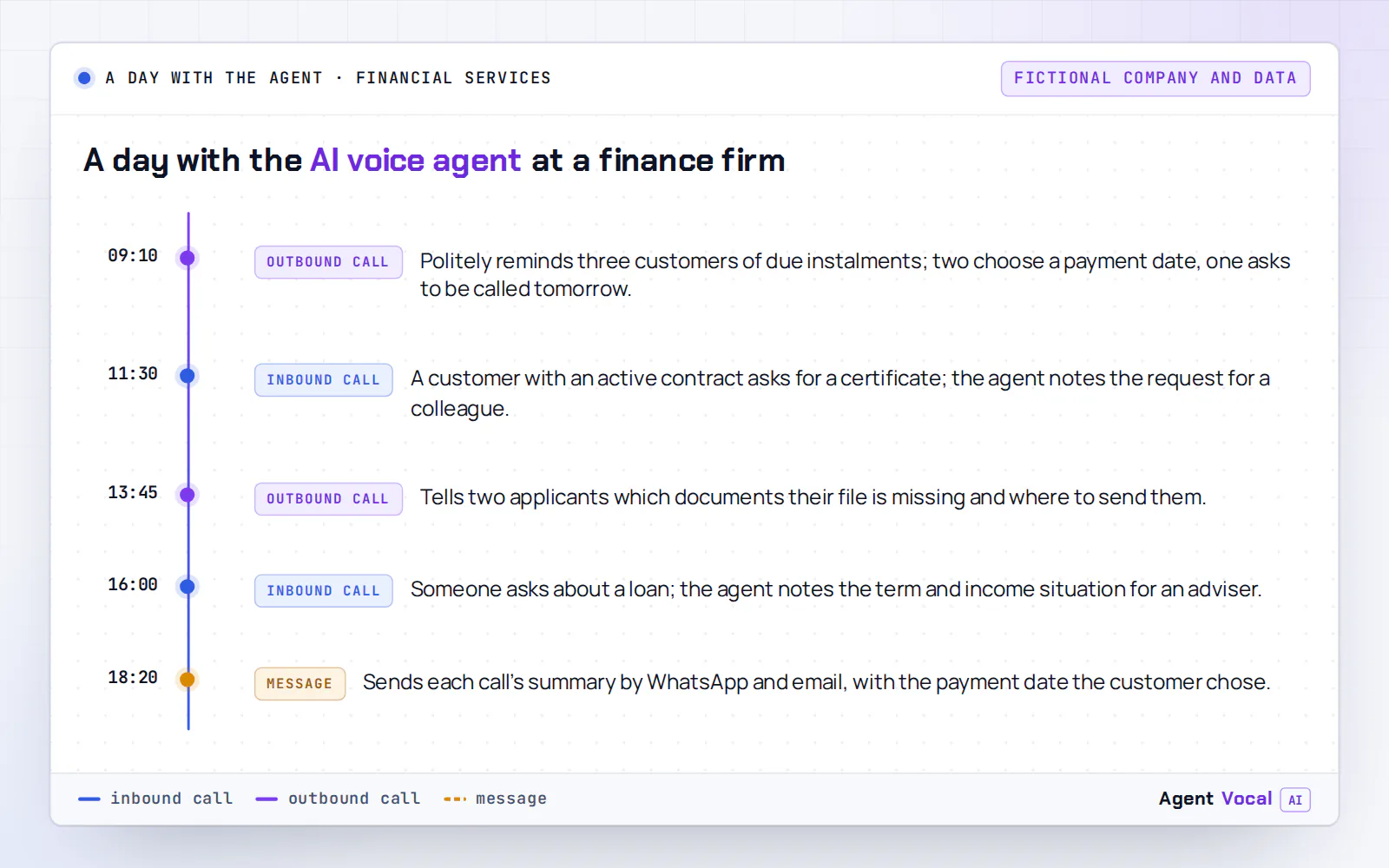
At Nord Credit, a fictional lender with a few branches, the morning starts with reminders: the AI voice agent calls the customers whose instalment is near its due date, listens and notes when they want to pay. One asks for a certificate, and the request reaches a colleague with every detail. After lunch the agent tells two applicants which documents are missing from their file, and in the evening the branch manager finds the summary of every call in the portal.
Between calls, the agent never mixes up cases: each customer has their own brief, contract and note. If someone asks not to be called again, the agent honours it at once and the number leaves the list. A customer who promises to pay on a given day gets a short confirmation message, so a written record of what was agreed remains. No one sat with the list all day, yet no customer was forgotten: the voice agent carried the repetitive part, and the advisers spoke only with the people who needed a decision.
What does a finance firm gain from automation?
In a lender’s office, the gain shows in customers called on time and files that no longer sleep on a desk. A well configured AI voice assistant from AgentVocal AI brings:
- no missed calls: the agent answers around the clock, after hours and at weekends;
- reminders on time, before an instalment or a pawn deadline is forgotten;
- unblocked files, because missing documents are requested at once, not two weeks later;
- colleagues freed from the mechanical part, left to handle the cases that need judgement;
- everything in the portal, with a recording, transcript and summary for each call;
- after-call messages by WhatsApp, SMS or email, with what the customer chose;
- a reply in under a second and 84 available languages.
An AI voice agent in finance does not push people towards payment; it makes their day easier with a polite reminder at the right moment. The tone is everything.
See how after-call messages are sent in the follow-up after call scenario, and how calls stay safe and compliant. Whatever the scenario, the trail in the portal is the same: a recording, a transcript and a summary with the payment date or the documents the customer chose, so no adviser has to rebuild a conversation from memory.
What stays with your loan advisers, and what the agent never does
Honesty is part of compliance. The AI voice agent has clear limits:
- it never negotiates rates, interest or discounts, and never promises to write off debt;
- it never threatens and never applies pressure; a reminder stays a reminder;
- it never asks for card details, passwords or codes;
- it neither approves nor rejects a loan; it notes the request for an adviser;
- it does not validate documents and does not interpret contract clauses;
- it does not pretend to be human: it introduces itself as a virtual assistant and states that the call is recorded;
- it respects “do not call me again” and requests not to be contacted.
Financial decisions stay with the advisers. The voice agent is only the calm voice that carries the repetitive part of the phone.
What to prepare before the first reminder call
An AI voice agent from AgentVocal AI is only as polite and correct as the information you give it. You prepare:
- the knowledge base: the products, the documents needed, the payment methods, the branch hours. How to write it well is in the guide on the knowledge base;
- the briefs for outbound calls: which instalment, which file, which documents are missing, worded neutrally and without pressure;
- the contact lists for reminders and amicable recovery, with the right customers and correct data;
- the connections with your CRM and ERP, so the outcome of each call reaches the right place. See what can be linked in integrations;
- the calling hours in which the agent is allowed to call, respecting people’s quiet time.
Starting your voice agent in a finance firm, step by step
You do not depend on anyone to start: you configure the agent yourself in the platform, and we only approve the account within 24 hours at most. If you first want the overall picture, see how an AI voice agent works.
- Choose a single scenario, for example due instalment reminders.
- Prepare the knowledge base with the correct answers about products and documents.
- Upload the lists and briefs, neutral and accurate.
- Register and go through the 9-step setup: company, industry and scenarios, modules, price, connections, agent and voice, a phone number assigned automatically, lists and working hours, a test call. In a real test, the technical setup of a complete agent took 4 minutes and 38 seconds.
- Make a few test calls from your own phone and check the tone.
- Start gradually, on one scenario, then expand.
The steps are the same ones in the launch checklist.
Test an AI voice agent on your own financial cases
The best way to see whether an AI voice agent fits your finance firm is to try it on your own cases, not a general example. You create an account in a few minutes at Create your account, where the form shows the estimated cost before you start, and you choose the financial industry and exactly the scenarios above, from due instalment reminders to the documents missing from a file.
After your account is approved, you receive the 9-step guide and configure an AI voice assistant yourself, with your own voice, language and hours. Then you make the first test call on your own phone: ask for a reminder, check the polite tone and see what the agent writes in the portal, before it calls a single real customer. Only when you are happy with how it sounds do you start it on a real list.
How much does an AI voice agent cost for a finance firm?
The model is simple: you pay per minute of conversation, rounded up per call, plus a one-time setup per channel. The only calls that are not charged are the ones nobody answers; voicemail is charged as a normal minute. You pay for the conversations actually handled, not a fixed salary. Exact figures are on the pricing page, and you can hear a real call on the demo page. This way automation in finance becomes a cost you control, not a surprise at month’s end. An AI voice agent from AgentVocal AI is, in essence, a colleague who forgets no customer and never oversteps the polite tone.