In this guide11 sections
- 01Why do dental practices lose calls, and what does it cost?
- 02What a dental voice assistant handles: the scenario map
- 03How does a dental emergency call sound with the AI voice agent?
- 04A day with the AI voice agent at a dental practice
- 05What does a dental practice gain through automation?
- 06When does each dental call start, and what stays in the portal?
- 07What stays with the dentist and what the agent will not do
- 08What do you prepare before launch at the practice?
- 09How do you start the AI voice agent at a dental practice?
- 10Test an AI voice agent on your own dental practice needs
- 11How much does an AI voice agent for dental practices cost?
An AI voice agent for a dental practice is a voice assistant that answers the clinic phone and makes calls in place of the front desk: it books check-ups and treatments, takes dental emergencies, confirms appointments and calls patients back for their recall. AgentVocal AI is an AI voice assistant that speaks naturally in the patient’s language, writes everything into the portal and lifts the repetitive phone work off the team through automation, so the dentist and the nurse stay beside the patient in the chair.
A dental practice lives on two things the phone keeps breaking: the emergency that rings exactly when the dentist has both hands in someone’s mouth, and the check-ups patients forget. With AgentVocal AI you switch this automation on one scenario at a time, and the dental industry page sums them up. Below you will see every scenario you can start, how a real call sounds and what, naturally, stays with people.
Why do dental practices lose calls, and what does it cost?
In a practice, the phone always rings at the worst moment. The dentist is working under the lamp, in gloves, and cannot pick up. The nurse is sterilising instruments or settling the next patient. That is how a practice loses exactly the calls that matter:
- after-hours dental emergencies, in the evening or at the weekend, when someone in pain is desperate for anyone to answer;
- new patients calling for the first time, who reach nobody and dial the next practice on their list;
- forgotten check-ups and scaling, because nobody has time to call patients back at six months;
- treatments started and left half finished, because the patient never came back for the next session.
None of these losses shows up at once, but they all add up. An AI voice assistant does not slow the dentist’s drill; it takes over precisely the phone work the practice cannot cover with people.
What a dental voice assistant handles: the scenario map
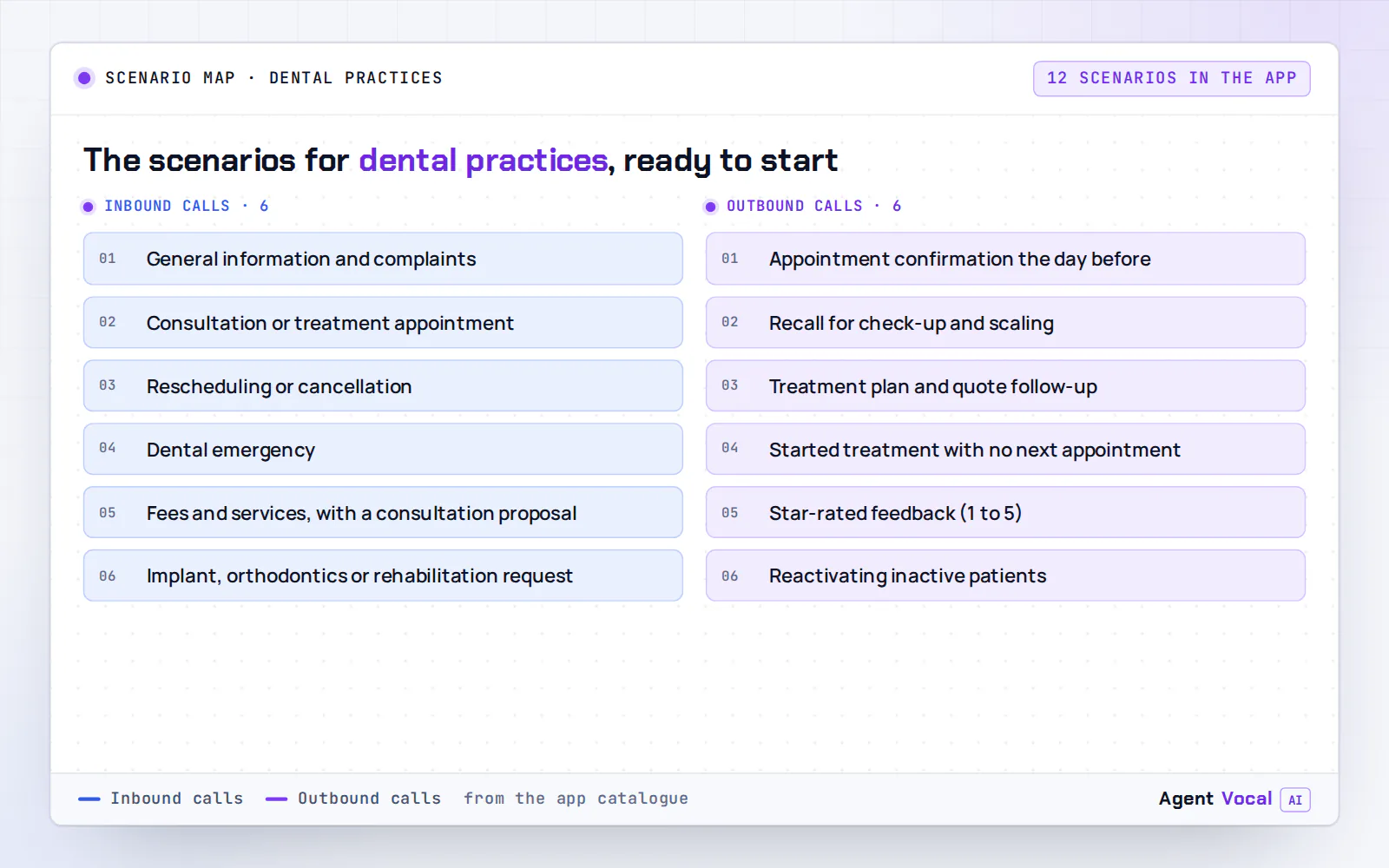
As an AI voice assistant, the agent covers both incoming calls and outbound calls. You can switch each scenario on separately, and everything that happens on a call stays in the portal, with recording, transcript and summary.
Incoming calls
- Consultation or treatment appointment: the patient calls for a consultation, a check-up, scaling or a treatment session. The voice agent offers free time slots from the practice calendar, confirms the day and time by reading them back and books the place. The practice wins bookings even while the front desk is busy; see the clinic appointment booking scenario in full.
- Rescheduling or cancellation: the patient wants to move or cancel an existing appointment. The agent finds it by name and phone number, offers a new slot or frees the place. That way a free slot reaches another patient instead of staying empty.
- Dental emergency: the patient calls with pain, swelling, a lost filling or a broken tooth. The agent finds the nearest free slot, and at signs of a serious emergency it tells the patient to call the emergency number. It gives no medical advice at all; it only finds the slot and alerts the team.
- Fees and services, with a consultation proposal: the patient asks what services the practice offers, how long a procedure takes, the hours, the address or the payment methods. The agent answers only from the knowledge base and proposes a consultation, without inventing anything.
- Implant, orthodontics or rehabilitation request: the patient is interested in a larger treatment, such as an implant, braces, veneers or a denture. The agent learns what they want and when they can come, and books an assessment consultation.
- General information and complaints: the patient calls with a question about the hours, address, parking, dentists or insurance cover, or with a grievance. The agent answers from the knowledge base and notes complaints in full, so the team can resolve them.
Outbound calls
- Appointment confirmation the day before: the day before, the agent calls the patient, reminds them of the appointment and asks for confirmation. If they can no longer come, it notes the reschedule, so the place goes to another patient. This is where no-shows drop the most.
- Recall for check-up and scaling: the agent calls patients whose usual check-up interval has passed, often six months, and offers an appointment for a check-up and cleaning. The practice calls its own patients back, with no manual list.
- Treatment plan and quote follow-up: the patient received a treatment plan or a quote and has not yet booked the first session. The agent learns whether they have questions and want to begin, then notes the answer for the dentist.
- Started treatment with no next appointment: the patient began a treatment, say a root canal or a temporary restoration, and has no next session booked. The agent reminds them and notes when they can come, so the work is not left half finished.
- Reactivating inactive patients: the agent calls patients who have not come for a long time, for example over a year, and invites them in for a check-up, with the offer from the brief if there is one. It brings an otherwise forgotten patient base back to life.
- Star-rated feedback (1 to 5): after the visit, the agent asks 7 short questions, each with a score from 1 to 5 stars, and notes the patient’s comments. See the phone surveys and feedback scenario in full.
How does a dental emergency call sound with the AI voice agent?
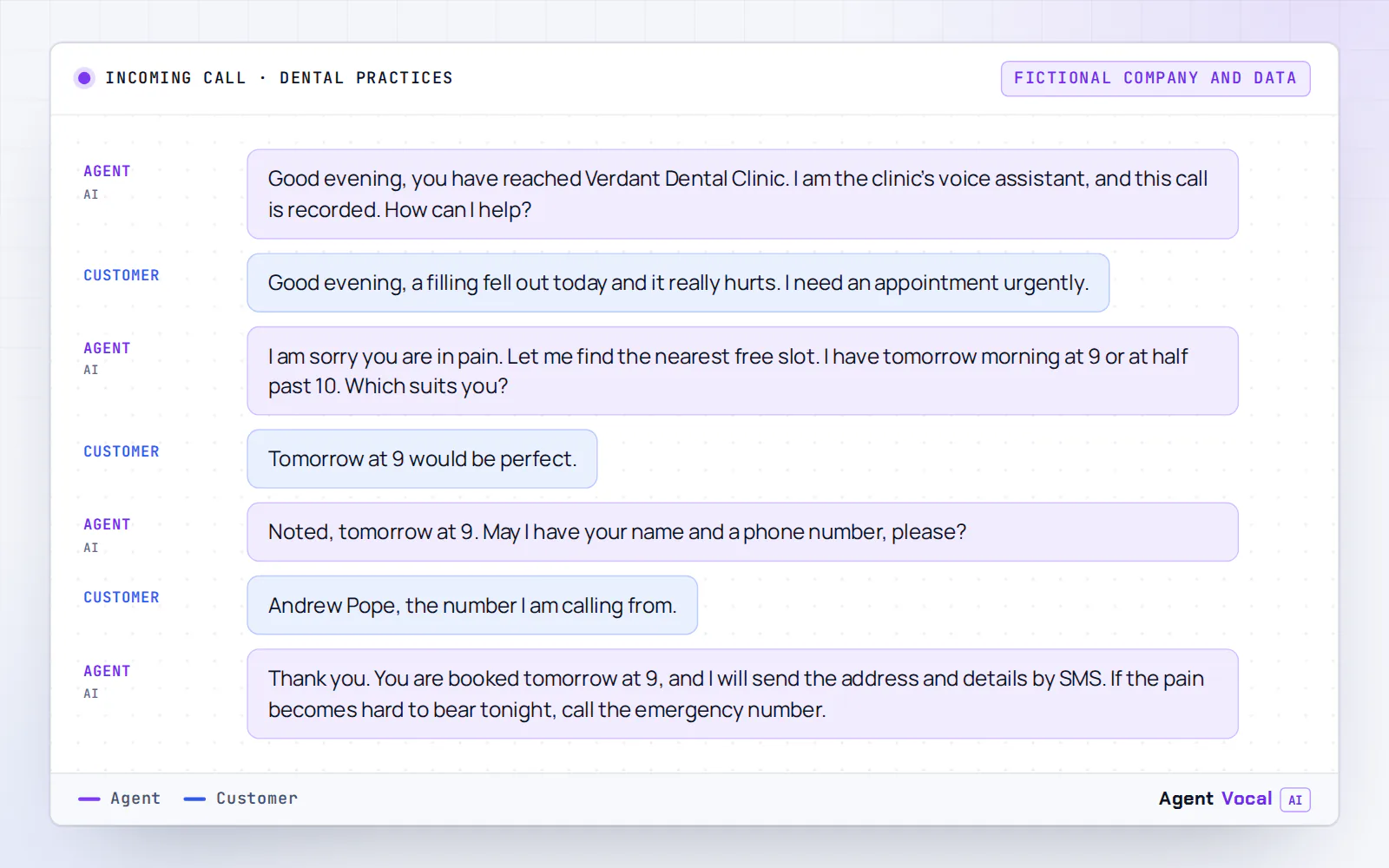
Notice what the voice agent did, step by step. It introduced itself as the clinic’s virtual assistant and said from the first second that the call is recorded, without pretending to be human. It listened to the problem, without diagnosing and without saying “it is nothing serious”. It looked in the calendar for the nearest slot and offered only two clear options, not a long list. It confirmed the day, the time, the name and the number by reading them back, sent the details by SMS and pointed to the safe path, the emergency number, for a serious case. Everything stayed in the portal, with recording, transcript and summary, ready to read in the morning.
A day with the AI voice agent at a dental practice
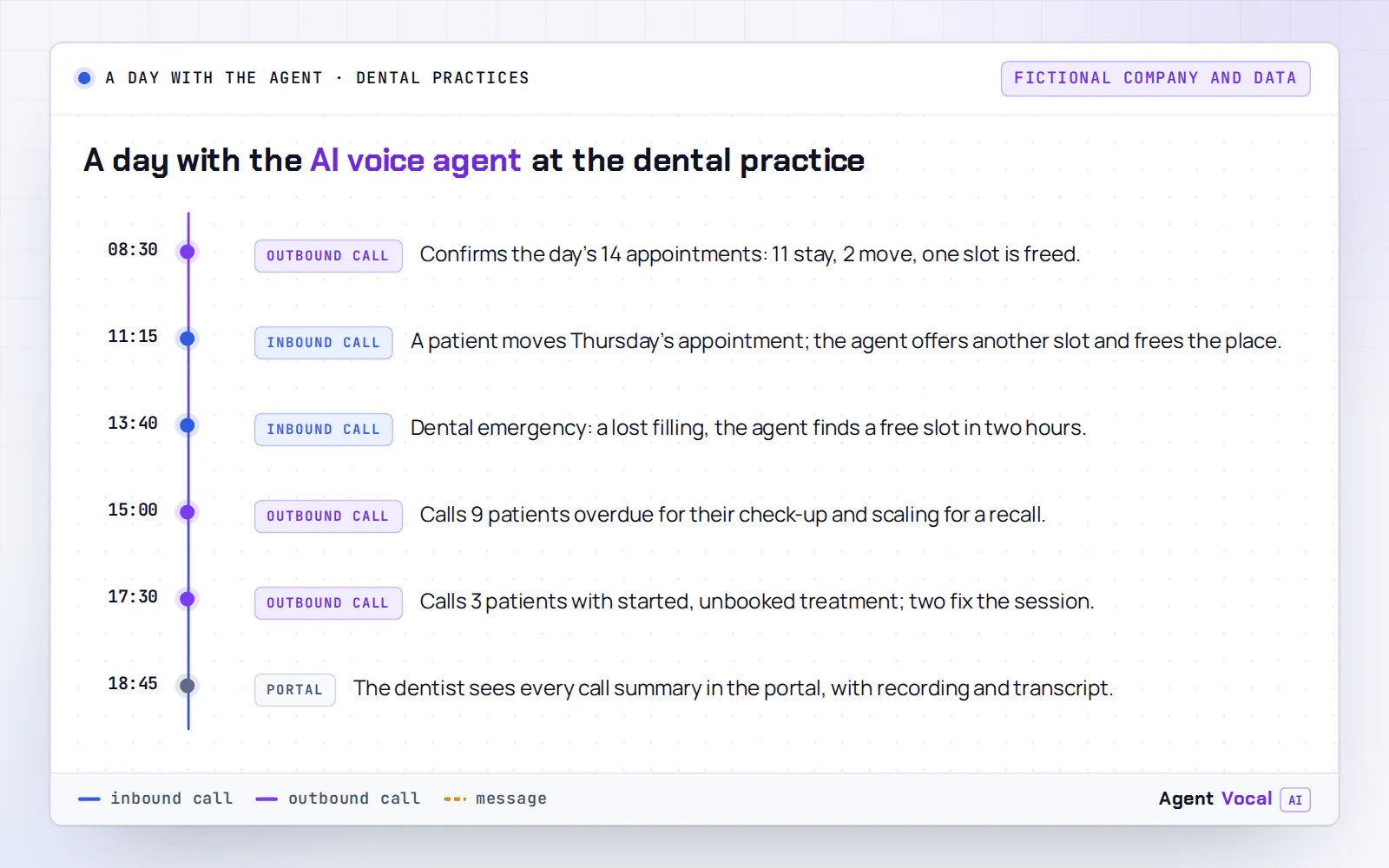
At Verdant Dental Clinic, a small, fictional practice with two dentists, the morning starts with the agent confirming the day’s appointments, so the front desk knows from the first hour who is coming and which slot has opened. Through the day, between patients, the phone is never left unanswered: a reschedule, an emergency, a question about an implant, all taken and noted, and the dentist sees them during breaks.
In the afternoon, when the front desk would have been too busy to call anyone, the AI voice agent runs the recall for patients overdue on their check-up and chases those who left a treatment unfinished. In the evening, the dentist opens the portal and finds every call with a summary and transcript, without having picked up the phone away from the chair. No emergency rang into the void, no free slot stayed unused.
What does a dental practice gain through automation?
The gain comes from simple mechanisms, not from promises. Through the automation of calls with AgentVocal AI, your practice gets:
- no missed call: the agent answers from the first ring, including evenings and weekends, around the clock;
- emergencies caught in time, because the person in pain always finds someone to give them a slot;
- fewer no-shows, through the confirmation the day before and the on-the-spot reschedule;
- a full diary without manual work, because the check-up recall and treatment follow-up run on their own;
- an answer in under a second, in a natural conversation, in any of the 84 languages available;
- a complete trail in the portal: recording, transcript, summary and outcomes, plus a message by WhatsApp, SMS or email after the call.
The calendar stays the brain of the practice, and the agent is its voice. The agent sees only what is free, so it cannot double book a slot.
No inflated figures and no savings promises: as an AI voice assistant, AgentVocal AI does exactly the phone work you used to squeeze in between two patients. This automation works quietly, in the background.
When does each dental call start, and what stays in the portal?
So you can see at a glance how it works, here is when some of the most used scenarios in a dental practice are triggered and what each leaves behind in the portal:
| Scenario | When it is triggered | What stays in the portal |
|---|---|---|
| Dental emergency | On an incoming call with pain or a lost filling | Recording, transcript, the proposed slot and the note for the team |
| Appointment confirmation the day before | Automatically, the day before the appointment | The call outcome: confirmed, moved or to be rescheduled |
| Recall for check-up and scaling | When the check-up interval passes, often six months | The list of patients called and the new appointments fixed |
| Treatment plan and quote follow-up | After the patient received a plan and did not book | The note with the patient’s answer, ready for the dentist |
Each row is a call that would otherwise have fallen on the front desk or never happened at all. The agent starts them on time, and you see the outcome in the portal without having to remember a thing.
What stays with the dentist and what the agent will not do
An honest AI voice assistant states its limits clearly:
- it gives no medical advice and makes no diagnosis; it does not say “it is nothing serious” and does not recommend medication;
- it does not decide a treatment plan; it brings the patient back to the phone, but the dentist sets the treatment;
- it makes no exceptions to rules you did not give it; it notes the request for a colleague;
- it does not pretend to be human: it introduces itself as the virtual assistant and says the call is recorded;
- it respects “do not call me again” and the time slots you set.
The human side of dentistry, the dentist’s hand and the calming of a frightened patient, stays entirely with people.
What do you prepare before launch at the practice?
So the agent answers like a well-trained person, you prepare in advance:
- the knowledge base: hours, address, parking, dentists, services, payment methods, insurance cover and the preparation for each procedure; see the guide on how to prepare the knowledge base;
- the calendar: the dentists, the treatment types, the duration of each and the time slots in which patients can book;
- the contact lists for the outbound calls: patients to recall for a check-up, with unfinished treatment or inactive;
- the connections: the calendar, the knowledge base, WhatsApp, SMS and the practice email; see what you can link in integrations.
The booking logic is the same as in the guide on appointment booking by phone, adapted to dental treatments.
How do you start the AI voice agent at a dental practice?
None of the setup lands on our team: you carry it out yourself, in the platform, and we only approve the account. You register with an estimated cost in plain view in the form and wait for approval, within a day. Then you work through a nine-step guide: the company from the trade register, the industry and the scenarios, the modules, the price, the connections, the agent and the voice, the phone number allocated automatically, the lists and working hours, the test call. In a real test, the technical setup of a complete agent took 4 minutes and 38 seconds.
Start with a single scenario, for example the after-hours emergencies or the appointment confirmations, make a few test calls from your own phone, then extend. If you want to hear how AgentVocal AI sounds first, listen to the demo calls and see how it works.
Test an AI voice agent on your own dental practice needs
The most honest test is the one you run yourself, on your practice’s own pains and check-ups. You press Create your account and set up an account in a few minutes, see the estimated cost right in the form and choose the dental industry with the scenarios you need, from dental emergencies to the recall for check-ups and scaling. Nobody commits you to anything, and we promise no particular result.
Once the account is approved, you get the nine-step guide and make the first test call on your own phone, before the agent calls a single patient. You call, ask for an appointment, describe a pain as an emergency and see in the portal what it understood and what it noted. Only when you are satisfied do you let it loose on real calls, with the practice’s patients.
How much does an AI voice agent for dental practices cost?
At a practice, billing is per minute of conversation, rounded up per call, plus a one-off setup per channel. The only calls that are not charged are the ones nobody answers; voicemail is billed as a normal minute. In practice you pay for the emergencies caught and the check-ups called back, not for a fixed front-desk salary that runs on while the phone is silent. All the figures and thresholds are explained clearly on the pricing page, and the rest of the languages available you can see on languages.