In this guide10 sections
- 01Where does a garage lose work on the phone?
- 02The scenarios an AI voice assistant covers in a car service
- 03What a service booking call sounds like, step by step
- 04One workday with the AI voice agent in a workshop
- 05Which repetitive calls does automation take off your reception?
- 06What stays with the mechanic, and what the agent never does?
- 07The groundwork before your first automated call
- 08How do you launch the voice agent in your workshop?
- 09Try an AI voice agent on your own garage calls
- 10What does an AI voice agent for a car service cost?
An AI voice agent for a car service is an AI voice assistant that answers the workshop phone even while the mechanic has their hands in the engine, books repairs, services and roadworthiness tests, and calls customers whose deadline is approaching. In short, it is a voice assistant that misses no call and an automation of the repetitive workshop phone. AgentVocal AI puts it to work in Romanian and dozens of other languages, with a recording, transcript and summary for every call.
Below you have, one by one, why a job slips away on the phone, every scenario you can switch on, a call taken from start to finish, a full day in the workshop and what stays in the hands of the mechanic.
Where does a garage lose work on the phone?
In a workshop the phone always rings at the worst moment. The mechanic is under a car or has hands full of grease, reception is taking in a vehicle, someone is explaining an estimate. The call rings out, and the customer who wanted an appointment calls the next garage. You lose the job not because you are expensive, but because nobody answered.
On top of that are the deadlines customers forget:
- roadworthiness tests and services that expire with no one to warn them, so customers end up at another garage or drive on expired paperwork;
- seasonal tyres that customers forget to change until the first snow and the queue forms;
- cars ready for days that stay uncollected because no one had time to call the owner;
- additional estimates waiting for a phone approval while the car takes up a bay for nothing.
There is also the seasonality every workshop knows: for two weeks a year, when the tyres change, the phone rings far more than usual, and reception can neither book nor take in cars at the same time. At a test station, the most frequent question is “which documents do I need?”, asked dozens of times a day, with the same answer. All these calls have one thing in common: they are predictable, repetitive and do not need a mechanic, only someone to answer.
An AI voice assistant does not hold the socket wrench, but it holds the phone for you: it answers the first call and calls customers in time on its own.
The scenarios an AI voice assistant covers in a car service
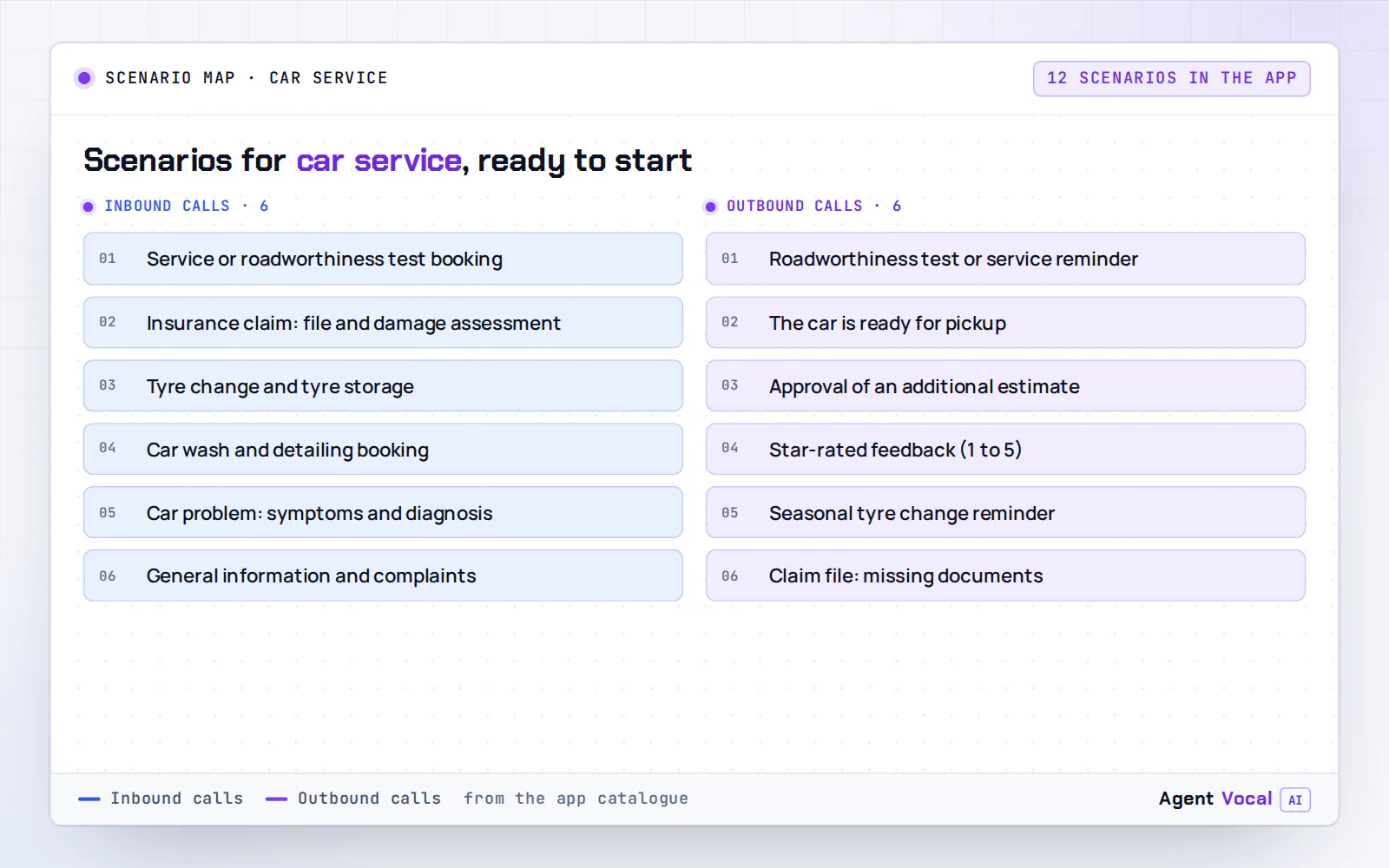
A car service has twelve scenarios in the app, across incoming and outbound calls. You switch them all on at once, or only the ones that squeeze you now, from bookings to the roadworthiness test reminders.
Incoming calls
- Service or roadworthiness test booking: the customer calls for a service, maintenance or roadworthiness test appointment. The agent finds out the car and the problem and offers free slots from the calendar. No booking call goes unanswered; see the car service appointments scenario in full.
- Insurance claim: file and damage assessment: the customer had an accident. The agent finds out the situation, says which documents are needed from the knowledge base, notes towing if required and books the damage assessment. The customer knows exactly what comes next, even when they call in the evening, stressed.
- Tyre change and tyre storage: the customer wants to change seasonal tyres or store them. The agent finds out the car, the size and whether the tyres are in storage, then books the change.
- Car wash and detailing booking: for a wash, an interior clean, a polish or detailing, the agent finds out the package and the car and books a free slot.
- Car problem: symptoms and diagnosis: the customer describes a noise, a dashboard light or a car that will not start. The agent notes the symptoms, checks whether the car is safe to drive and books the diagnosis, without diagnosing anything itself.
- General information and complaints: questions about hours, address, the services offered, the fixed prices in the list, the labour warranty, the documents for the test, or a complaint. The agent answers from the knowledge base and logs complaints in full for the team.
Outbound calls
- Roadworthiness test or service reminder: the agent calls customers whose roadworthiness test is expiring or whose service is due, reminds them of the deadline and proposes an appointment. You bring customers back exactly when they need you.
- The car is ready for pickup: the agent calls the customer to say the car is ready, gives the pickup hours and notes when they will come. The bays free up sooner.
- Approval of an additional estimate: the mechanic found extra work. The agent tells the customer exactly what the estimate says and notes whether they approve it, refuse it or want to speak to the mechanic. The work no longer waits for a call.
- Star-rated feedback (1 to 5): after the work, the agent asks seven short questions, each rated from 1 to 5 stars, and notes the customer’s comments. See the phone surveys and feedback scenario.
- Seasonal tyre change reminder: the agent calls customers before the season, especially those with tyres in storage, reminds them of the change and proposes an appointment, so they do not all pile into the same week.
- Claim file: missing documents: the agent calls customers with an open claim file and reminds them which documents are missing, so the file does not stall. For the mechanism, see follow-up after call.
What a service booking call sounds like, step by step
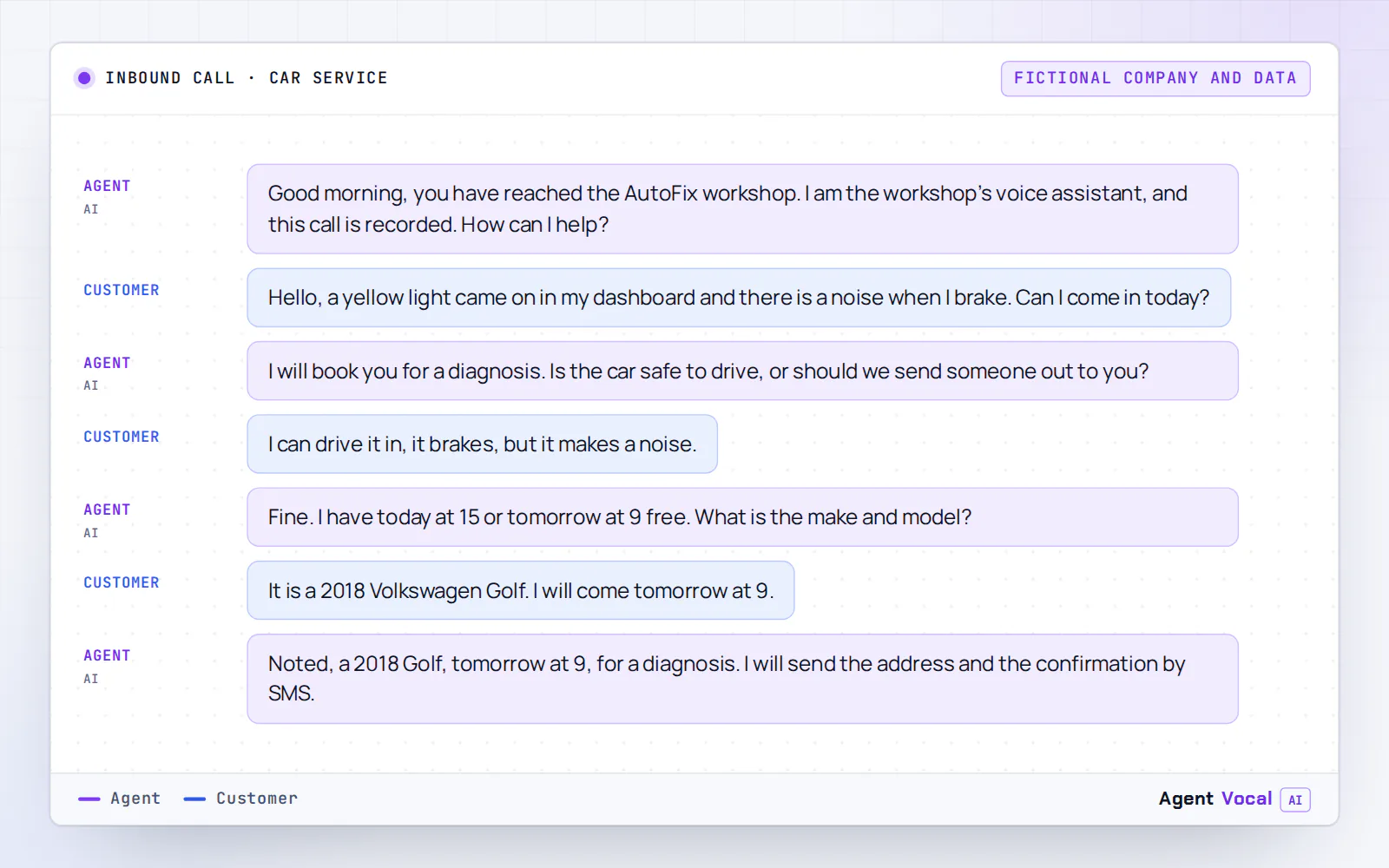
Take the call above piece by piece. The AI voice assistant said who it was, the workshop’s assistant, and announced that the call is recorded, as every call in AgentVocal AI is. Instead of guessing the fault, it asked the safety question (“is the car still safe to drive?”), noted the symptoms and the make, and booked a diagnosis, without promising a cost or a verdict. It confirmed the day and time by repeating them back and sent the address by SMS. Reception was not pulled off the job, and the booking appeared straight in the portal, with the call summary.
One workday with the AI voice agent in a workshop
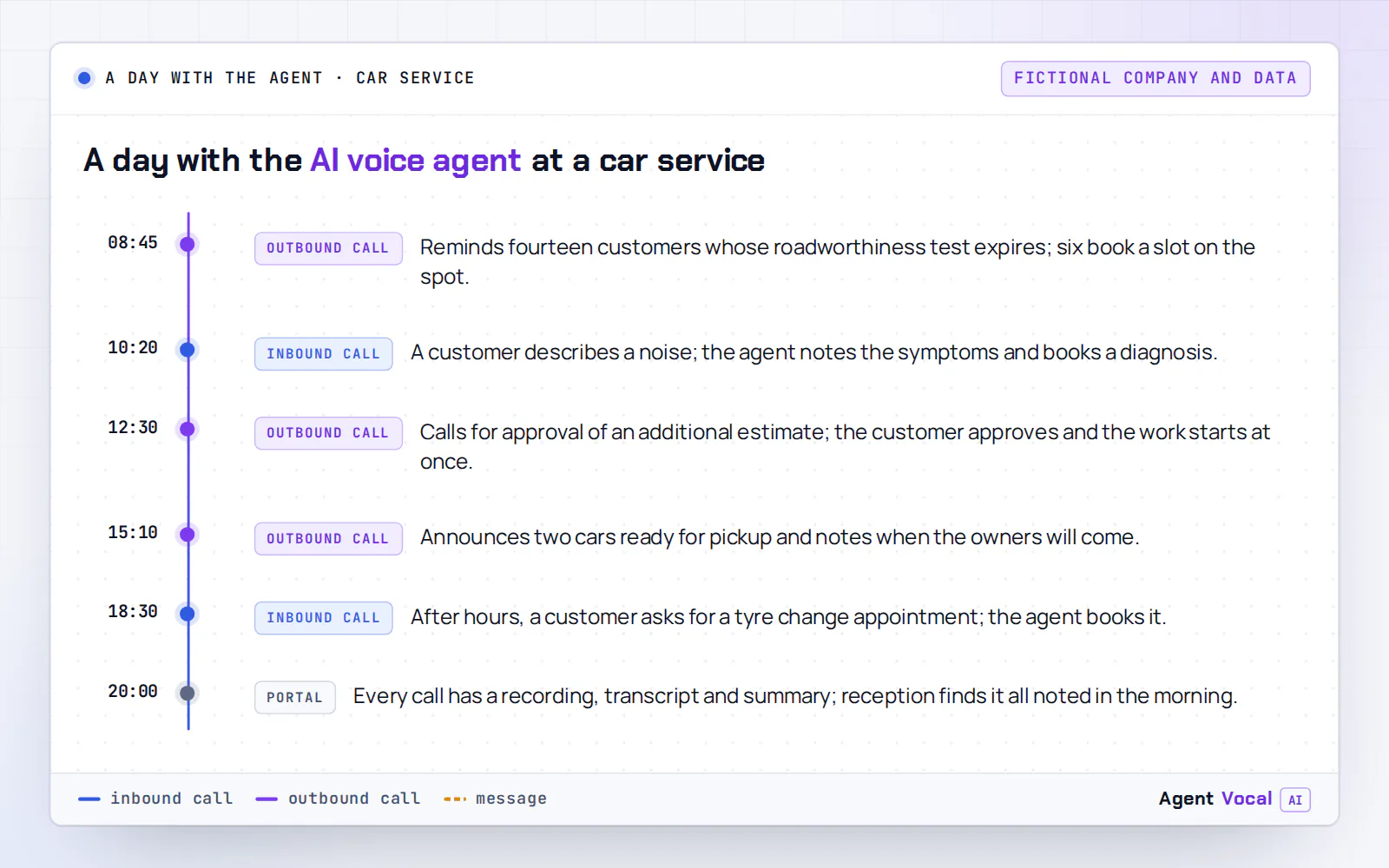
At the fictional AutoFix service, the day starts with the reminder calls for the roadworthiness tests expiring this month. Of fourteen customers called, six book a slot on the spot, which used to need someone on reception spending an hour on the phone. At midday, while the mechanics work, the agent takes new bookings and calls a customer for approval of an additional estimate; the customer approves, and the work starts without the car waiting on the ramp any longer.
In the afternoon, AgentVocal AI announces two cars ready for pickup and notes when the owners will come. In the evening, after closing, a customer calls about a tyre change and reaches the agent, not a voicemail box. The next morning, reception finds every call in the portal with a recording, transcript and summary, plus the bookings already in the calendar.
Which repetitive calls does automation take off your reception?
Automation in a workshop does not mean taking people out of the bays, it means no longer losing work on the phone. Here is what an AI voice assistant like AgentVocal AI brings a workshop, through automation:
- No lost call: the AI voice agent answers from the first ring, during hours and after, when people call on the way home.
- Customers brought back in time through the roadworthiness test, service and tyre reminders, exactly when they need the garage.
- Bays freed sooner, because cars that are ready are announced at once.
- Estimates approved on the spot, not after someone finds a free moment to call.
- A reply in under a second and a natural conversation, not a keypad menu.
- Everything in the portal: recording, transcript, summary and outcome for every call, plus WhatsApp, SMS or email messages after the call.
- 84 available languages, useful for foreign drivers passing through; see the available languages.
In a workshop, the mechanic’s time is the most expensive. A voice assistant that holds the phone lets the person keep working, and the garage no longer loses customers just because the line rang out.
To see clearly what each call leaves behind, here are the most used scenarios in a workshop and what each one leaves in the portal:
| Scenario | When it triggers | What stays in the portal |
|---|---|---|
| Service or roadworthiness test booking | The customer calls for a job, a service or a test | The car, the job requested, the slot set in the calendar |
| Roadworthiness test or service reminder | The list of deadlines expiring this month | Booked, postponed or refused, the new appointment |
| Approval of an additional estimate | The mechanic finds extra work during the repair | Approved, refused or “I want to speak to the mechanic” |
| The car is ready for pickup | Reception marks the job finished | The time the customer will come to collect the car |
| Claim file: missing documents | An open file with documents missing | Which documents are missing and when they are brought |
Every row rests on a recording, a transcript and a summary, so reception knows what was said to the customer without calling them again.
What stays with the mechanic, and what the agent never does?
An honest voice agent says plainly where it stops, and in a workshop the limits are important:
- it does not diagnose and does not say what is wrong with the car; it notes the symptoms and books the diagnosis;
- it does not estimate the cost of a repair that only the mechanic can give after seeing the car;
- it does not approve a job on its own: it only passes on the estimate and notes the customer’s answer;
- it does not promise deadlines the workshop cannot keep and does not negotiate prices;
- it does not pretend to be human: it introduces itself as a virtual assistant and announces the recording;
- it respects “do not call me again” and the time slots on outbound calls.
The groundwork before your first automated call
Good automation starts from clear information:
- The knowledge base: the list of jobs, the documents for the roadworthiness test, the labour warranty, the frequent questions. See how to prepare the knowledge base.
- The workshop calendar: the time slots, the number of bays, how long each job takes, the seasonal schedule.
- The lists for outbound calls: the customers whose roadworthiness test or service is about to expire and those with tyres in storage.
- The connections with your management software and the messaging channel. See integrations.
- The time slots for outbound calls, so the reminders land at sensible hours.
For how bookings work as a mechanism, see the guide on AI appointment booking by phone.
How do you launch the voice agent in your workshop?
You do the configuration yourself in the platform, and our team only approves the account. The steps from how it works are the same:
- Fill in the registration form, where you see a cost estimate, and wait for your account to be approved, within 24 hours at most.
- Follow the 9 step wizard: company, industry and scenarios, modules, price, connections, agent and voice, the automatically allocated phone number, lists and working hours, a test call. In a real test, the technical setup took 4 minutes and 38 seconds.
- Make a few test calls from your own phone: ask for an appointment, describe a noise, ask for a time that does not exist.
- Start with a single scenario, for example the bookings or the roadworthiness test reminders, then add the rest.
Before launch, go through the launch checklist, and for how calls are recorded lawfully, see call recording and GDPR.
Try an AI voice agent on your own garage calls
The best test is not a generic demo, it is your own workshop. Create an account in a few minutes at Create your account: in the registration form you see the estimated cost for your number of calls, you choose the “Car service” industry and the scenarios described above, for example only Service or roadworthiness test booking and Roadworthiness test or service reminder at the start. After your account is approved you receive the 9 step wizard, you give the agent your list of jobs, the documents for the test and your workshop hours, then you make the first test call from your own phone.
In the test call, describe a noise when braking, ask for a roadworthiness test appointment for your car, ask which documents you need, then have it call you with a fictional additional estimate and see how it notes the answer. Until you are satisfied, the agent calls no real customer on your lists. Test it on your bookings, on your fixed list prices and on the questions reception gets dozens of times a day.
What does an AI voice agent for a car service cost?
At AgentVocal AI the sum is per minute of conversation, rounded up per call, plus a one-off setup per channel. The only calls that are not charged are the ones nobody answers; voicemail is charged as a normal minute. You do not pay for a booking or a reminder, but strictly for the minutes spoken. All the details are on the pricing page, and the car service page sums up the service for your workshop. For what keeps your customers’ data safe, see the security page.