In this guide11 sections
- 01Why do veterinary clinics miss calls, and what slips away?
- 02What a veterinary voice assistant takes over: the scenario map
- 03How does a late-night emergency call sound?
- 04A day with the AI voice agent at a veterinary clinic
- 05What does a veterinary clinic gain through automation?
- 06When does each veterinary call start?
- 07What the agent will not do in a veterinary clinic
- 08What do you prepare before switching the agent on?
- 09How do you start the AI voice agent at a veterinary clinic?
- 10Test an AI voice agent on your own clinic’s cases
- 11How much does an AI voice agent for a veterinary clinic cost?
An AI voice agent for veterinary clinics is a voice assistant that answers the clinic phone and makes calls in place of the front desk: it books consultations, vaccines and grooming, points emergencies to the clinic or the on-call hospital and calls owners for a booster. AgentVocal AI is an AI voice assistant that speaks naturally, writes everything into the portal and takes the repetitive phone work off the team through automation, so the vet and the nurse stay with the animal in front of them.
A veterinary clinic lives on two moments when the phone decides everything: the frightened owner calling late at night, and the vaccine and deworming boosters nobody finds time to chase. With AgentVocal AI you switch this automation on scenario by scenario, and the veterinary industry page gathers them in one place. Below you will find every scenario, a real call and the point where the agent hands over to a person.
Why do veterinary clinics miss calls, and what slips away?
In a veterinary clinic, the phone always rings over a consultation. The vet has both hands on a restless animal, the nurse holds the patient, and a queue of owners builds at the desk. Meanwhile, calls that never come back are lost:
- evening and night emergencies, when a frightened owner is looking for anyone to tell them where to go;
- new owners, calling for the first time, who reach nobody and go to another clinic;
- due vaccine boosters and deworming, because the list in the records does not call itself;
- grooming clients and those who have not come for a while, forgotten because nobody has time to call.
The losses do not show at once, but an animal not vaccinated on time and an owner who reached nobody are money and trust draining out of the clinic. An AI voice assistant does not keep the vet from the patient; it takes over exactly the phone the clinic cannot cover with people.
What a veterinary voice assistant takes over: the scenario map
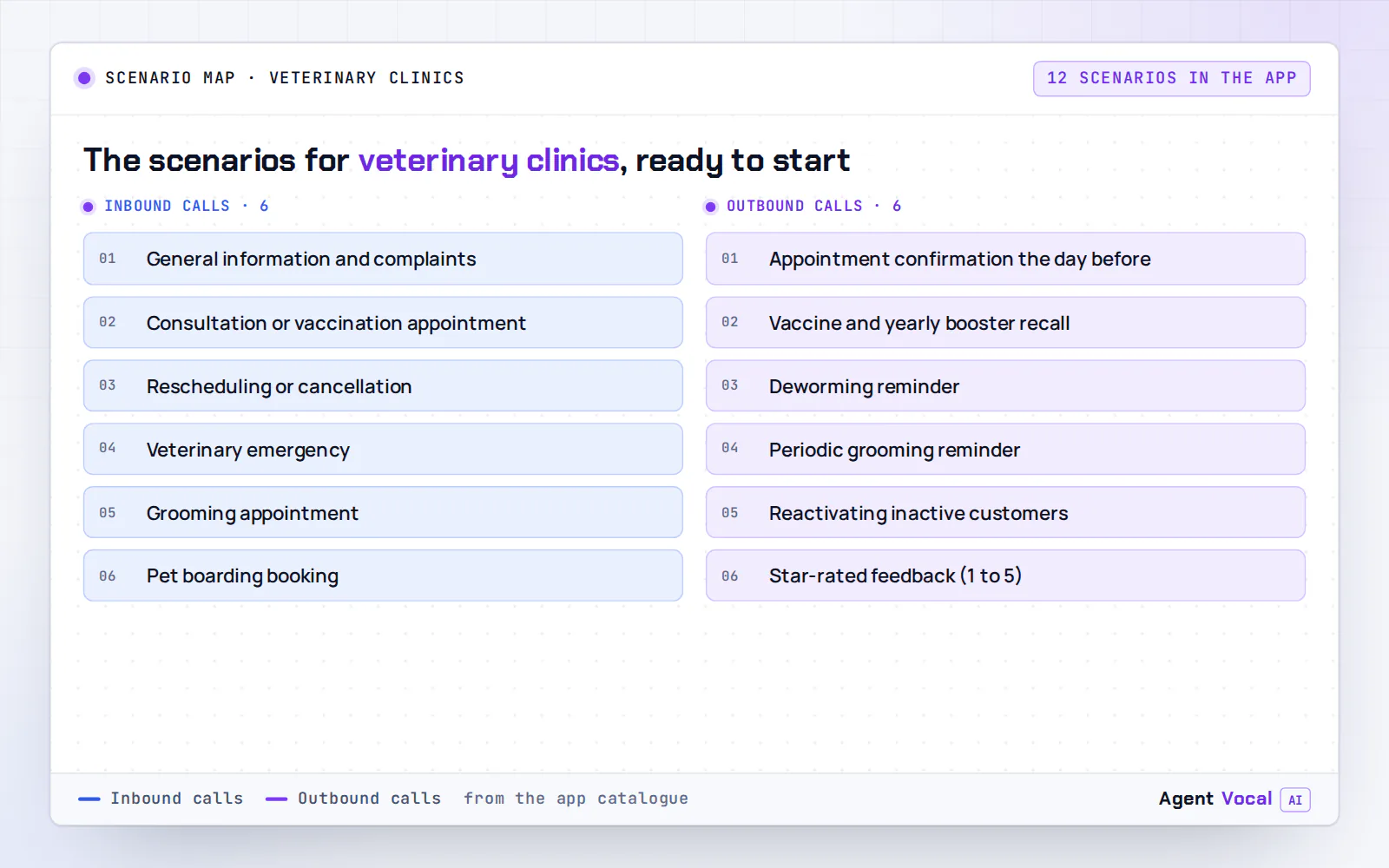
As an AI voice assistant, the agent covers two directions: the calls owners make, and the calls it makes to your lists. You switch each scenario on when you like, separately, and from every call the portal keeps the recording, the transcript and a summary, so the vet sees at a glance what was asked.
Incoming calls
- Consultation or vaccination appointment: the owner calls for a consultation, a vaccine, deworming, a check-up or a planned procedure. The voice agent learns the animal and the service and offers free slots from the calendar. The clinic catches bookings even while the desk is busy.
- Rescheduling or cancellation: the owner wants to move or cancel an appointment at the clinic or at grooming. The agent finds it and offers a new slot, so the freed place reaches another animal.
- Veterinary emergency: the owner calls in a panic, the animal was hit, swallowed something, is not breathing normally or is having seizures. The agent points them straight to the clinic or the on-call hospital, with no medical advice, and alerts the team. Here the speed of the answer matters most.
- Grooming appointment: the owner calls for a bath, a trim, nail clipping or a full package. The agent learns the breed and size, which change the duration, and offers free slots from the calendar.
- Pet boarding booking: the owner is going on holiday and wants to leave the animal in boarding. The agent learns the period, the animal and the requirements, such as vaccines, food and treatments, and notes the request for confirmation.
- General information and complaints: the owner calls with a question about the hours, the on-call schedule, the address, services, fees or shop products, or with a grievance. The agent answers from the knowledge base and notes complaints in full for the team.
Outbound calls
- Appointment confirmation the day before: the day before, the agent calls the owner, reminds them of the clinic or grooming appointment and asks for confirmation. Fewer places stay empty through forgetfulness.
- Vaccine and yearly booster recall: the agent calls owners whose vaccine booster date from the record is near or past and offers an appointment. The clinic calls its own patients, with no list dialled by hand.
- Deworming reminder: the agent calls owners whose periodic deworming is due, internal or external, per the date from the brief, and notes whether they want to come in. That way the treatment is not put off indefinitely.
- Periodic grooming reminder: the agent calls grooming clients whose usual interval has passed, for example six or eight weeks, and offers the next appointment.
- Reactivating inactive customers: the agent calls owners who have not come for a long time and invites them in for a general check-up of the animal, with the offer from the brief if there is one.
- Star-rated feedback (1 to 5): after the visit, the agent asks 7 short questions, each with a score from 1 to 5 stars, and notes the owner’s comments. See how the after-call messages and calls work in the guide on follow-up after a call.
How does a late-night emergency call sound?
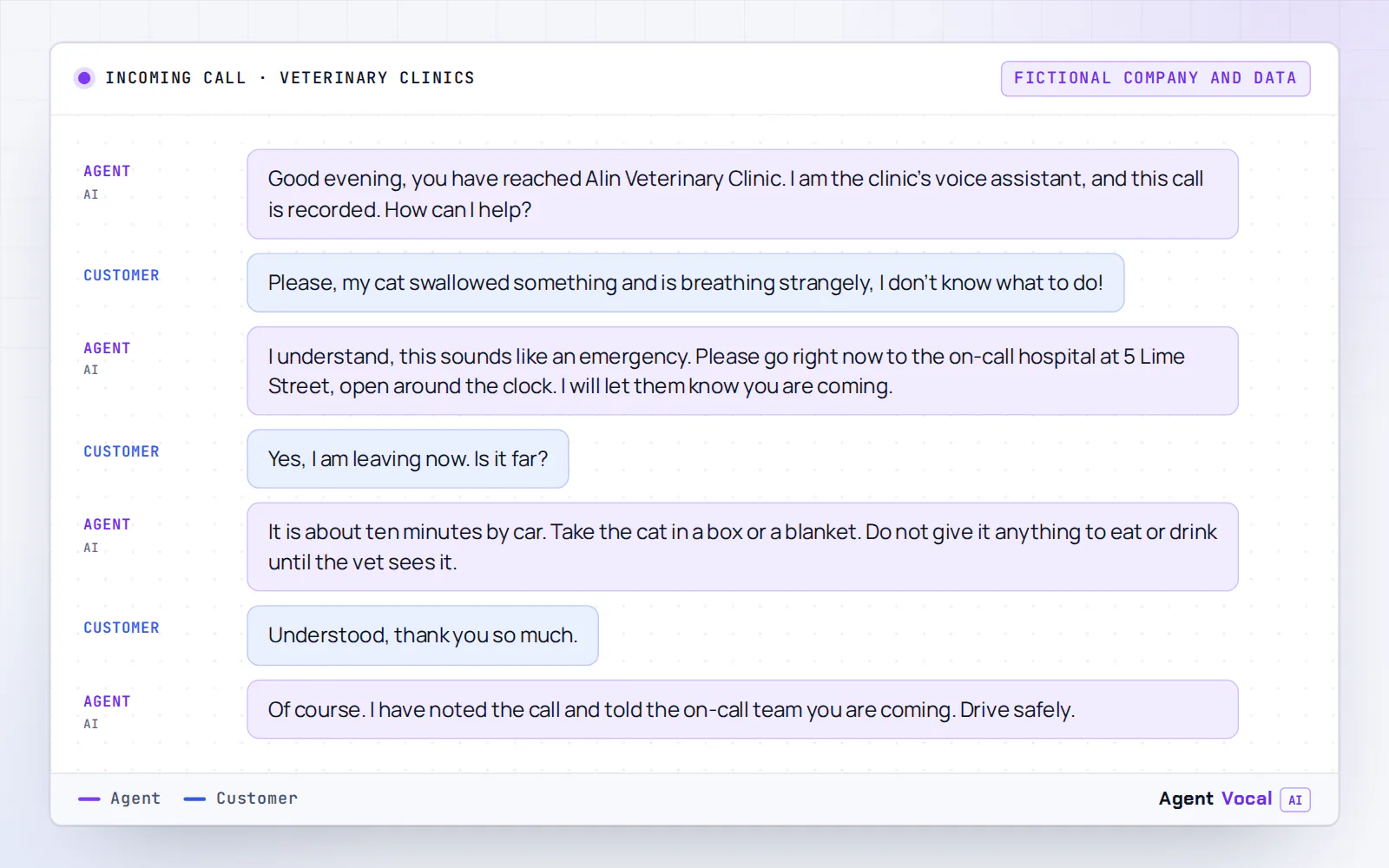
Notice what the voice agent did at an emergency. It introduced itself as the virtual assistant and said the call is recorded. It listened to the panicked owner without diagnosing and without guessing what was wrong with the animal. It gave the one thing that helps in an emergency: where to go now, the on-call hospital, with the address and how long it takes to get there, plus the safety steps from the knowledge base, not medical advice. It told the on-call team the owner was coming and noted everything in the portal, with recording, transcript and summary. Calm, clear, in under a second on each line.
A day with the AI voice agent at a veterinary clinic
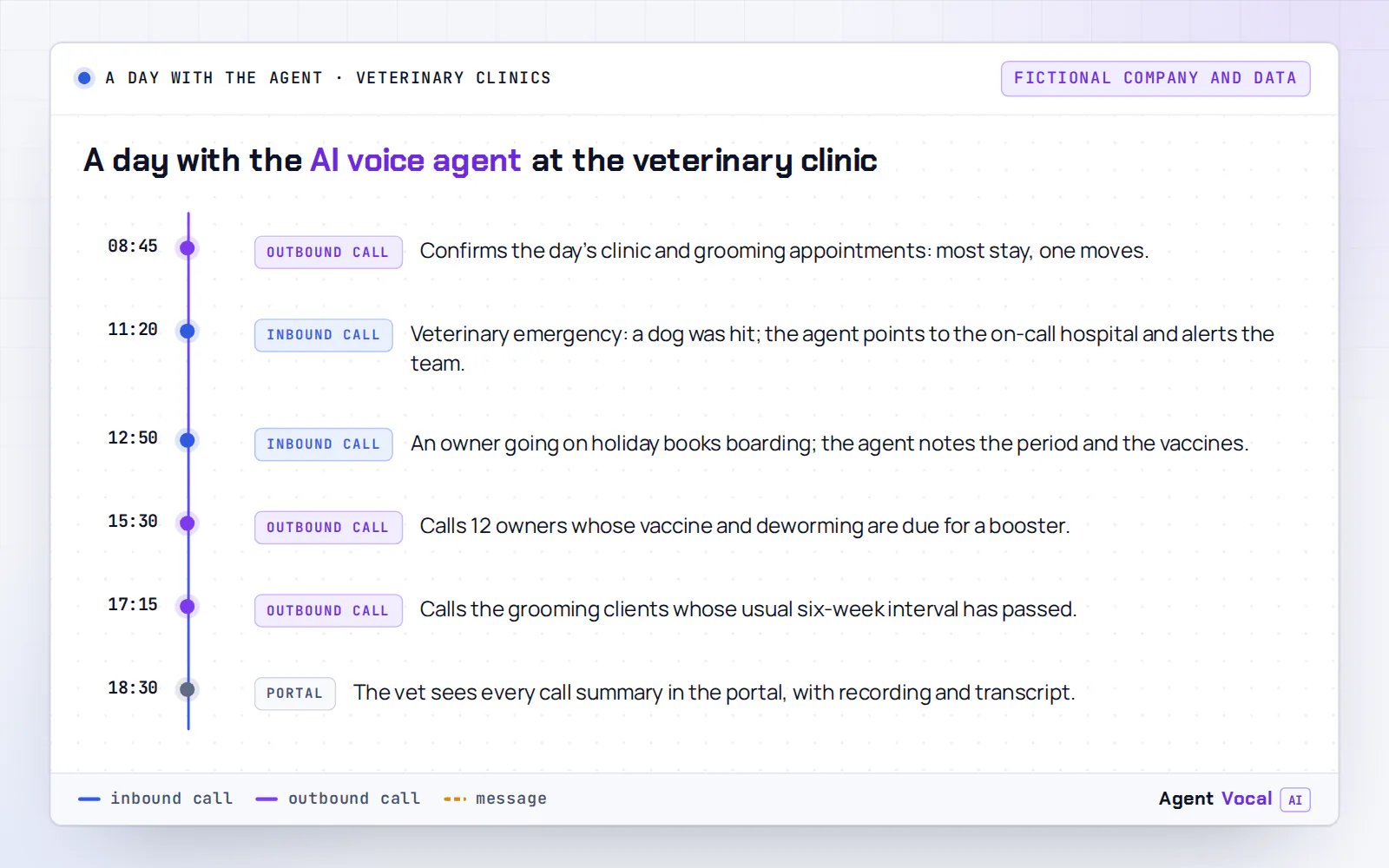
At Alin Veterinary Clinic, a fictional neighbourhood practice with grooming and a small boarding service, the morning starts with the agent confirming appointments, so the vet knows from the first hour who is coming. Through the day, between consultations, no call is left unanswered: an emergency sent to the on-call hospital, a boarding reservation for a holiday, a question about a vaccine, all taken and noted.
In the afternoon, when the desk would have had no time for anyone, the AI voice agent calls owners whose vaccine and deworming are due and brings the grooming clients back. In the evening, the vet opens the portal and finds every call with a summary and transcript, without once stepping away from the clinic to pick up the phone. No emergency rang into the void, no booster was forgotten.
What does a veterinary clinic gain through automation?
The gains do not come from big words, but from things you can check in the portal. With the automation of calls on AgentVocal AI, your clinic has:
- a phone that always answers, from the first ring, including at night, at the weekend and on holidays, around the clock;
- emergencies handled fast, because the frightened owner learns in seconds where to go;
- records kept up to date: the vaccine and deworming recall runs on its own, with no lists dialled by hand;
- a full grooming and boarding diary, because the voice agent calls clients and takes reservations;
- a natural conversation, with an answer in under a second, in the owner’s own language, from the 84 available;
- the trail of every call in one place: recording, transcript, summary and outcome, plus the message sent after the call by WhatsApp, SMS or email.
An owner calmed on the phone, even at ten at night, comes back with the animal to your clinic. The agent does not cure the animal, but it shows the way and does not leave them alone.
As an AI voice assistant, AgentVocal AI carries the clinic’s phone calmly and at any hour, without tiring and without breaks, and this automation keeps working even while the clinic is closed.
When does each veterinary call start?
Here, in short, is when each of the most used scenarios in a veterinary clinic starts and what stays written in the portal after the call:
| Scenario | When it is triggered | What stays in the portal |
|---|---|---|
| Veterinary emergency | On an incoming call, when the owner calls frightened | Recording, transcript, the referral to the on-call hospital and the note for the team |
| Appointment confirmation the day before | Automatically, the day before the visit or grooming | The call outcome: confirmed, moved or to be rescheduled |
| Vaccine and yearly booster recall | When the booster date from the record is near or past | The list of owners called and the new appointments fixed |
| Deworming reminder | When the periodic deworming from the brief is due | The note with the owner’s answer and the proposed date |
| Pet boarding booking | On an incoming call, before a holiday | The period, the animal and the requirements, ready for confirmation |
Each row is a call that would otherwise have rung into the void or never happened at all. The agent starts it on time, and you open the portal and see the outcome, with nothing to keep in your head.
What the agent will not do in a veterinary clinic
A serious AI voice assistant owns its limits, especially in a field where the animal’s health is at stake:
- it gives no veterinary medical advice and makes no diagnosis; at an emergency it refers to the clinic or on-call hospital and gives only the safety steps from your base;
- it does not treat and does not prescribe; it brings the owner back to the clinic, but medicine stays with the vet;
- it does not confirm a boarding reservation on its own when a colleague checks availability; it notes the request and leaves it for confirmation;
- it does not pretend to be human: it says from the first that it is a virtual assistant and that the call is recorded;
- it respects “do not call me again” and calls only in the time slots you give it.
Care for the animal and the calming of the owner stay, naturally, with the people in the clinic.
What do you prepare before switching the agent on?
The agent is only as good as the information you give it. Before launch, you prepare:
- the knowledge base: hours, on-call schedule, address, services, listed fees, shop products and the safety steps for emergencies; see the guide on how to prepare the knowledge base;
- the calendar: the vets, the services, the duration by breed and size for grooming and the booking time slots;
- the contact lists for the outbound calls: owners with a vaccine booster, with due deworming, grooming clients and inactive ones;
- the connections: the calendar, the knowledge base, WhatsApp, SMS and the clinic email; see what you can link in integrations.
The booking logic is detailed in the clinic appointment booking scenario, easy to adapt to a veterinary clinic. The same groundwork sits behind the guide on appointment booking by phone.
How do you start the AI voice agent at a veterinary clinic?
You carry out the setup yourself, in the platform; our team only approves the account, within a day. You register with the estimated cost shown in the form, then go through a nine-step guide: the company from the trade register, the industry and the scenarios, the modules, the price, the connections, the agent and the voice, the phone number allocated automatically, the lists and working hours, the test call. In a real test, the technical part took 4 minutes and 38 seconds.
Start with a single scenario, say the after-hours emergencies, make a few trial calls from your own phone, then extend to the rest. If you want to hear AgentVocal AI’s voice first, listen to the demo calls and see step by step how it works.
Test an AI voice agent on your own clinic’s cases
The surest way to be convinced is to put it to work on your own cases. You create an account in a few minutes through Create your account and, right in the form, see the estimated cost as you fill it in. You choose the veterinary industry and your own scenarios, from emergencies and appointments to the vaccine recall, the deworming reminder and grooming. You judge it on your own cases, in your own clinic’s words, before it ever rings an owner.
Once the account is approved, you get the nine-step guide and make the first test call on your own phone, before the agent calls a single owner. You play a panicked owner, ask for an appointment, ask about boarding and see in the portal what it noted and where it referred. Only when you are satisfied do you let it loose on real calls, with the clinic’s clients.
How much does an AI voice agent for a veterinary clinic cost?
You pay per minute of conversation, rounded up per call, plus a one-off setup per channel. The only calls that are not charged are the ones nobody answers; voicemail is billed as a normal minute. For a clinic, it means you pay for the emergencies caught and the boosters called in time, not a fixed wage that runs on while the phone is silent all day. All the thresholds are on the pricing page, and the languages available you can see on languages.